Ethelred II
-
I think that when it comes to royal St Edwards, most of us think of St Edward the Confessor, and his memorable tomb in Westminster Abbey. But there is another St Edward who was also King of England—St Edward the Martyr, who was murdered on 18th March 978, aged 19 at the most. Between 3rd…
-
London: 2000 years of history (channel 5)
Admiralty Arch, Aldwych, Alfred the Great, ampitheatres, Anderson shelters, Anglo-Saxons, Black Death, Blitz, Boudicca, bridges, Brunel, Channel Five, Charles Booth, Charles I, cholera, City of London, Commonwealth immigration, coronations, Covent Garden, Crossrail, Dan Jones, Docklands, Edward VII, Elizabeth I, Ethelred II, Euston, expansion, glass, Golden Hind, Great Fire of London, Great War, Green Belt, Guido Fawkes, GWR, Hampstead, Harold II, Henry III, Henry IV, Henry VIII, hills, industrialisation, Jack the Ripper, Joseph Bazalgette, Kent, Lamb Street Teenager, land reclaimed, Londinium, London, Londonburgh, Londonwich, Metroland, Metropolitan Line, MI5 building, Norman stone, Normans, Northern Line, Old London Bridge, Paddington, pottery, railways, rebellions, Richard II, Richard Whittington, Rob Bell, Roman walls, Romans, Royal Ordnance factories, Samuel Pepys, Savoy, Selfridges, sewage system, shipping containers, Shoreditch, Sir Christopher Wren, Sir Francis Drake, Spanish ‘flu, Spitalfields, St. Paul’s, stone, Suffragettes, Suzannah Lipscomb, Thames, Thomas Wolsey, Tower of London, trials, Underground, Viking raids, War Office, Westminster, Westminster Abbey, Westminster Hall, White Tower, Whitechapel, Whitehall Palace, William I, William Wallace, ZeppelinsWho let Dan Jones out? At least, as in his last outing, he is accompanied both by a historian (Suzannah Lipscomb) and an engineer (Rob Bell), narrating and illustrating almost two millennia of the city’s past. In the first episode, we were taken through the walled city of “Londinium” being built and rebuilt after Boudicca’s…
-
Well, all this should be very interesting indeed…except for Hicks on Richard III, of course. Now, if it were to be Richard III on Hicks….yes, that would be worth the effort! “If your interest in royal history is piqued by the wedding of Prince Harry and Meghan Markle, make a date in your diary to…
-
Does someone not understand science?
“Beauforts”, Anglo-Saxons, Cecily Duchess of York, DNA evidence, dynastic succession, Edmund Mortimer, Edmund of Langley, Edward III, Ethelred II, evidence, executions, forked beard, Henry V, House of Wessex, Joan “Beaufort”, John Ashdown-Hill, Lancastrians, Lionel of Antwerp, mortimer claim, Nevilles, Penrith church, Raby, Ralph Earl of Westmorland, Richard Earl of Cambridge, Richard III, Sir Thomas Grey, Southampton plot, Strathclyde, William Scrope, Y-chromosome, YorkistsThis blog suggests that the failure of Richard’s Y-chromosome to match that of the Dukes of Beaufort doesn’t make him a male line descendant of Edward III through the “illegitimacy” of Richard, Earl of Cambridge. The issue it fails to address is this: The inconsistent chromosome has several other, more likely explanations – that Richard…
-
Bearing in mind that I am NOT a historian, here is a little teaser to pass the time. We all know the texts from the Bible about bastard slips not taking root, and the sins of the fathers being visited on subsequent generations. Right, so what happens if we apply that literally to the throne…
-
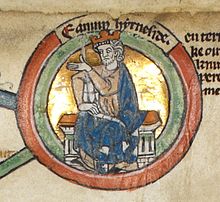
Edmund II (Ironside) is a curiosity among English Kings. He reigned for barely seven months, succeeding his father Ethelred II (Unraed) on St. George’s Day 1016 but dying “in suspicious circumstances” on St. Andrew’s Day the same year. He was the half-brother of Edward the Confessor and grandfather of Edgar the Atheling, thus the ancestor…
-
We have posted before about the lives of noblewomen and how they were almost never executed before the “Tudor” era began – including how King Lear, featuring the death of Cordelia, reflected this changed reality. Here is as near as we can manage to a counter-example from 1003, after the St. Brice’s Day Massacre of…
-
Why lineage still matters in battle
“Beauforts”, “Tudors”, Battle of Bosworth, Blanche of Lancaster, Cnut, Earl of Oxford, Edmund Mortimer, Edward I, Edward IV, Edward VI, Emma of Normandy, Ethelred II, Hastings, Henry I, Henry IV, Henry V, Henry VI, Henry VII, House of York, James VII/II, Jane, Joan of Acre, Mary I, Matilda, Richard II, Richard III, Stephen, William I, William IIIThe crown of England, among others, has often been claimed in battle or by other forceful means. However, to exercise such a claim, it is necessary to persuade a challenger’s military followers that he has a dynastic claim of sorts, even when this is greatly exaggerated or totally spurious. Thus William I, the Conqueror or…
 The New Murrey and Blue blog