altered portraits
-
As I write my failure to find anything online about a particular event, apart from someone’s FB page, leads me to hesitate. But let’s assume it IS what’s happening…. It ‘s said that art galleries are suddenly declining to display the above portrait of Henry VIII, Jane Seymour and the boy Edward VI (who died…
-
Where Richard III is concerned, his physical appearance is all important. His enemies alter his portraits to give him an evil, scheming aspect that suits their agenda. His friends prefer more flattering portraits that show him as he really was. There is one portrait in the National Portrait Gallery (above) that is perhaps the most…
-
THE TRIAL OF RICHARD III – PART TWO
“Princes”, “Tudor” propaganda, adultery, AJ Pollard, altered portraits, Anne Sutton, Battle of Bosworth, bigamy, Buckingham rebellion, Charing Cross Hospital, Constable of England, Coronation, David Starkey, Edward of Warwick, Elizabeth Wydeville, executions, George Duke of Clarence, Henry VII, Jean Ross, Lady Eleanor Talbot, letter to York, Middleham Castle, More, Pamela Tudor-Craig, Phillippe de Commynes, portraits, pre-contract, Richard III, Robert Stillington, Rosemary Horrox, royal collection, Sir James Tyrrell, Southern bias, succession, William Lord Hastings, Windsor CastleREBLOGGED FROM A MEDIEVAL POTPOURRI SPARKYPUS.COM The two QCs prepare to do battleFollowing on from my earlier post. The day had dawned – the trial commenced. Because of the length of the trial I only give snippets here which stand out and which I think are the most pertinent/funny/excruciating. The judge addressed the jury as to…
-
I have often wondered what Richard might have looked like had he triumphed at Bosworth and lived on into the 16th century. He would have had another queen, of course, and probably another family. . .and he would have worn clothes that we are inclined to term “Tudor”. They wouldn’t be known by that name…
-
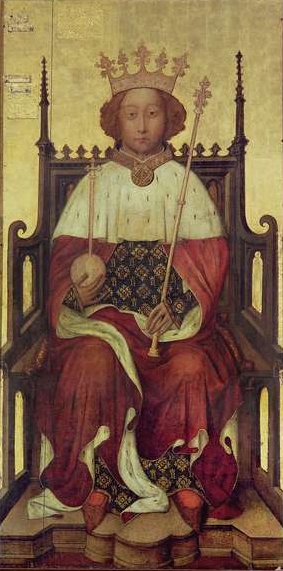
This portrait of Richard II in Westminster Abbey is familiar. What is less well-known is that it is heavily ‘restored’ over the years, most recently in 1866. In Richard II, Manhood, Youth and Politics, 1377-99, Christopher Fletcher reveals that when examined under infra-red reflectography the king’s beard was much more developed, covering much of his…
 The New Murrey and Blue blog