buildings
-
Since the discovery of Richard’s remains, and his final place of rest in Leicester Cathedral, everyone now knows who he was. Still is. Countless more people now question the “facts” of the gross caricature Shakespeare dreamed up after too much cheese for supper. Now Leicester Cathedral is planning a new extension “built onto the cathedral…
-
I had never looked into the English origins of George Washington’s family, although I did know that his ancestors were associated with Washington Old Hall, Washington, Tyne & Wear. https://www.nationaltrust.org.uk/washington-old-hall So I am surprised to discover that the family was also associated with other places, including Purleigh in Essex (http://www.kenmore.org/genealogy/washington/descendants.html) and Sulgrave Manor in…
-
This time it’s Henry VIII’s blockhouse in Hull, see above. It promises to be a huge project. You’ll find much more information here …
-
This very good blog post details the career and planned future of Henry Fitzroy, Duke of Richmond, who might have succeeded Henry VIII had he not died suddenly at seventeen and a legitimate half-brother been born a year and a quarterlater. It also states his original and current burial places, the latter being St. Michael’s…
-
On the left is Gipping Chapel in Suffolk, attached to the Tyrrell property of Gipping Hall. It is a tradition within the Tyrrell family that the “Princes”, the sons of Edward IV who were technically children, lived there during 1483-4 “with the permission of the mother” . To the right is St. Nicholas of Myra,…
-
If you can stomach paragraph two of the article below (by Henry James) the rest is quite interesting! I have taken the precaution of copying the entire article because of a server problem that messed me around after a minute so. So I opened it again, copied, and it’s below, complete with link to the original. “A…
-
When I watched this video, talking about the precise location of the high altar of the Abbey with respect to Henry I, the parallels with the search for Richard III in Leicester’s Greyfriars are almost exact: Neither should we forget Henry I’s Queen, Edith (Matilda) of Scotland, who reintroduced Anglo-Saxon royal (Wessex) blood to the…
-
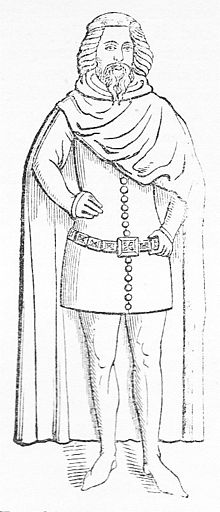
Lionel of Antwerp, Duke of Clarence, was born today in 1338, although he died just before his thirtieth birthday. He is, of course, a mixed-line direct ancestor of Richard III but he is the brother of Edmund of Langley, Richard’s male-line great grandfather. Here, John Ashdown-Hill spoke to Nerdalicious about his attempts to locate Lionel…
-
There are plans to look for evidence of the fishponds and orchards of the 12th-century abbey, in what is now Abbey Park, Leicester. There are also calls for this search to include seeking the tomb of Cardinal Thomas Wolsey, who died in Leicester in 1530. His resting place was not left undisturbed for long, because…
-
Warwick Castle Portcullis Francis Frith Photo of the portcullis 1901 The mound as viewed from the portcullis Old bridge Warwick Castle The moat Warwick Castle. Old staircase in Warwick Castle 14th century Guys Tower For more photos and an interesting article from ‘Britain and Britishness’ about Warwick Castle please see this link . Much of…

