The cathedral is dim and quiet, the early-morning hush broken only by the faint hum of machinery being tested near the chancel. A group of tech consultants in matching polo shirts bustle around a tall, coffin-shaped metal frame draped in a dust sheet.
Richard and Anne drift in through the north transept, mid-conversation.
“I’m telling you, Anne,” Richard says, “I heard them say ‘interactive experience.’ Nothing good ever follows those words, nothing.”
Anne peers at it, and says: “So do people have to climb into it?”
Before Richard can reply, the Vicar approaches the tech team with forced enthusiasm. “So this is the… installation?”
One of the consultants beams. “Yes! The centrepiece of your new visitor engagement strategy. A full-body, life-sized hologram of King Richard III. He’ll greet visitors, explain the Wars of the Roses, and pose for selfies.”
Richard covers his ghostly face with his palm.
Anne whispers: “Don’t panic husband.”
“I am not panicking,” Richard says, already panicking. “I am seething.”
The consultant continues, oblivious.
“We’ve programmed him with a friendly personality. Lots of jokes. Very approachable. We didn’t want him to seem too… medieval.”
Richard makes a noise like a pressure cooker. Anne places a steadying hand on his sleeve.
“Let’s hear them out, let’s see what they say, it might be good.”
The consultant pulls off the dust sheet with a flourish. The machine whirs. Lights flicker. A shimmering figure begins to form.
Richard leans forward, horrified. “But, why is it so tall?”
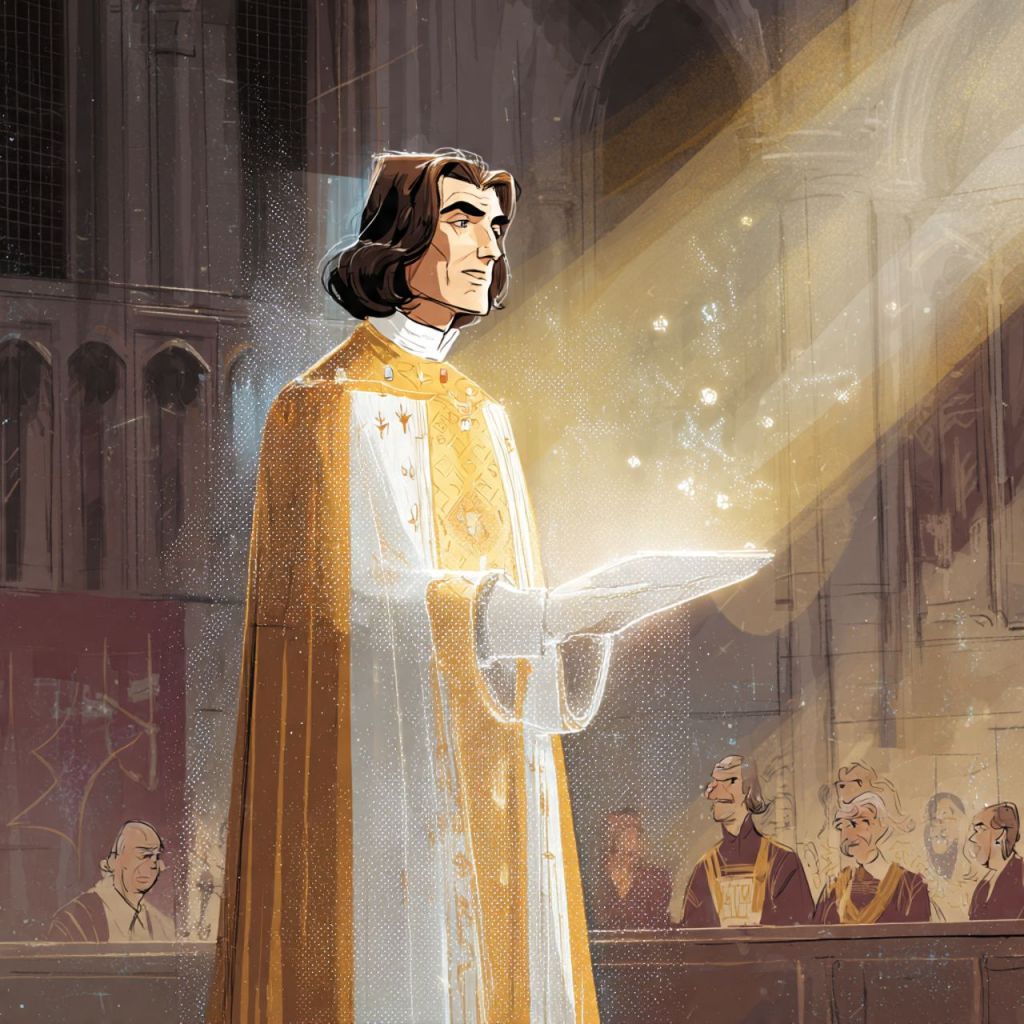
The hologram stabilises. It is indeed Richard III — or rather, a bizarre, Disney-prince version of him: heroic jawline, flowing hair, suspiciously broad shoulders, and a smile so white and wholesome it could illuminate a small village.
“HELLO, FRIENDS!” the hologram booms. “I’M KING RICHARD THE THIRD! HISTORY’S MISUNDERSTOOD GOOD GUY!”
Richard clutches his head. “Make it stop Anne.”
The hologram continues cheerfully, “I NEVER DID ANY MURDERS! LET’S TAKE A SELFIE!”
Anne winces. “Oh dear dear, this doesn’t bode well at all.”
The hologram waves enthusiastically. “PRESS MY HAND TO LEARN ABOUT MY FAVOURITE BATTLE!”
Richard turns to Anne, voice trembling with existential despair. “Anne. They’ve made me into a jester.”
Anne nods solemnly. “It’s worse than the new ergonomic seating.”
Richard straightens, eyes blazing. “This is an abomination. A travesty. A crime against history, and, and me.”
The hologram begins dancing.
Richard whispers, “Anne… fetch my sword please.”
“You don’t have a sword husband, no swords or weapons of minor destruction in eternity remember?”
“Then fetch me something sharp. I refuse to be remembered as a holographic dancing buffoon.”
Anne sighs. “Or, hear me , we sabotage it.”
Richard brightens. “Sabotage it? Tell me more wife!”
The hologram flickers as the tech team runs diagnostics. The Disney-prince version of Richard stands frozen mid–thumbs-up, smiling with the frozen unblinking cheerfulness of a children’s TV presenter.
Richard circles the machine like a hawk. “Look Anne, I believe I can get inside it.”
Anne raises an eyebrow. “Inside that hologram thing?”
“Yes. It’s light. I’m light. It’s practically an invitation!” he sniggered wickedly.
Before she can protest, Richard steps forward and dissolves into the shimmering projection. The hologram spasms, glitches, and then— the smile drops to a regal and dignified expression.
The jawline becomes more medieval. The shoulders shrink to something recognisably human. The voice, when it emerges, is unmistakably Richard’s: dry, northern, and deeply unimpressed.
“Right. Let’s get a few things straight.”
The tech consultants stare, horrified. The Vicar crosses himself. The hologram-Richard continues, arms folded.
“First of all, I did not have a hunchback. Scoliosis, yes, a curvature of the spine. Painful, inconvenient, and absolutely not the dramatic lump you people keep giving me in films. And you can programme that in your hologram!”
The hologram flickers, briefly showing the original cartoonish version before Richard forces it back into shape.
“And while we’re at it,” he says, “I did fight in battle. Personally. With a battleaxe.” He looks up. “I’m not talking about you, Anne, my love. And, battles, were never my ‘favourite’ anything. They were muddy, terrifying, and involved far too many people trying to do me in.”
Anne, watching from the side, nods approvingly. “Much better.”
The consultants whisper frantically.
The hologram leans forward, voice sharpening. “As for executions, Aye, I ordered some. Buckingham, for instance. He rebelled. That tends to have consequences tha knows. I was a medieval king, not a primary school teacher.”
The Vicar faints gently into a pew.
“And finally,” Richard says, straightening with ghostly dignity: “I did not seek the crown. I accepted it when it was presented to me as the lawful option. You may disagree with the politics, but do not paint me as some moustache-twiddling usurper.”
The hologram pauses. Sparks crackle. A faint smell of burning plastic wafts through the nave.
Richard adds, almost conversationally: “Also, this hairstyle is ridiculous. I like it not.”
The hologram’s hair collapses into a more historically plausible shape.
Anne claps lightly. “Well done, my love. Very measured.”
The machine emits a worrying whine.
Richard’s voice echoes from inside the projection. “Anne… I think it’s about to explode.”
“Of course it is,” she sighs. “You’ve overloaded it with medieval facts.”
The hologram begins to strobe wildly, cycling through every inaccurate depiction of Richard III ever created — Shakespearean villain, pantomime baddie, brooding antihero, cartoon mascot — before finally collapsing into a shower of sparks.
Silence.
Smoke drifts upward.
Richard steps out of the wreckage, brushing off holographic static. “That,” he says, “was cathartic.”
Anne links her arm through his. “And educational.”
Richard nods. “Aye, Let’s see them try to install that again.”
The hologram has just exploded in a shower of sparks, the tech team is traumatised, and the Vicar is still unconscious in a pew. Smoke curls up toward the clerestory.
Richard emerges from the wreckage looking like a man who has just won a war.
Anne barely has the time to say, “Richard, don’t—” before he takes off at a triumphant sprint down the nave.
Or rather, a triumphant float, but with all the swagger of a man who believes he is sprinting.
The cathedral cat — a sleek black creature with the self-importance of a minor deity immediately gives chase, tail high, yowling with the thrill of the hunt.
“Richard!” Anne calls, exasperated. “Be careful! You’ll knock over the Easter candle again!”
“I am celebrating!” Richard shouts back, looping around a pillar with the cat in hot pursuit. “Let me have this! Wheee!”
He zooms past the font, through the choir stalls, and straight through a startled curate, who drops his mug of tea, crosses himself and whispers: “Not again!”
Anne follows at a dignified glide, calling: “Slow down! You’re shedding ectoplasm everywhere!”
Richard does not slow down.
He does a full lap of the nave, then another, then a third for good measure. The cat is now convinced this is the greatest game ever invented. At one point Richard leaps theatrically through the pulpit, shouting: “Long live historical accuracy!”
Anne pinches the bridge of her nose. “Richard, you are impossible.”
Eventually, the tech team regains enough composure to start muttering about “insurance claims” and “rebooting protocols.” Within hours, through a combination of stubbornness, pressure and sheer denial, they manage to get the hologram up and running again.
This time, they’ve installed extra fireproofing, surge protection, and a laminated sign that reads:
PLEASE DO NOT HAUNT THE EQUIPMENT.
Richard eyes the rebooted hologram with deep suspicion. The machine hums. The projection stabilises. And then — with a crackle of static — Richard steps neatly into the hologram again.
Anne groans. “Oh Richard, no.”
“Oh aye,” he says, voice already echoing through the speakers. “If they insist on resurrecting this abomination, I shall make full use of it.”
The hologram turns toward the first group of visitors — a school trip of Year Sevens, armed with clipboards and bottled water.
Richard folds his arms, looks them dead in the eye, and says: “Right, children. Today we’re learning actual history. No nonsense, no slander, no drama. And if any of you ask me about the princes, I swear I will start throwing pews, so sit yourselves down and listen.”
The teacher gasps. The children cheer. The hologram flickers ominously.
Anne sighs, but there’s a fondness in it. “Well,” she murmurs. “At least he’s passionate.”
Richard, now fully in his element, launches into a lecture so fiery, so uncompromising, and so gloriously unfiltered that the cathedral staff begin quietly drafting a new sign:
THE MANAGEMENT ACCEPTS NO RESPONSIBILITY FOR ANY OPINIONS EXPRESSED BY THE KING.
The hologram is running smoothly, or, as smoothly as anything can when it’s being piloted by a furious medieval king with a grudge, and a sense of truth.
A steady stream of visitors gather, drawn by the novelty of a talking monarch and the faint fragrance of burning circuitry.
Richard stands proudly inside the projection, arms folded, ready for whatever nonsense the public throw at him.
First, The Teachers Who Should Have Known Better.
Two teachers at the back — both wearing lanyards and the smug expressions of people who think they’re funnier than they are — whisper to each other.
“Look at his clothes,” one snickers. “He looks like he’s going to a fancy-dress do, I wouldn’t wear that hat.”
“He looks more like a historical pantomime,” the other adds.
Richard swivels toward them with the slow, ominous precision of a knight.
“Thou,” he says, pointing at the first teacher. “Go forth and boil thy head.”
The entire school group gasps. The teachers turn beetroot red. The children howl with laughter.
Anne, hovering nearby, mutters: “Richard, please.”
“I’m being restrained,” he replies. “You should hear what I wanted to say.”
Second, The Nun With the Innocent Question.
A small, elderly nun steps forward, hands folded, eyes shining with curiosity.
“Your Majesty,” she asks sweetly. “What did you do on Sundays?”
Richard’s expression softens. He leans forward, gives her a conspiratorial wink, and says: “Come and find out.”
The nun blushes so hard her wimple nearly combusts.
Anne groans into her hands.
“Oh Richard. You cannot flirt with nuns.”
“I wasn’t flirting Anne,” he says. “I was being cool and enigmatic.”
“You were being inappropriate.”
“Well, same thing.”
Third, The Devoted Admirer.
Next in line is a plump blonde woman in her forties, trembling with excitement.
“I, I just wanted to say,” she stammers. “I’ve loved you since I was ten. I’ve admired you all my life, you’re my hero, my king, my knight in shining armour.”
Richard freezes. The hologram flickers. He blushes — an impressive feat for a dead man possessing a light projection.
“Oh,” he says, suddenly shy. “Well. That’s… very kind. Thank you…are you married, my lady?”
She shakes her head, somewhat startled.
“Well, I am not proposing, I cannot.” He looks towards the stone pillar where Anne is. “But if I were king in these times, I’d soon find you a husband.”
Anne is sulking.
Richard glares at her. “Oh, don’t start.”
Fourth. The Henry Tudor Question.
Finally, a man steps up, arms crossed, clearly ready to stir trouble.
“So, Richard,” he says. “What did you think of Henry Tudor?”
Anne’s eyes widen. “Richard, don’t.”
Richard inhales. The hologram crackles and fizzes. The speakers buzz.
What comes out is… censored by the machine itself. A long, furious string of medieval profanity, political commentary, and personal insult — all rendered as a series of loud electronic bleeps, static bursts, and one alarmed clang from the sound system, ending in a gigantic loud raspberry blown by Richard.
The man stares, stunned.
Anne sighs. “Honestly, you brought that all on yourself.”
Richard finishes with a final, emphatic bleep and folds his arms triumphantly.
The crowd applaud. The Vicar faints again. The hologram is glowing steadily, the crowd is thickening, and Richard is having the time of his afterlife.
Anne can already tell this is going to end in a serious diocesan meeting.
A man approaches, looking mildly lost.
“Excuse me,” he asks the hologram. “Do you know where the toilets are?”
Richard answers him, no holds barred
“No,” he says crisply. “But you should find one fast, because that noise wasn’t static from this holographic contraption.”
A ripple of horrified laughter spreads through the visitors. The children are howling with laughter.
“Oh Miss Pemberton, he’s funny!”
The man flees. Anne covers her face with both hands.
“Richard,” she hisses. “You cannot say things like that.”
“I absolutely can,” he replies. “I’m having fun.”
Before Anne can intervene, the cathedral choir begins warming up in the chancel. The vicar, a well-meaning man with the vocal range of a malfunctioning trombone, launches into a hearty, off-key rendition of ‘All Things Bright And Beautiful’.
Richard winces so hard that the hologram flickers. He turns toward the chancel and bellows, amplified by cathedral acoustics and the 21st‑century speakers:
“Vicar! Stop thy singing! You sound like a blocked drain!”
The choir halts. The vicar sputters: “I, I beg your pardon?”
Richard folds his arms. “You heard me. A blocked drain. A medieval one. The sort that floods the entire street wi’ muck and ruins everyone’s shoes.”
Anne swoops in, mortified. “Richard, apologise this instant!”
“I will not,” he says. “I’m performing a public service.”
The vicar, red-faced and trembling, mutters something about “spiritual warfare” and retreats behind the organ.
The choir, unsure whether they’re allowed to continue, hums uncertainly.
Richard beams, pleased with himself. “This is marvellous. Why didn’t we do this years ago?”
Anne gives him a look that could curdle milk.
“Because you didn’t have a holographic amplification system capable of broadcasting your rudeness to half the county.”
Richard shrugs. “Their loss.”
Richard is mid‑lecture, leaning towards a teenage boy who looks like he’d rather be swallowed up by the earth.
“Don’t be shy,” Richard says, voice booming through the speakers. “Ask the girl, whatshername, Mandy, out. Faint heart never won fair maiden. I’d already got two children before I married Anne, so what are you waiting for boy?”
The boy turns the colour of a ripe tomato.
Anne, hovering nearby, splutters. “Oh Richard! You cannot use our marriage as a motivational anecdote for adolescents.”
Richard waves her off. “But Anne It’s historically accurate.”
“That is not the point, husband.”
But the damage is done. The boy’s friends are howling with laughter. The boy himself looks torn between gratitude and the desire to evaporate.
And then, it happens. A ripple moves through the cathedral. People begin drifting closer.
Then more.
Then more.
Within minutes, a queue forms. A long queue. Stretching from the nave to the font, curling around the side aisle, and threatening to spill into the cloisters.
A handwritten sign appears at the back: LINE FOR THE KING STARTS HERE.
Richard straightens, delighted. “At last. A proper audience.”
Anne groans. “This is going to be a complete disaster.”
The first person steps forward — a nervous-looking man, clutching a guidebook.
“Your Majesty,” he says. “I just wanted to—”
Richard interrupts. “Excellent. State your business. Petition? Complaint? Marriage proposals? I’m accepting all three.”
The man blinks. “I… I just wanted a photo.”
Richard sighs. “Fine. But make it quick. I have a kingdom to mismanage.”
Behind him, the queue shuffles along eagerly.
A teenager whispers: “Do you think he’ll roast me when I mention them princes?”
A woman says, “I hope he flirts with me like he did with the nun.”
A man mutters, “I’m asking him about the Battle of Bosworth.”
Anne rubs her temples.
“Richard, you cannot possibly speak to all these people.”
Richard beams. “Watch me, Anne.”
And he does — or at least, he prepares to — standing tall inside the hologram, ready to dispense history, insults, oaths, charm, and questionable advice in equal measure.
The cathedral staff exchange looks of pure dread. The cat sits at Richard’s feet, tail flicking, as if preparing to act as royal bodyguard. The Vicar, revived at last, takes one look at the queue and faints again.
Richard claps his hands. “Next!”
The queue gets longer, and Richard is in his element. Anne hovers nearby, torn between pride and dread.
The teenage boy scurries away, newly emboldened and traumatised in equal measure. The next visitor steps forward — but before Richard can speak, the cathedral lights flicker. Then flicker again. Then flare.
The hologram surges, brighter than before, crackling with ghostly energy. Richard looks down at himself, startled.
“Anne, Anne!!,” he says, “I think I’ve… overcharged it.”
The machine begins to hum. Louder. Higher. The stained glass windows tremble.
The Vicar, revived for the third time, screams: “EVERYONE OUT!”
But no one moves. They’re transfixed.
The hologram expands — not exploding this time, but unfurling, like a banner caught in a gentle breeze.
Richard’s figure grows, sharper, and more vivid than any projection has a right to be. His cloak ripples. His crown, glows like molten gold.
The crowd gasps.
Anne stares, wide‑eyed. “Richard… what are you doing?”
Richard looks down at his luminous form, then at all the people gathered before him.
And something shifts. The swaggering softens. The medieval mischief quietens.
For the first time all day, he speaks not as a hologram, not as a ghost, not as a man defending his reputation — but as a king addressing his people.
“Thank you,” he says, voice resonant and steady. “For listening. For asking. For caring enough to come.”
The cathedral falls silent.
“I was not perfect,” he continues. “I made mistakes. I lived in a very hard age. I tried to do right by those I loved. And I have been many things in your stories, villain, hero, monster, mystery.”
He smiles wryly, so real, and entirely human. “But today… you let me be myself.”
Anne’s eyes shine. The cat sits at his feet, purring.
The hologram glows brighter, then begins to dissolve — not in sparks this time, but in soft, drifting light, like candle smoke rising toward the vaulted ceiling.
Richard steps out of the fading projection, his ghostly form gentle and unassuming once more.
The crowd applauds — not wildly, but warmly, reverently.
Anne slips her hand into his.
“Well done,” she murmurs.
Richard exhales, a long, quiet breath. “That,” he says, “was the best audience I’ve had since my parliament in 1483.”
The machine gives one final, exhausted ping and shuts down completely.
The Vicar faints for the fourth time.
And as the visitors file out, buzzing with excitement, the cathedral cat trots after Richard, tail high, ready for the next exciting adventure.
 The New Murrey and Blue blog
Leave a comment