Most people know of the murder of Thomas a Becket in Canterbury Cathedral, but far fewer know that, in the mid-15th century, another bishop was murdered in the quiet priory church of Edington in Wiltshire.
Edington is a peaceful place today; however, it was anything but in medieval times. Its most famous event was when, in 878, Alfred the Great fought a battle nearby at Ethandune, where he decidedly defeated the Great Heathen Army of the viking Guthrum. The name of Edington is believed to have come from Ethandune.
In 1450, unrest was beginning to grip England, even extending to the more rural areas of counties like Wiltshire. William Ayscough, Bishop of Salisbury, had become highly unpopular in his diocese as had the weak and ineffective rule of Henry VI. Ascough was Henry’s confessor and had also married him to Margaret of Anjou, who was not exactly popular either, being thus far childless…and French. The townspeople of Salisbury had many grievances with Ayscough too, for he had restricted traditional trading rights and raised taxation, causing growing poverty in Wiltshire.
After Jack Cade’s Rebellion broke out, Ayscough, fearful for his life, fled Salisbury for the countryside and the small Augustinian monastic house in Edington. However, his enemies pursued him, and On June 29th, 1450, he was saying mass before the church’s high altar when a band of assailants crashed through the door, dragging him away as the monks reacted with terror.
The Bishop was hauled up the a nearby steep hillside, where he was brutally murdered by the mob.
Bishop Ayscough has no known grave,the fate of his remains left unrecorded although stories say he was buried in the nearby fields.
However, there is a strange tomb at Edington, near the church, that some believe might hold his bones. It is a stone box, too small to contain a laid out body, and it sits on the top of the churchyard wall. Although its appearance doesn’t look particularly medieval, it is possible that in various restorations of the church over the years, the bones may have gone into an ossuary chest which eventually ended up moved outside. I am sure the monks would have sought for his remains and given him a proper burial as he was attacked in their own church.
Edington Church itself is well worth a visit, with a charming 15th c painted tomb of an monk whose feet are resting on a beer barrel. There are also effigies of medieval knights brought to Edington from the lost village of Imber. The house behind the church, visible from the graveyard contains parts of the medieval monastic buildings, and around the corner there is also a medieval holy well inside a 14th c wellhouse.
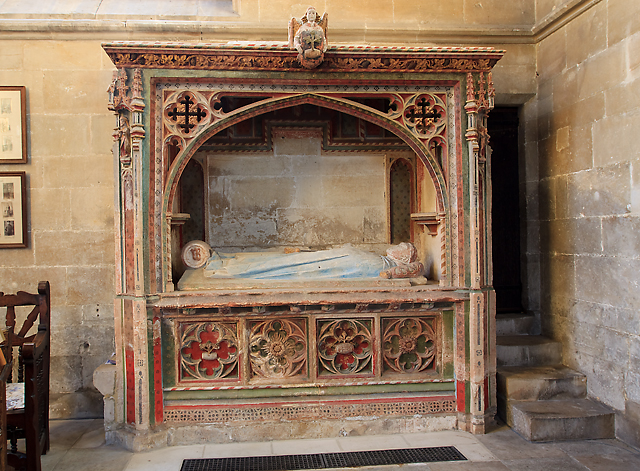
Monk’s tomb, Edington
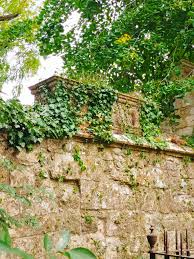
The mysterious tomb on the wall
Credit Wikimedia Commons
 The New Murrey and Blue blog
Leave a comment