Lady Godiva (or Godgifu, meaning gift of God), was not just a legend – she was real! And, what’s more, she was Richard III’s ancestor. Here’s how:
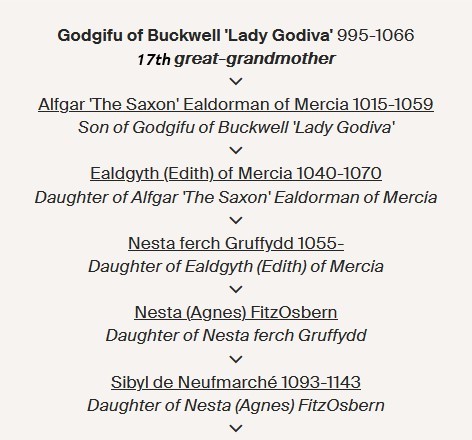
From Sibyl de Neufmarché, follow the pink dots back (right to left) through Richard’s family tree.



Lady Godiva, was a late Anglo-Saxon noblewoman who was the wife of Leofric, Earl of Mercia, and a patron of various religious institutions. According to William of Malmesbury, Godiva directed in her will that a ‘circlet of precious stones which she had threaded on a cord in order that by fingering them one after another she might count her prayers exactly’ were to be placed on a statue of the Blessed Virgin Mary, the oldest known textual reference to the use of a Rosary-like string of prayer-beads.

She is, however, mainly remembered for a disputed legend dating back to at least the 13th century, in which she rode naked – covered only by her long hair – through the streets of Coventry to gain a remission of the oppressive taxation that her husband, Leofric, imposed on his tenants. She appealed again and again to her husband, who at last, weary of her repeated requests, said he would grant her request if she would ride naked on a horse through the streets of the town. Lady Godiva took him at his word, and issued a proclamation that everyone should remain indoors and shut their windows, as she rode through the town, clothed only in her long hair. Just one person in the town, a tailor called Thomas, disobeyed her proclamation in what is the most famous instance of voyeurism. In most versions of the story, Tom is struck blind or dead for his transgression. This is where the term ‘Peeping Tom’ is said to have originated.

 The New Murrey and Blue blog
Leave a comment