In 2008, archaeologists made a find that was possibly even more astounding than the discovery of Richard III’s remains. Beneath the floor of Magdeburg Cathedral in Germany, they opened a sarcophagus that was believed to be a cenotaph, or empty, symbolic memorial. Inside, they found a lead coffin which turned out to contain the remains of one of England’s oldest royal figures, Queen Eadgyth of England, who was born in 910 and died in 946. The coffin had Eadgyth’s name engraved on it, along with a note referencing her reburial in 1510. Eadgyth’s almost intact skeleton was uncovered inside the lead coffin, wrapped in silk and preserved in excellent condition.
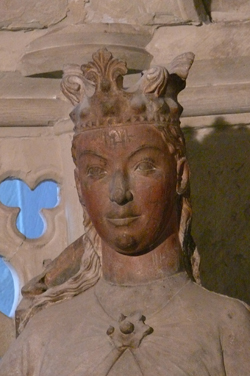
Eadgyth was the granddaughter of Alfred the Great and sister to King Athelstan, and she played a major part in medieval European politics. She married Otto I, the future Holy Roman Emperor, and this alliance strengthened ties between England and the Saxon empire. She lived in Saxony and bore Otto at least two children, one of whom later became king himself. When she died at the age of 36, she was laid to rest in Magdeburg. Eventually, her tomb was embellished with a prestigious 16th-century monument, which led many to believe that her remains were no longer there.
Scientific analysis confirmed the skeleton belonged to a female aged between 30 and 40, matching Eadgyth’s profile. Isotope analysis of the teeth to determine where she grew up confirmed that the individual had spent her youth in the chalky uplands of Wessex, matching historical accounts of Eadgyth.
The Anglo-Saxon princess is likely the oldest member of the English royal family whose remains have survived.
 The New Murrey and Blue blog
Leave a comment