I took a trip out to Kelmscott Manor, the home of noted medievalist, scholar and artist William Morris. In the little church of St George, standing near the Manor’s carpark, there was a plethora of interesting medieval features, ranging from Norman columns, to a medieval stained glass panel of St George, interesting carved faces, and a whole chantry full of well-preserved medieval wall-paintings. Perhaps most interesting, though, was the other chantry, which was a later addition in Tudor times.
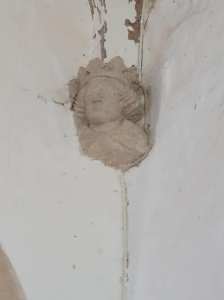
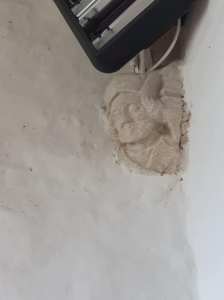
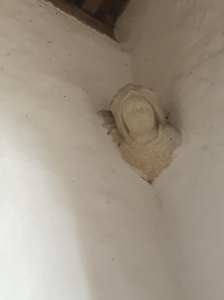
In this chantry, there were three carved stone heads set high along the ceiling line–two men, and a woman. There is a local legend that these heads represent King Richard III, Henry VII, and Elizabeth of York. The one supposedly of Henry does bear a resemblance to his portraits. He is shown wearing a cap very similar to that in the famous bust by Torrigiano. The other man is crowned and has very wavy hair; I suppose it could be Edward IV, but his hair was always depicted as straight, while Richard’s was shown with waves. The female carving is not as identifiable except for having a full face rather than narrow.
Why would Richard be depicted as well? In the area there were quite a few Yorkist connections, such as the church in Lechlade, just 3 miles away, where in 1472, she granted a license to John Twynyho (yes, brother_in_law to Ankaret) to found a perpetual chantry in Lechlade Church, in honor of Saint Blaise. She also founded a chantry for three chaplains to celebrate services daily in the Chapel of the Virgin.
I suspect that some of the carved heads in the quire in Lechlade may represent members of the York family, and at Kelmscott also, there are several more, slightly older carvings lining the nave walls which just might be depictions. One is a King, who in appearance could conceivably be Edward IV.
PIC ONE–Could this be Richard?
Henry and his Hat?
ELIZABETH? Face is very worn but the headdress appears to be correct.
 The New Murrey and Blue blog
Leave a comment