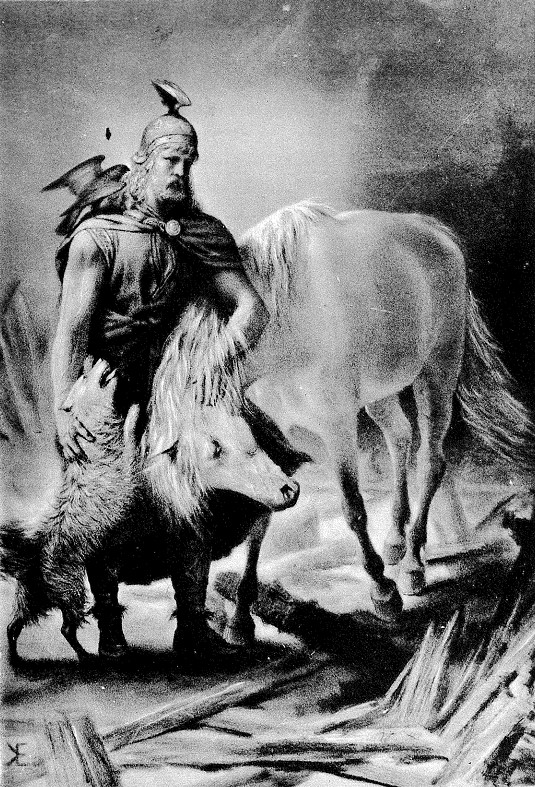
Another of Richard’s Scandinavian ancestors is King Olav II (Saint Olav) of Norway. Here is his story.
Saint Olav/Olaf (c. 995 – 29 July 1030), was King of Norway from 1015 to 1028. He was canonised at Nidaros (Trondheim) by Bishop Grimketel, one year after his death in the Battle of Stiklestad on 29 July 1030. His remains were enshrined in Nidaros Cathedral, built over his burial site. His sainthood encouraged the widespread adoption of Christianity by Scandinavia.
Pope Alexander III confirmed Olav’s local canonisation in 1164, and Olav started to be known as Rex Perpetuus Norvegiae – eternal king of Norway.
The saga of Olav Haraldsson and the legend of Olav the Saint became central to a national identity: Olav became a symbol of Norwegian independence and pride.
Saint Olav is symbolised by the axe in Norway’s coat of arms and Olsok (29 July) is still his day of celebration. Many Christian institutions with Scandinavian links as well as Norway’s Order of St. Olav are named after him. (There will be a future article about St Olave’s Church in York).
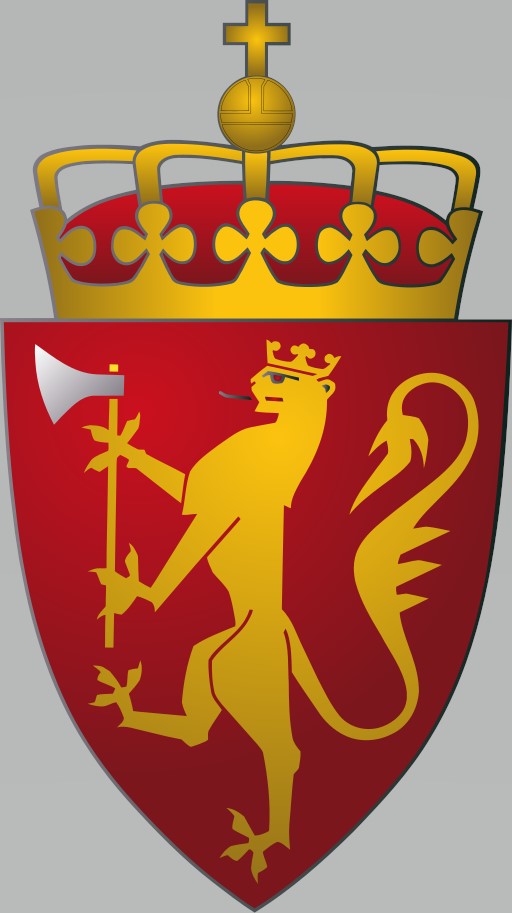
Image: OrangePoint, CC BY 3.0 https://creativecommons.org/licenses/by/3.0, via Wikimedia Commons
During his lifetime he was known as Olav “the stout” or simply as Olav “the big” (modern Norwegian Olav Digre). In modern Norway he is commonly called Olav den hellige (Olav the Holy) or Heilag-Olav (the Holy Olav) in recognition of his sainthood.
Olav Haraldsson was the son of Åsta Gudbrandsdatter and Harald Grenske, a petty king in Vestfold. According to Icelandic sagas, Harald Grenske was descended from King Harald I Fairhair Halvdansson. The latter had unified Norway as one Kingdom, thus, according to the sagas, Olav was a great-great-grandson in the male line of the founder of the Norwegian kingdom. Harald Grenske died when Åsta Gudbrandsdatter was pregnant with Olav. Åsta later married Sigurd Syr, with whom she had other children, including Harald Hardrada, who later reigned as king of Norway and was killed whilst attempting to invade England, at the Battle of Stamford Bridge (by Harold Godwinson, another of Richard’s ancestors).
The oldest text to mention him is the Glælognskviða or “Sea-Calm Poem”, composed by Þórarinn loftunga, an Icelander. It praises Olav and mentions some of the famous miracles attributed to him. There are also several Icelandic sagas about him, including Fagrskinna (c. 1220) which Snorri Sturluson bases his Heimskringla (c. 1225) on. The sources suggest that he had been raised in the Norse pagan religion, but converted to Christ early in his adulthood.
According to Heimskringla, Olav was involved in several battles in 1008 and participated alongside fellow Viking, Thorkell the Tall, in the siege of Canterbury in 1011.
As a teenager Olav went to the Baltic, then to Denmark and later to England. Skaldic poetry suggests he led a successful seaborne attack that took down London Bridge, though this isn’t backed by Anglo-Saxon sources. This may have been in 1014, restoring the English throne to Æthelred the Unready and removing Cnut. According to Snorri’s Heimskringla, Olav assisted Æthelred in driving the Danes out of England after the death of Sweyn Forkbeard. Olav is also said by Snorri to have aided the sons of Æthelred after his death. After this, he set his sights on Norway.
Olav saw it as his calling to reunite Norway into one kingdom, as Harald Fairhair had done. On the way home he wintered with Duke Richard II of Normandy. Richard was himself an ardent Christian, and the Normans had also previously converted to Christianity. Before leaving, Olav was baptised in Rouen in Notre-Dame Cathedral by Richard’s brother, Robert the Dane, archbishop of Normandy.
Olav returned to Norway in 1015 and declared himself king. In 1016 at the Battle of Nesjar he defeated Earl Sweyn, up until then the de facto ruler of Norway. Within a few years he had won more power than any of his predecessors.
He annihilated the petty kings of the south, subdued the aristocracy, asserted his sovereignty in the Orkney Islands, and conducted a successful raid on Denmark. He made peace with King Olof Skötkonung of Sweden and married Astrid Olofsdotter, King Olof’s illegitimate daughter. The union produced a daughter, Wulfhild, who married Ordulf, Duke of Saxony in 1042.

By 1029 the Norwegian nobles, became discontented and Olav was driven into exile in Kievan Rus. He stayed for a while in the Swedish province of Nerike, where, according to local legend, he baptised many locals. In 1029, Olav took an opportunity to win back the kingdom. However, Olav was killed in the Battle of Stiklestad on 29 July 1030 where some of his own subjects took arms against him. The exact position of Saint Olav’s grave in Nidaros is unknown.
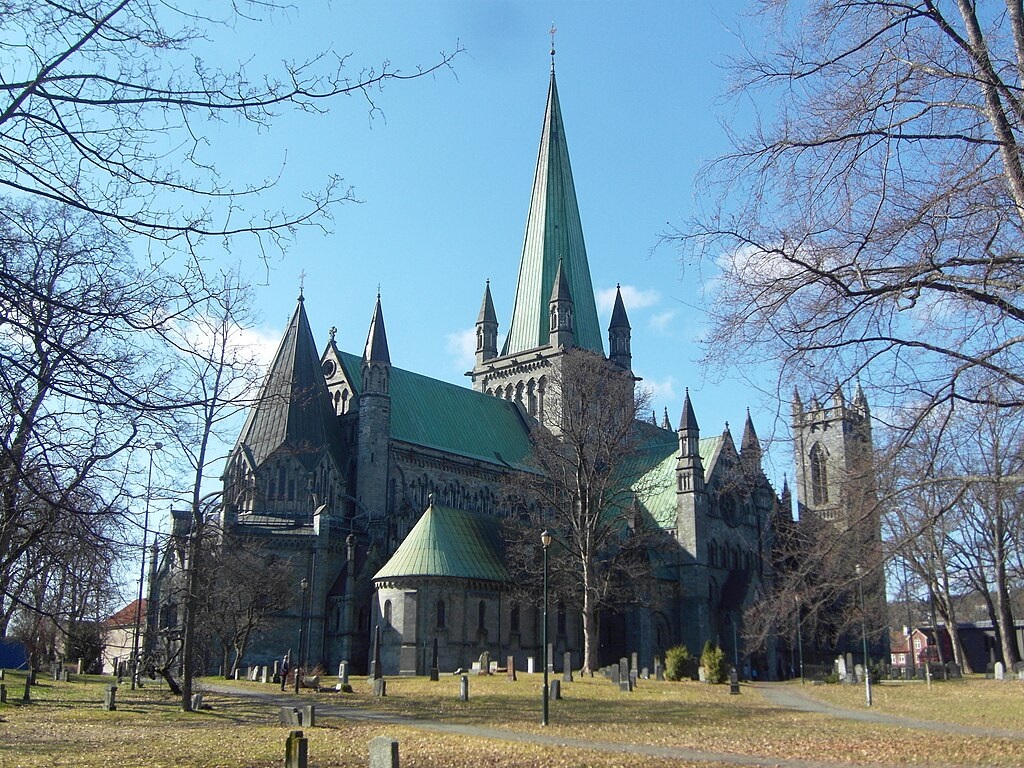
Image: Molde20, CC BY-SA 3.0 https://creativecommons.org/licenses/by-sa/3.0, via Wikimedia Commons
King Cnut, ruled Norway for five years after Stiklestad, with his son Svein and Svein’s mother Ælfgifu as regents. But they were unpopular, and when Olav’s illegitimate son Magnus (‘the Good’) laid claim to the Norwegian throne, Svein and Ælfgifu were forced to flee.
Olav has traditionally been seen as leading the Christianisation of Norway, and he most likely did try to bring Christianity to the interior of Norway, where it was less prevalent.
As regards the nature of Olav’s Christianity, it’s generally agreed that Olav was inclined to violence and brutality, and it seems likely that Olav used his Christianity to gain power for the monarchy and centralise control in Norway. Olav himself is portrayed in later sources as a saintly, miracle-working figure to help support this quick view of conversion for Norway, but the historical Olav acted differently.
The saint’s feast day, Olsok (Olav’s Vigil), celebrated on 29 July, became a national holiday and a time for Norwegians to reaffirm their national identity and Christian faith.
Olav’s transformation from a Viking warrior to a Christian king and, ultimately, to a saint, reflects the broader cultural and religious shifts that shaped medieval Scandinavia.
If you want to see how Richard is related to Olav, click here and you will see Olav on the tree leading to Harald Fairhair.
 The New Murrey and Blue blog
Leave a comment