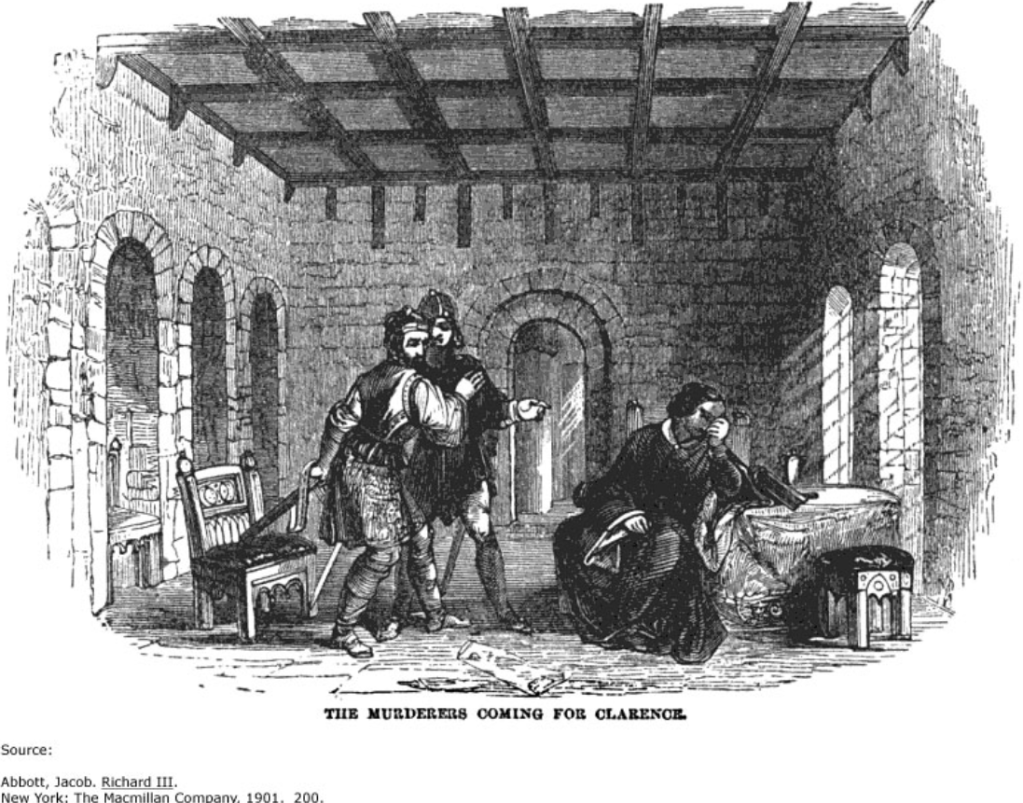
George, Duke of Clarence, is the often overlooked York brother, sitting as he does between Edward IV and Richard III. He was the one who didn’t become king, although he tried to pinch it from Edward IV, who eventually executed him as a traitor.
On the whole George doesn’t get a very good press. He has his supporters, of course, and there are many who regard him as the misunderstood brother. If you go here, https://shorturl.at/i6uCS, you’ll find an article about him entitled He Tried To Take His Brother’s Throne, And Was Rumored To Have Been Executed With Wine.
Fame has it that George was either a selfish, treacherous drunk who caused trouble, or he’d learned that Edward IV’s marriage to Elizabeth Woodville was fraudulent, meaning that he, George, was Edward’s heir, not any child of Edward’s by Elizabeth. Whether or not George knew about the marriage, and whether this knowledge was a contributing factor to Edward choosing to execute him as a traitor, no one knows. After all, George had been a rebel, switching sides by supporting Richard Neville, Earl of Warwick, when the latter turned on Edward. George wanted the throne, and believed Warwick, the greatest magnate in England ( to whose elder daughter George was married), could facilitate just that. Make no mistake, Edward was the rightful king, but by wanting his elder son to succeed him he was definitely in the wrong. The boy’s illegitimacy rendered him ineligible for the throne, and perhaps George found out and threatened to broadcast this awkward fact across the land.
The problem for Edward was that when he took his marriage vows with Elizabeth Woodville, he’d already been betrothed (which in medieval times as binding as an actual marriage) to Lady Eleanor Talbot. When Lady Eleanor died four years later, Edward took no steps to change the situation. Perhaps he couldn’t because the Church wouldn’t tolerate it. Living with a woman who wasn’t your wife, and having children with her, was a definite no-no for the Church. Such a couple could not be married, and their children certainly couldn’t be made legitimate afterward. Unless you were Henry VII and prepared to resort to whatever jiggery-pokery necessary to bend the rules to suit.
But at the time, the children of Edward and Elizabeth were baseborn and therefore barred from the throne, which was something that Edward wanted hushed at all costs.
So in fact George was indeed Edward’s legitimate heir, as became clear too late for him, when Edward died suddenly in 1483 and the great marriage secret came to light at last. But when George rebelled against Edward, he was rebelling against the rightful king, which was Treason with a capital T. Perhaps it was then that George revealed what he knew about Edward’s marriage? Privately, of course, because it certainly got out until after Edward’s death. Whatever, it wasn’t long before Edward had George declared a traitor and had him executed.
Edward then attainted George and barred his children from the throne, so there was only one York brother left, Richard, Duke of Gloucester. But Edward persisted with the deceit about his marriage, thus deliberately denying his faithful youngest brother his own rights. Let’s face it, Edward IV was a bit of a s-h-1-t! But he was thwarted after death when the story of his marriage came out after all, and Richard was invited to step up to the throne as Richard III. As the only brother who hadn’t known anything about Edward’s fraudulent marriage, Richard must have been really shaken. And hurt to think that the eldest brother he’d always supported and to whom he’d been steadfast and loyal, had used him so shabbily.
Eventually, of course, when Richard himself was murdered by treachery at Bosworth, and Henry Tudor usurped his throne to become Henry VII, the wily new king wasn’t taking any chances with the woman he had to marry, Elizabeth of York, Edward IV’s eldest daughter. As an exile in France and Brittany, Henry had vowed to marry her in order to garner more support for his imminent invasion of England. Their marriage would supposedly end the Wars of the Roses, but she, like her siblings, had been declared illegitimate. Henry couldn’t marry a baseborn queen. Good grief no! So he reversed the law that had made Richard III king, and then had Elizabeth and her siblings legitimised again. Including, of course, her brothers, the Princes in the Tower. Hey-ho, enter several claimants to Henry’s throne, stage left….and so the Wars of the Roses continued after all.
The rest, as they say, is history and England was to be burdened with the likes of the monstrous Henry VIII.
But what if George had still been alive on Edward’s death? What if he’d always kept his discovery of the fake marriage to himself? When Edward breathed his last, George would presumably have revealed the truth and become Edward’s legitimate heir. England would have had its first King George.
Finally…concerning George’s famous death in a “butt of Malmsey”. In the above link you’ll find the following: “….George was executed in the Tower of London on February 18, 1478, by immersion in a vat of Malmsey wine, an expensive sweet beverage made with Portuguese grapes….However, his execution was private due to his high rank. So, whatever happened that day was unclear. His death by wine is just a rumor….”
Yes, indeed, there’s no proof that it ever happened, but like all such myths, it has come to be believed. The butt of Malmsey has been taken to mean that George drank too much, so it was an appropriate way of despatching him. And because of it, George has been labelled as a troublemaking drunkard ever since.
by viscountessw
 The New Murrey and Blue blog
Leave a comment