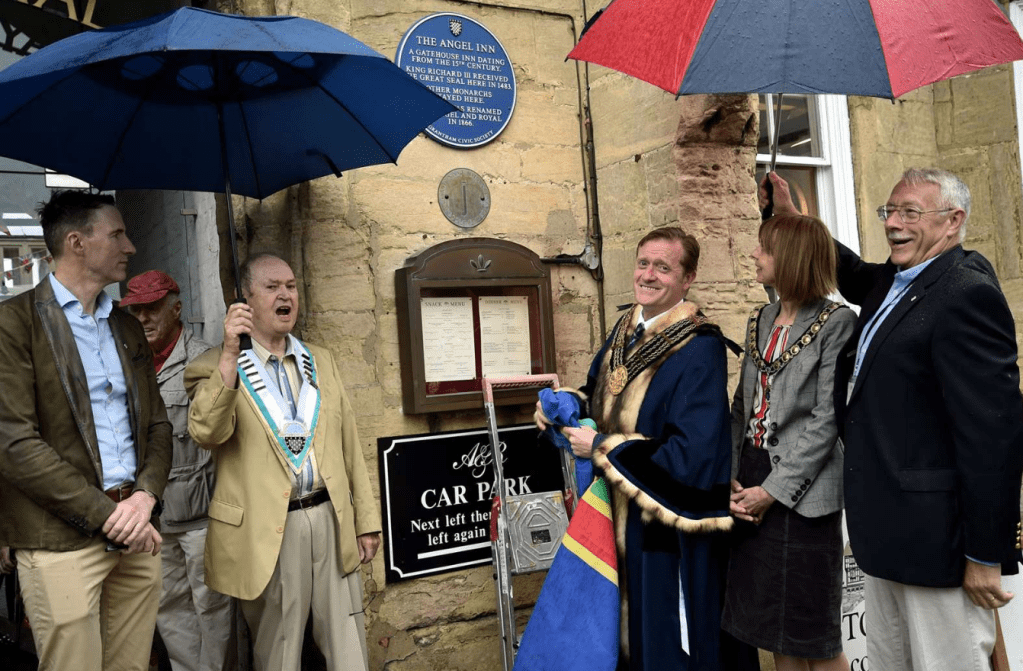
We first posted about a blue plaque for the Angel & Royal Inn back in October 2021 (see https://murreyandblue.co.uk/2021/10/19/a-blue-plaque-for-the-angel-royal/). Well, at last that blue plaque has become fact. The plaque (see in detail at the end of this article) is in place and very impressive it is too….if long overdue! It is there thanks to the Richard III Society.
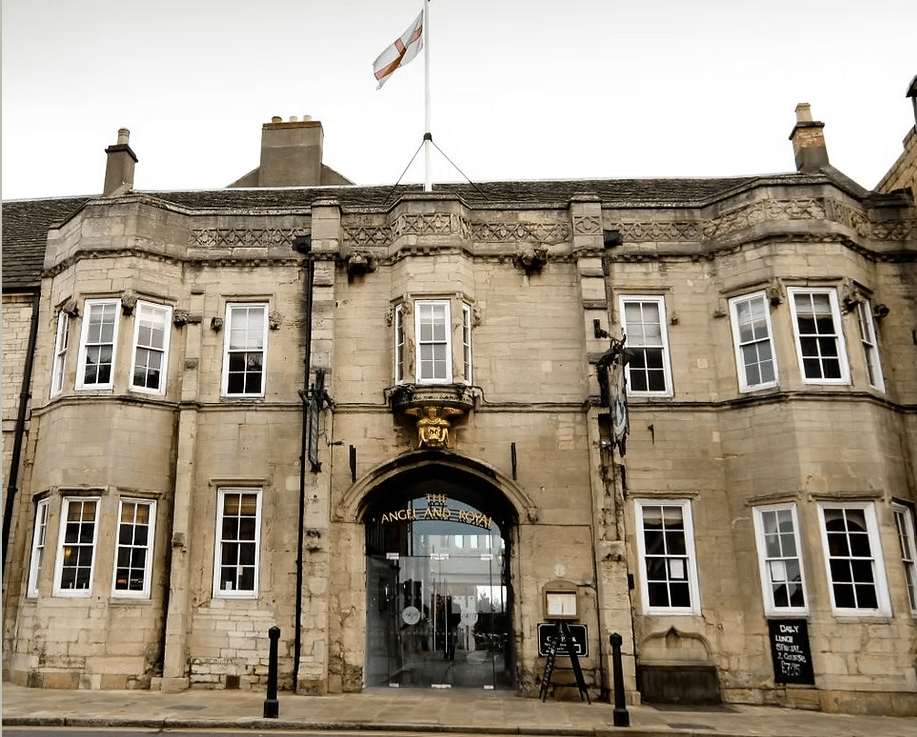
The Angel & Royal Inn, is famous for many reasons, but for Ricardians its greatest allure is its historic association with King Richard III. It was there in 1483 that he received the Great Seal, although back then the hostelry was known as just the Angel Inn. It received the “Royal” addition in 1866.
Richard’s presence at the Angel Inn was at the time of the 2nd Duke of Buckingham’s rebellion. The duke (see https://www.luminarium.org/encyclopedia/henrystafford.htm) was a cousin whom Richard was eventually driven to describe as “the most untrue Creature living”, Out of the blue, Buckingham had turned upon Richard, who’d been all that was generous to him. Such perfidy must have shaken poor Richard to the core.
When Buckingham first rebelled, “…Robert Blackwell, one of the clerks of the chancellery, delivered the Great Seal into the hands of the King at the Angel Inn in Grantham….” (Quote from Richard III by Paul Murray Kendall, p 269, Sixth impression 1968.) The Great Seal was required in order to issue the duke’s death warrant.
I have taken the following from https://greatnorthroad.co.uk/the-angel-inn-grantham: “….In October 1483 Richard III held court at the inn and sent a letter requesting for the Great Seal to issue the death warrant against his rebellious cousin, Henry Stafford, 2nd Duke of Buckingham. A copy of the letter is displayed in the hotel’s dining room, known for centuries as La Chambre du Roi….”

Why did the duke turn on Richard? He too had royal blood, so was he making a bid for the throne? Or did he secretly support the House of Lancaster and thus the somewhat puny claim of the so-called Lancastrian heir, Henry Tudor? We’ll probably never know why or the nature of his ultimate purpose, but we do know he failed and was beheaded in Salisbury on Sunday, 2 November 1483. He’d begged an audience with Richard, but the angry, betrayed, deeply hurt king had learned his lesson and refused. See https://www.warsoftheroses.com/a-levels-england/history/the-buckingham-rebellion/.
You can read about Buckingham’s ultimate downfall here: https://murreyandblue.co.uk/2017/10/18/just-why-did-buckingham-think-he-could-cross-the-flooded-severn/. Mother Nature and the River Severn were far too discerning to be on the side of the Judas duke.
If only Richard had applied that hard-learned lesson to certain other traitors around him, including women! But in spite of the vile reputation with which Tudor history has seen fit to damn him, Richard III was not a bloodthirsty, cruel, self-seeking monster who murdered his way to the throne. He was a man of principle, a good, just man who trusted when he should have followed raw instinct. He followed that raw instinct at the Angel Inn in 1483 and saved the day, but later he held back and showed mercy. It was to be, quite literally, the death of him.
Richard may have been victorious against treachery in 1483, but almost two years later, in August 1485 there were too many spiteful, jealous turncoats on the field at Bosworth. It wasn’t August for Richard, but the Ides of March. But at least we have the satisfaction of knowing that quite a number of his killers came to regret putting Tudor on the throne.
Henry VII was, I’m sure, psychologically flawed, and spent his entire life wallowing in mistrust and suspicion, always looking over his shoulder, always seeing plots and rebellions, afraid to trust anyone except perhaps his mother, his uncle Jasper Tudor and (perhaps, eventually) his Yorkist wife, Richard’s niece, Elizabeth of York. He’d had to promise to marry her before invading, to drum up support from disaffected Yorkists. I’m not Christian enough to be sorry for him. He very definitely became the tyrant he accused Richard of being, and it eventually broke his health. He had a miserable death, but it was in his own bed, not stabbed cruelly from behind in battle by false friends!
Richard III reigned for such a short time that he was never able to prove to posterity what a great king he would have been. But we know. Loyaulte mie lie.

by viscountessw
 The New Murrey and Blue blog

Leave a comment