St Cuthbert was one of Richard’s favoured saints, being associated with the north of England, but who was he?

Public Domain
Cuthbert of Lindisfarne (c. 634/5 – 20 March 687) was a saint of the early Northumbrian church. He was a monk, bishop and hermit, associated with the monasteries of Melrose and Lindisfarne in Northumbria, today in northern England and southern Scotland. He became a popular medieval saint of Northern England, with a cult centred on his tomb at Durham Cathedral. Cuthbert is regarded as the patron saint of Northumbria as well as Durham, Hexham, and Newcastle. He is also the patron saint of maltsters, shepherds and sailors, otters and against the plague. His feast day in the Catholic Church is 20th March. St Cuthbert’s holy symbol is a ruby-studded starburst on a platinum circle. Other symbols include a circle at the centre of a starburst of lines, a wooden billet or a crumpled hat.
Cuthbert was born in North Northumbria in about the year 634/5 – possibly the same year in which the monastery on Lindisfarne was founded by Aidan. He came from a wealthy English family and, like most boys of that class, he was placed with a foster family for part of his childhood to learn the art of warfare. It seems that, in his mid-teens, he was involved in at least one battle, which would have been usual for a boy of his background.
He decided to become a monk after seeing a vision of a soul apparently being escorted to heaven by a light. This was on the same night in 651 that Aidan, the founder of Lindisfarne, died. Cuthbert became a novice at Melrose and, in about 662, after spending over a decade with the monks, Cuthbert was made prior there. Cuthbert had been educated in the Celtic tradition, but accepted the Roman forms after the Synod of Whitby in 664.

Many miracles were attributed to him, dating from his early life. He was credited, for instance, with having saved, through prayers, some monks who were being swept out to sea on a raft.
Cuthbert was known for being a travelling priest, spreading Christianity to remote villages, and equally able to impress royalty and nobility. In around 665 he went to Lindisfarne as prior. His asceticism was complemented by his charm and generosity to the poor, and his reputation for wisdom and healing led many to consult him, from which he got the name of ‘Wonder Worker of Britain’. He continued his missionary work, travelling around the country from Berwick to Galloway, carrying out pastoral work and founding religious institutions.
When he was around forty, he chose to follow his calling as a hermit, fighting the spiritual forces of evil while living a life of solitude. He moved to the island ‘Inner Farne’ and built a hermitage there, where he lived for ten years. However, people still went out in their boats to the island, when weather permitted, to consult him or to seek healing.

In 684 he was asked by both Church and King to become bishop of Lindisfarne. He reluctantly agreed and for two years he was a travelling bishop, journeying far and wide. Then, feeling he was soon to die, he went back to his hermitage, where he died on March 20th 687AD. His body was brought back by the monks and buried on Lindisfarne.
People came to pray at the grave and then miracles of healing were claimed. The monks of Lindisfarne felt this was a sign that Cuthbert was now a saint and they decided to wait eleven years for his body to become a skeleton and then ‘elevate’ his remains to sainthood on the anniversary of his death (20th March 698). This was to be a day of joy and thanksgiving but it was also a day of surprise, because, when they opened the coffin, they found no skeleton as they expected, but a complete and undecayed body. This was a sure sign of great sainthood.

So the cult of St.Cuthbert began. Pilgrims began to flock to the shrine. Life continued as usual for almost a hundred years until, on 8th June 793, the Vikings came. St Cuthbert’s body, along with other relics and treasures which had survived the Viking attack, was taken by the monks onto the mainland where, after many years, they finally settled at Durham.
After 1066, a Benedictine community was established and they began to build the Norman cathedral at Durham. They wanted to honour St Cuthbert with a new shrine and in 1104 the location was ready.
Doubting the truth of the story of the undecayed body, the Durham monks opened up the coffin and apparently found that the body was indeed still incorrupt. The coffin was placed in a beautiful shrine and visited by great numbers of pilgrims during the mediaeval period but, at the Reformation, the monastery was dissolved, the shrine was dismantled and the coffin opened again – it was said that the body was still complete even then. It was reburied in a plain grave behind the High Altar.
After more than once being re-examined in the 1800s, the human remains were eventually re-interred again and marked by a plain gravestone with the name Cuthbertus. St Cuthbert has been described as ‘perhaps the most popular saint in Britain prior to the death of Thomas Becket in 1170.’
Legends About St Cuthbert
- King Oswald’s Head – King Oswald of Northumbria was killed in the Battle of Maserfield in 641 or 642, dismembered, and his head, hands, and arms were placed on stakes by his enemy, King Penda of Mercia. Oswald’s successor King Oswiu took the body parts back with his army and his head was taken to Lindisfarne, to be kept safe as a holy relic. Oswald was considered a saint because he had helped to bring Christianity to Northumbria. When Viking raids forced the monks to flee Lindisfarne in 875, they took Oswald’s head and put it in St Cuthbert’s coffin. They carried it with them until they settled in Durham in 995. Today, Oswald still shares a tomb with Cuthbert in Durham Cathedral.
- The Otter’s Gift – According to legend, while Cuthbert was praying by a river, an otter appeared and laid a fish at his feet. This miracle was seen as a sign of God’s provision and care for Cuthbert. It was also said that, after standing waist-deep in the North Sea during his nightly prayer vigils, two otters would come and warm his feet.

- The Monk’s Knee – One story tells that a monk, who was also Cuthbert’s servant, injured his knee. Cuthbert prayed for him and the monk’s knee was miraculously healed.
- The Protection of Lindisfarne – During one Viking raid, of which there were many, the monks of Lindisfarne fled, leaving St Cuthbert’s relics behind. Legend says that the Vikings were not able to remove the relics, as they were miraculously stuck to the ground.
- The Healing of the Plague – During an outbreak of the plague, St Cuthbert’s relics were carried through the affected areas and many people were reportedly healed.
- The Dun Cow – Legend has it that while travelling with the body of St Cuthbert, the cart carrying the coffin suddenly stopped and would not move. Their leader had a vision of St Cuthbert demanding to be taken to ‘Dunholme,’ but nobody knew it. While the monks were wondering what to do, a cow girl passed by, and asked another young woman if she had seen a lost dun (brown) cow. She said she had seen the cow going towards Dunholme – and pointed out the direction. The monks, overhearing this, followed the cow-girl, and found that the cart moved perfectly in that direction. They continued that way and finally got to Dunholme (Durham).
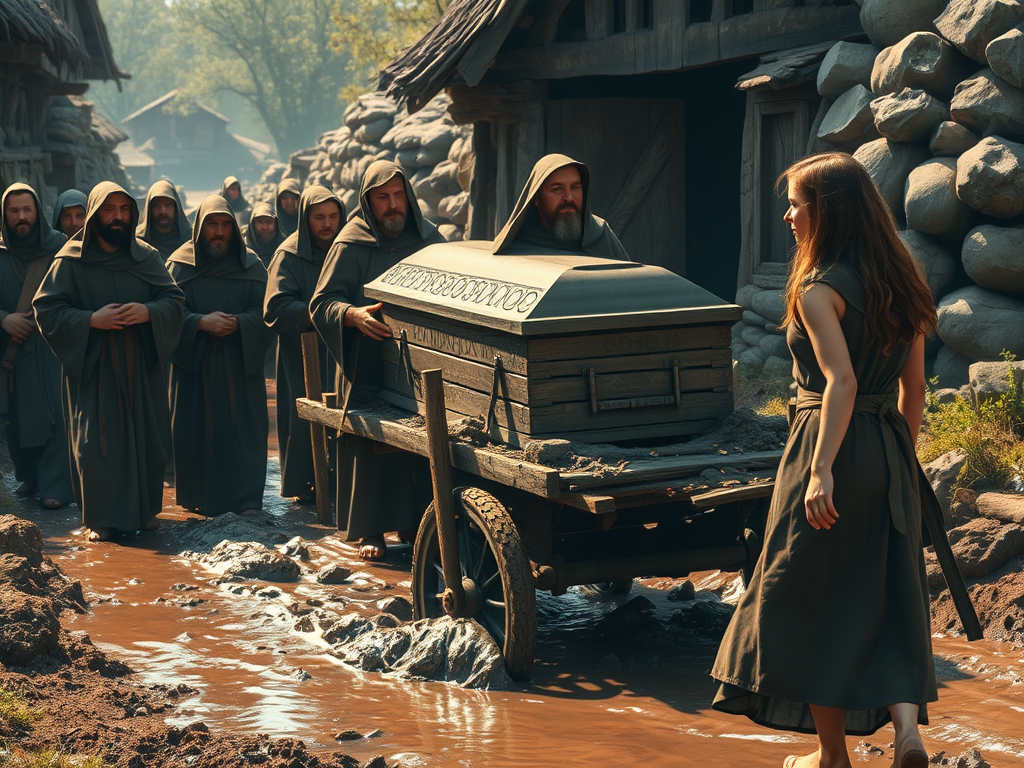
- St Cuthbert’s Banner -There is a story that, at the Battle of Neville’s Cross in 1346, the Prior at Durham had a vision of Cuthbert, telling him to take the corporal cloth of the saint and raise it on a spear point near the battlefield as a banner. Doing this, the Prior and his monks found they were protected from harm. Whether the story of the vision is true or not, the banner of St Cuthbert was regularly carried in battle against the Scots until the Reformation, (incuding by Richard of Gloucester), and it shows how St Cuthbert was regarded as a protector of his people.

 The New Murrey and Blue blog
Leave a comment