While reading Francis Pryor’s book Britain in the Middle Ages: An Archaeological History, I came upon an example of medieval graffiti that is to be found in the Church of St Mary, Ashwell, Herts. Inside the wall of the west tower is a Latin verse which captures the horror, fear and guilt felt by survivors in the immediate aftermath of the Black Death (https://www.history.com/topics/middle-ages/black-death). In the book the translation reads:
1350—Miserable, savage, crazed. Only the worst of people remain as witnesses And to cap all came a tempest With St Maur thundering over the earth.
The heartfelt words reach out across the centuries, and give an idea of the numbness with which the survivors of the terrible pestilence faced their future. So many of their relatives and friends had perished, there weren’t enough people to tend the land and do all the other tasks that were essential to daily life….and the lords fully intended to assert themselves again on the same terms as before. This highborn idiocy would eventually lead to the Peasants’ Revolt of 1381 (https://www.historyextra.com/period/medieval/your-guide-peasants-revolt-facts-timeline/), and even then the ruling class didn’t learn its lesson.
But there was something else about the inscription that then caught my attention. The bit about the tempest “With St Maur thundering over the earth”. Does this refer to St Maurus, patron saint of cripples, charcoal burners, cobblers, coppersmiths and shoemakers, to whom we appeal for help against rheumatism, epilepsy, gout and hoarseness?

by Friar Filippo Lippi, O.Carm. (ca.1445)
St Maur (https://christianapostles.com/st-maurus/) was a 6th-century saint whose present feast day is 22 November, but prior to 1969 it was today, 15 January. So, presumably, this terrible tempest of 1350 was in January, not November.
The black death had begun to relent slowly in the autumn of 1349, but fate still had the tempest in store. However, finding any mention of it anywhere is proving an unrewarding labour. For instance, although England and France were officially abiding by a temporary truce, on Christmas Eve 1349 Edward III heard of a sneaky French plot to retake Calais, which had been English for a couple of years.
Edward gathered a secret army and with his son, Edward of Woodstock (to be the Black Prince) was just as sneaky and slipped over the Channel to catch the plotters off guard. They were successful and after a bloody skirmish on New Year’s Eve 1349, Calais was secure again. By 12 January 1350 Edward was back in England. No mention of the terrible tempest three days later on St Maur’s Day, 15 January 1350. So perhaps it was more localised to Hertfordshire? More like a tornado than a slower-moving, wider spread hurricane?
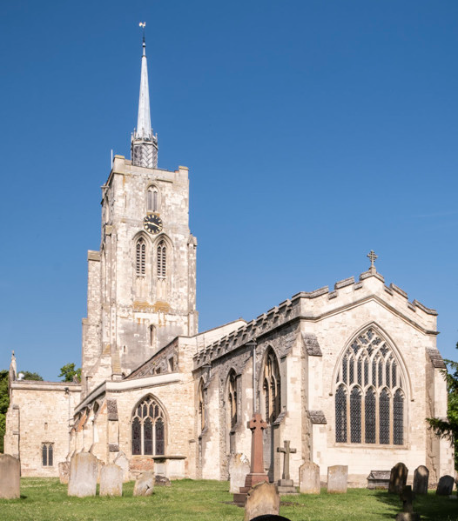
As usual, I resorted to the excellent British History Online site concerning Ashwell and read that “….on the north wall of the tower, internally, the following 14th-century inscription has been roughly scratched. The beginnings of the second and third lines are imperfect: ‘xlix pestil[en]cia qinz
M. C. [T..]. X penta miserāda ferox violēta….su[p..]est plebs pessima testis in fine qe vēt’ valid’….oc anno Maurus in orbe tonat MCCC lxi.’….”
This has been translated by Mr. C. Johnson, M.A. who says that the third line alludes to the great storm on St. Maur’s Day of 15 January 1361, as mentioned in the ‘Eulogium Historiarum.’
Eh? 1361? Well, that does it! 😠 I started off with 22 November 1350, and had to change it to 15 January 1350….now the year itself is wrong. No wonder Edward III sailed back from Calais that month in 1350 and was oblivious the awful storm just after his arrival!
The British History Online entry continues: “It may be that this great wind destroyed the newly-erected tower and two western bays of the nave, which had to be rebuilt; the present western bay, which is wider than the others, and the panelled buttresses to the tower occupy the same space as two of the earlier eastern bays. Underneath the inscription is a roughly incised drawing of a large church with double transepts, and a lofty central tower and spire.”
So now I have to think again about it all. Francis Pryor is very definite that the event was on St Maur’s Day in 1350, and that it was in thunderous pursuit of the Black Death. But if MCCCLXI is 1361 (which it is) I begin to wonder if the storm and the pestilence can really be linked at all. Admittedly one followed the other, but there was a gap of eleven years between them. Unless there was another occurrence of the pestilence in 1361?
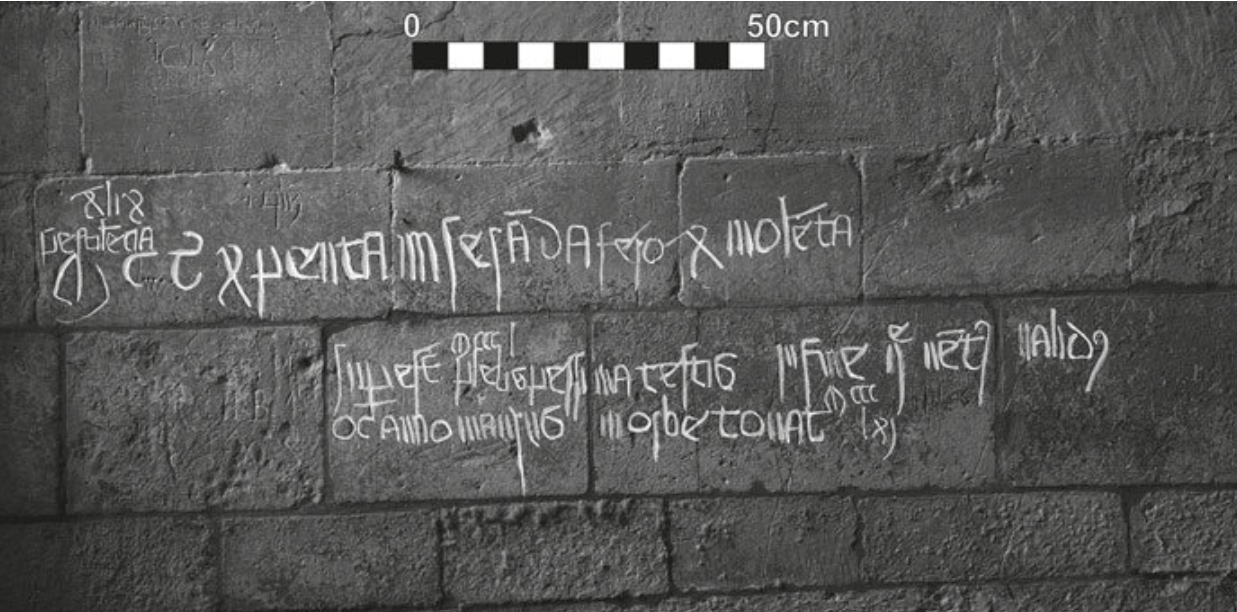
If you’d like to know more about the above inscription in St Mary’s Church, Ashwell, go here https://www.researchgate.net/figure/The-graffito-at-the-base-of-the-tower-of-St-Marys-Church-Ashwell-Hertfordshire-The_fig2_337950531 The site describes the inscription as follows: “….The graffito at the base of the tower of St Mary’s Church, Ashwell, Hertfordshire. The inscription (highlighted) begins by describing the Black Death in 1350 with the last line quoting a line of popular verse which commemorates the storm of 1362 on the day of St Maur(us) (15 January). This can be translated as: “In the end, a mighty wind, Maurus, thunders in this year in the world, 1361” (Violet Pritchard, English Medieval Graffiti, Cambridge 1967, p. 182.) (Photograph by the author)….”
Argh! Now the storm was in 1362! Yes, yes, I know all about Julian/Gregorian calendars, but I’ve had enough. I think I’ll leave the subject alone for the moment, and close the porch door ever so quietly on my way out…. 😇

 The New Murrey and Blue blog
Leave a comment