
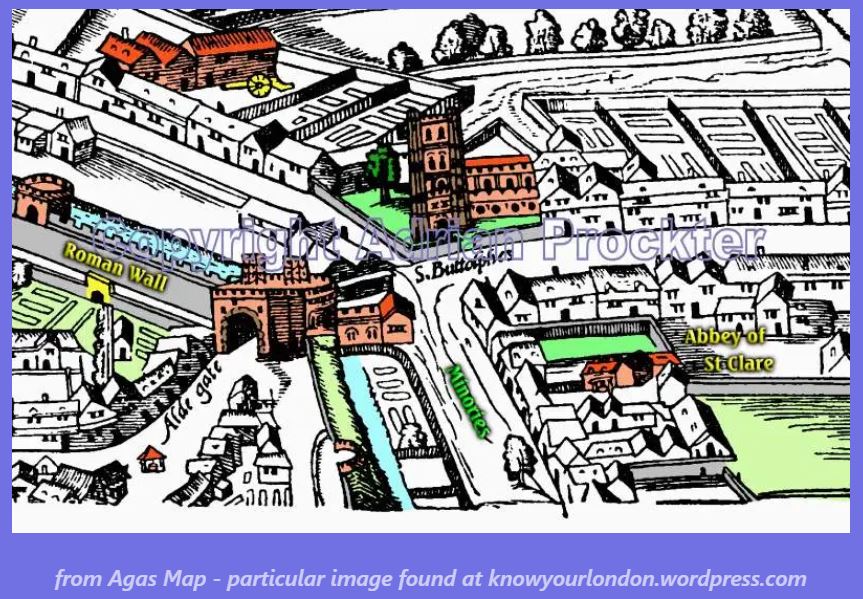
You have no doubt heard of the Minories. “….The Order of the Sorores Minores, to which the abbey of the Minores in London belonged, was founded by St Clara of Assisi in Italy, and claimed Palm Sunday, March 18th 1212, as the date of its origin….” More popularly referred to as the Minories, in the 14th and early 15th centuries it was a sought-after refuge for (mostly) wealthy women, who wished to be safe from forced marriage. See https://sparkypus.com/2021/03/21/the-abbey-of-the-minoresses-of-st-clare-without-aldgate-and-the-ladies-of-the-minories/.
I know I’ve griped before about the abominable practice of impoverished knights who, having failed to prepare for their retirement while on active military service, found an easy solution in abducting suitably well-off women and forcing them into marriage. These scoundrels were supported in their crimes by the likes of Edward III (https://www.royal.uk/edward-iii) and Edward of Woodstock, the “Black Prince” (https://www.englishmonarchs.co.uk/black_prince.htm), who’d been their commanders in the war against France. The philosophy was that men who’d risked their lives for their country deserved to have a comfortable old age. The women’s rights or wishes were given no consideration at all. See https://history.stackexchange.com/questions/44034/were-there-cases-of-bride-kidnapping-in-the-medieval-period and https://murreyandblue.org/2018/03/21/women-were-abducted-in-medieval-england/.
Reading the above, it’s soon evident why the Minories and other such establishments never lacked ladies who desired to live there. Not even women of the highest birth were safe from these abductions, see here https://historytheinterestingbits.com/2016/01/30/the-kidnapped-countess/.
Among the ladies at the Minories at the turn of the 14th/15th centuries was Lucia Visconti, Countess of Kent (1372-1424). Her life is apparently one of many viable spouses but, eventually, only one true husband, Edmund Holand, 4th Earl of Kent (https://military-history.fandom.com/wiki/Edmund_Holland,_4th_Earl_of_Kent). Please note, however, that there is a mystery which I will reveal at the end of this post.
If the thought of a highborn, apparently very attractive Milanese noblewoman failing to complete a string of marriage contracts sounds ridiculously unlikely, I doubt if Lucia herself would have joined in the humour. She was the victim of politics, with five marriages that were either abandoned before completion or annulled shortly afterward. Only the sixth was ever thought to be complete in every sense. She was a variation of the old saying “Always the bridesmaid and never the blushing bride”. And what follows now will tell you how she started life in Italy, but ended it in the Minories just outside London’s Aldgate.
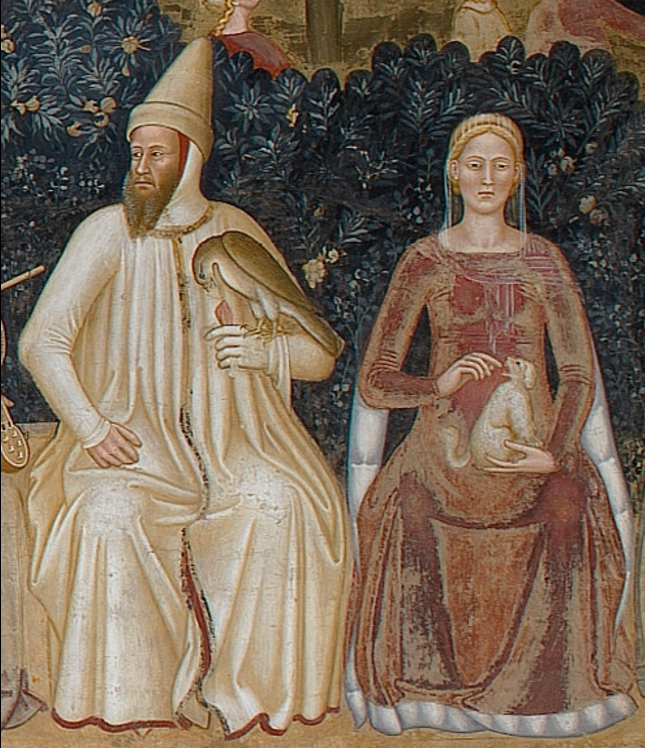
Andrea di Bonaiuto da Firenze
She was born in Milan, the fifteenth child of Bernabò Visconti, Lord of Milan, (https://www.britannica.com/biography/Bernabo-Visconti) and his wife Beatrice Regina della Scala (https://it.wikipedia.org/wiki/Regina_della_Scala) Her childhood was spent in Milan and in a number of her father’s many castles, especially Pavia of which he was particularly fond.
When she was ten she was betrothed Louis II of Anjou (https://pantheon.world/profile/person/Louis_II_of_Anjou), in the hope that it would make her the Queen of Naples. Unfortunately, in 1385 her father was defeated and deposed by his brother Gian Galeazzo Visconti (https://en.wikipedia.org/wiki/Gian_Galeazzo_Visconti). This brought a halt to negotiations for her first marriage.
She was now in the household of her father’s murderer, who became Lord of Milan….and eventually its duke. The relationship I’m going to relate next wasn’t in connection with a possible marriage (not at this stage anyway), but it gives a glimpse into Lucia’s passionate nature. In 1393, when she was fifteen and still in her uncle’s care, a certain English nobleman, Henry, Earl of Derby, passed through on his way back from a European crusade and a journey to Jerusalem. He and Gian Galeazzo became friends, and always corresponded afterward.
We know Henry, of course, because he was the son of John of Gaunt, murdered and usurped his cousin Richard II, and then became King of England in his place, founding the House of Lancaster in the process. He’s not my favourite historical figure. In fact he’s on my “Most Loathed” list because I happen to support Richard II’s side of the dispute. If I were a time-travelling hitwoman, Henry would have been decked long before he had a chance to dispose of Richard II! But then you all know that too!
Anyway, when Henry and Lucia met in Pavia in 1393, he was twenty-six and in his prime, with a reputation for bravery, chivalry and gallantry, etc. etc. Lucia fell for him. Subsequent events reveal that he wasn’t indifferent to her, but as he was already very much married to (and it seems in love with) Mary de Bohun (https://en.wikipedia.org/wiki/Mary_de_Bohun) the matter went no further for the time being. Lucia is reported to have written that if she had to wait forever to marry him, only to die three days later, the wait would have been worthwhile. Or words to that effect. But by the time she did eventually see him again, in 1407, he’d deteriorated into a pathetic shadow of his once striking self, and she may have thanked her lucky stars that she wasn’t married to the pock-marked, rather off-putting invalid he’d become.
In 1398 came her second possible marriage. Her uncle Gian Galeazzo wanted her to be the bride of his illegitimate son, Gabriele Maria, aged thirteen (https://en.wikipedia.org/wiki/Gabriele_Maria_Visconti). Lucia was by then twenty-six and refused. It went no further.
The third marriage came in June 1399 when through the mediation of emissaries, she was contracted to the son of the Landgrave of Thuringia, Balthazar Marquis of Misnia, (https://en.wikipedia.org/wiki/Balthasar,_Landgrave_of_Thuringia). But on the point of leaving for Germany, Lucia claimed she had been forced into the marriage and wouldn’t leave Milan. Had she learned that Henry in England, having murdered his cousin Richard II, was now Henry IV….and, more importantly, was now a widower?
Henry was, ofcourse, in constant correspondence with Gian Galeazzo, so it seems there were tentative negotiations for an English match with Lucia. Clearly Henry had liked the 15-year-old girl who had fallen for him so passionately in 1393.
On the death Gian Galeazzo in 1402, Lucia quickly formalised her objection to the German match: “…in 1402 Duke Gian Galeazzo Visconti died and Lucia was still in Pavia! It was obviously said that the marriage had not been consummated, and before a notary on February 24, 1403 ‘the inclined Domina Luzia protested several times that she had done it out of fear of the illustrious lord Gian Galeazzo and not with the intention of allowing the Marquis Federico to be her husband’; moreover, Lucia “wept and wept and told many that she was not married’. Lucia had won, probably thanks to the fact that Gian Galeazzo was dead….” Google-translated from https://www.italiamedievale.org/lucia-visconti-il-singolare-destino-della-figlia-di-bernabo-che-ebbe-tanti-sposi-e-nessun-marito/.
Unfortunately for her, Gian Galeazzo’s death lessened Henry’s interest. Perhaps too Henry realised that without the important li k with Milan, she was no longer quite important enough to be Queen of England. By this time too Henry was having a rough time as king, and his health was suffering badly. Some might say it was retribution for what he’d done to Richard II. But in Lucia’s mind’s eye Henry was still the brave, handsome knight of 1393. Was she excited and then desperately hurt and disappointed? Probably.
Marriage number five came along in 1404, when the Duke of Bavaria sent his ambassadors to the court of Milan to negotiate the marriage of his son Stephen with Lucia (https://en.wikipedia.org/wiki/Stephen_III,_Duke_of_Bavaria). However the political storms besetting the Milanese court after Gian Galeazzo’s demise were so alarming to the envoys that they scurried away again.
Now we come to Lucia’s only successful (as in being consummated if not in happiness) marriage and her journey to England at the age of thirty-four. Her husband wasn’t to be Henry IV, but Edmund Holand, 4th Earl of Kent (https://thesignsofthetimes.com.au/55/674168.htm). She was married by proxy in December 1406, and on 24 January 1407 was fully wed to Edmund at the church of St Mary Overy, now Southwark Cathedral. At the church door she was given away by none other than Henry IV. If , since landing in England, this was the first time she’d seen him since 1393, she must have been hard put not to show how shocked she was by his deterioration.

The much younger Edmund was described as “….inclytus et amabilis….” (renowned and loveable, or words to that effect), and like his late uncle, John Holand, 1st Duke of Exeter (see https://englishhistoryauthors.blogspot.com/2014/11/the-fate-of-john-holland-first-duke-of.html), he excelled at tournaments and seems to have inherited the same fatal Holand charm. Edmund was deep in debt and had no doubt been “….lured by [Lucia’s] dowry of 70,000 guilders….”
He was also still technically a minor but already an accomplished soldier, and was very much in favour with Henry IV. But just before his betrothal to Lucia he’d had a liaison with Henry’s cousin, Constance, daughter of Edmund of Langley, Duke of York (https://www.englishmonarchs.co.uk/plantagenet_69.html).
Whether Lucia knew about the affair before her marriage isn’t clear, but she certainly knew not long after when Constance gave birth to Edmund’s daughter, Alianor. See https://murreyandblue.org/2014/02/24/the-audley-case-of-1431/ and https://murreyandblue.org/2021/04/04/the-audley-case-of-1431-redux/. It was all a major scandal, and Lucia must have loathed every minute of it. What it did to her relationship with Edmund heaven alone knows. The little girl Alianor had been conceived before Lucia’s marriage, and I suppose it all depends on whether Edmund insisted on continuing his affair with Constance.
Not that it was to matter much in the end because only eighteen months after the marriage he was killed, on 15 September 1408, during the siege of Bréhat in Brittany. Apparently he insisted on riding too close to the besieged fortress without his helmet, and was killed by an arrow in the head. He was buried at Bourne Abbey in Lincolnshire.
Lucia’s huge dowry was never paid, and in 1486, in the reign of Henry VII, the many English attempts to acquire it were finally abandoned.
Most accounts of Lucia’s life end with her residence at the Minories, where she may have been as early as 1411. No further mention is made connecting her with marriage, for which I wouldn’t blame her. “Enough already” might possibly have been her motto. She passed away on 4 April 1424, and was buried at Austin Friars, London, where many Italian immigrants lay at rest. She was fifty-two, and clearly hadn’t wanted to be buried alongside Edmund, which might indicate her opinion of him. On the other hand, of course, she might simply have wanted to lie at rest with her own countrymen.
You will have noted my hint of query in the above paragraph. This is because Lucia’s life has an intriguing addendum. According to The Lancashire Hollands by Bernard Henry Holland, pages 157-163, (and a few other sites) after Edmund’s death Henry IV pressed Lucia to marry his (legitimised) half-brother, John Beaufort, Earl of Somerset (https://en.wikipedia.org/wiki/John_Beaufort,_1st_Earl_of_Somerset), who according to Hall was “il visaged” and not at all to her liking. She declined, especially, perhaps after her charming Holand rogue. Henry IV, needless to say, was displeased.
Then he was downright furious when she defied him further by marrying “….a goodly young esquire and bewtifull bachelor….” named Henry Mortimer. Henry IV never forgave her, and it was eventually his son, Henry V, who released her from royal wrath and promoted her husband to “….great offices in England and in Normandy….Henry had issue by this Lady [Lucia], Anne maried to sir Ihon Awbemond mother to Elizabeth Chandos mother to Phillis maried to sir Dauie Halle capitayne of Caen, she had also issue Mary maried to Ihon Cheddur and Luce espoused to sir Ihon Cressy….” See https://soc.genealogy.medieval.narkive.com/L8KvsfxH/edward-hall-on-lucy-countess-of-kent-d-1424.
So, if Hall is correct, it would seem that Lucia did not die childless. And perhaps she went to the Minories after this final marriage. Therefore her life has another ending, one of having finally married Henry Mortimer for love, and having two daughters with him.
Whether or not he was one of the Mortimers I don’t know. Nor am I aware of what happened next, but I do know which finale I prefer for Lucia….marriage number seven!


 The New Murrey and Blue blog
Leave a comment