Henry Grey was the father of the ill-fated Lady Jane Grey, the Nine Days’ Queen. A great grandson of Elizabeth Woodville, through her son , Thomas, from her first marriage to Sir John Grey, he married Frances Brandon, daughter Henry VIII’s sister, Mary, so their children, three girls named Jane, Katherine and Mary, had a claim to the throne.
Henry Grey was prominent in Henry VIII’s court, taking the role of sword-bearer at Anne Boleyn’s Coronation, carrying the Cap of Maintenance into Parliament, and helped lead an army into France.
After Henry VIII died, however, his position became precarious as he fell afoul of Edmund Seymour, Lord Protector of England. Returning to his Leicestershire home, he began plotting with Edmund’s brother, Thomas Seymour, to marry Jane to the young King Edward VI. This plot was foiled and Thomas executed for treason, but Henry managed to keep his head.
Things began looking up for Henry and his family when Edmund Seymour’s protectorate was overthrown by John Dudley. Henry became Duke of Suffolk jure uxoris, while Dudley became Duke of Northumberland. Henry then asked permission from the ailing young King Edward for Jane to marry Guildford Dudley, which was granted. Edward went on to change his will, making Jane his successor instead of his older sister, Mary.
However,despite Jane being proclaimed queen by the privy council on Edward VI’s death, the country was deeply divided as to who should rule, and Mary’s supporters won out. At first, Mary was inclined to be lenient, but when Henry joined Thomas Wyatt’s unsuccessful revolt against her, his fate and that of Jane and Guildford was sealed. The young couple were both beheaded on 12 February 1554, while Henry faced the headman’s axe 11 days later.
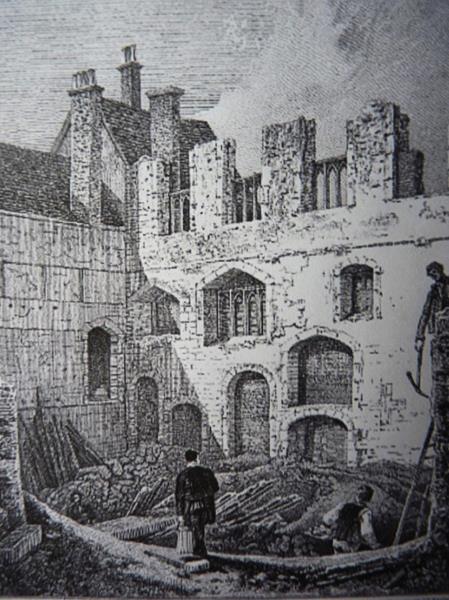
Here is when things get rather murky, mysterious and macabre. No one knew for sure what became of Henry Grey’s remains, whether he was buried in the Chapel of St Peter ad Vincula with his daughter,whether his head was spiked on Tower Bridge or whether head and body were taken elsewhere for burial. Then in 1851, a severed head in a basket, quite well preserved, turned up in a vault of the Church of the Holy Trinity, in the Minories. This little church was made out of a remaining chapel from the vanished convent of the Minoresses, nuns of the Order of St Clare, although it had been rebuilt several times. The Abbey of the Minoresses had been a hugely important convent, the home and later burial place of many powerful widowed ladies of the late 15th c, including the Dowager Duchess of Norfolk, Elizabeth Talbot, sister to Eleanor Talbot, Edward IV’s probable secret wife. It was also the second burial place of the tragic Anne Mowbray, Elizabeth’s young daughter, who had been briefly married to Richard of Shrewsbury, the younger of the ‘Princes in the Tower’–her tomb was discovered in an underground vault in the vicinity of the church in 1964.
But back to Henry’s head: it was surmised his widow Frances claimed the head and hid it in the church to avoid it going up on the bridge as a warning. Husband and wife had both worshipped frequently at Holy Trinity. The head was put on display in a glass case for a while but later was moved to St Botolph Aldgate, which likely saved it, for the Minories site was heavily bombed in WWII.
But is the mummified skull really Henry? Some are doubtful. There were claims it looked like his portrait, but without a proper facial reconstruction, it is difficult to say if that is true. Chroniclers said of his execution that he died with one blow of the axe, but the doctor who examined the head, Dr Fredrick John Mouat, said that more than one blow had been struck: A large gaping gash, which had not divided the subcutaneous structures, shows that the first stroke of the axe was misdirected, too near the occiput, and in a slanting direction. The second blow, a little lower down, separated the head from the trunk below the fourth and fifth cervical vertebrae. Mouat did say he believed the execution took place in cold weather (Henry was beheaded in February) so time of year tallies but the injuries do not, unless the writers of the day were incorrect in the number of blows, which is certainly possible.
The next person to examine the head was George Scharf of the National Portrait Gallery, who made detailed drawings. He believed the head was of a man past the prime of life…but Henry was only 37 when he died, so that does not fit with it being the Duke. Scharf, of course, was not a doctor or antiquarian interested in human remains, so was only really giving an educated guess.
So, again, as with the bones known as (but likely not) the ‘Princes in the Tower’,we are left in the dark because of the lack of ability to positively ascertain the identities of human remains in the era when they were found. For all we know, ‘Henry’ could be one of the many unfortunates who went to the block before and after the 16thc (the scaffold stood near the Minories) and not the Duke at all.
Nowadays, the preserved head could be carbon dated and DNA extracted from a tooth (most seem to have survived well). Here, though, the head’s story takes another twist. After a 1990’s archaeological dig at St Botolph Aldgate, in which the head was removed from the vault where it resided, it is said it was buried in the churchyard, although some claim it is kept safely and secretly elsewhere… So where is Henry Grey’s (possible) head today?


 The New Murrey and Blue blog
Leave a comment