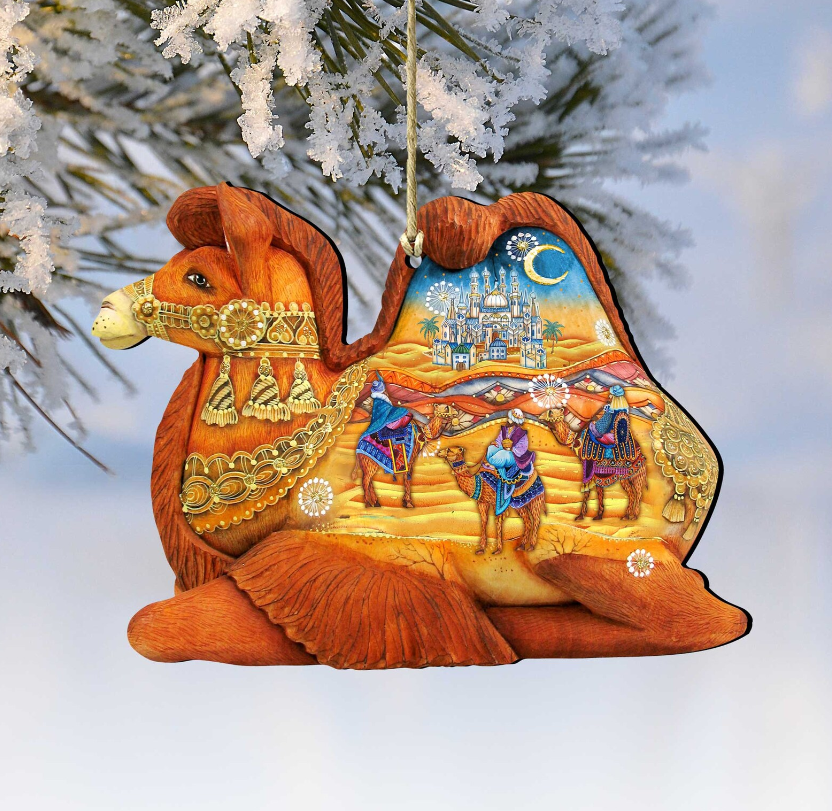
Camels seem to have figured quite a lot in gifts to medieval monarchs, at Christmas and other times. But I’ll begin with commenting on the season itself.
The boxes in question contained little gifts from masters to servants, from hopeful merchants to prospective clients, bribes of all description and so on. One servant, for example, reports that his employer had sent a note, 2,000 pounds in gold, and an image of the Epiphany to an acquaintance on New Year’s Day. That must have been one highly appreciated servant! To find a very interesting article about Boxing Day, its history and traditions, and its connection to St Stephen’s Day, go here https://en.wikipedia.org/wiki/Boxing_Day and here https://en.wikipedia.org/wiki/Saint_Stephen%27s_Day
These days we get our presents ready on Christmas Eve to give to happy recipients on Christmas Day. But the original gifts were the gold, frankincense and myrrh given by the Three Wise Men at Epiphany to the newly born Christ. They probably arrived on camels….but didn’t present them to the baby as well!

Of course, when we think of the Feast of Stephen, it is inevitable that the Christmas carol Good King Wenceslas springs to mind. It seems to be really old, but is only partly so. The lyrics date from 1853, but the tune “….is based on ‘Tempus adest floridum’ (‘The time is near for flowering’), a 13th century carol….” See more here: https://www.lyricsforchristmas.com/christmas-carols/good-king-wenceslas/.
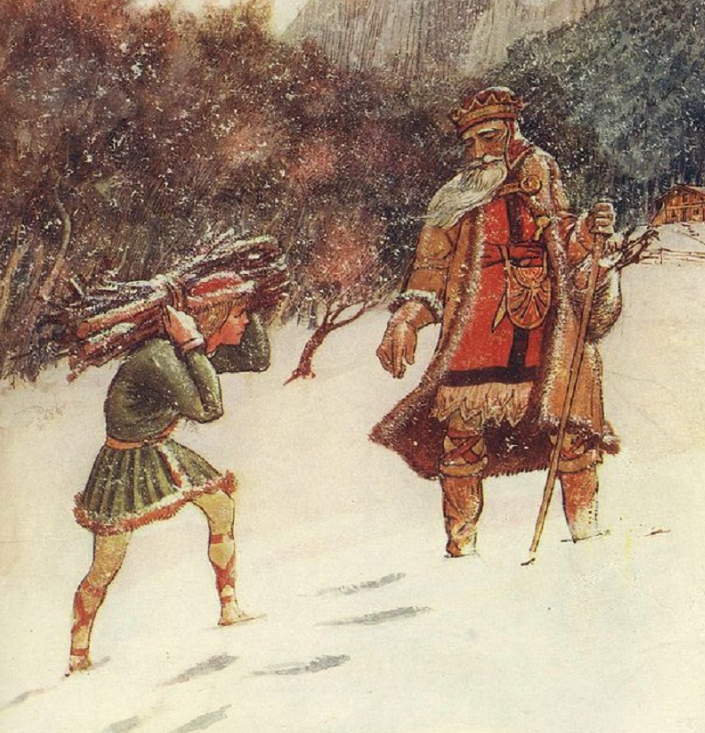
Nowadays, compared with medieval times, we live like royalty—and then some! That’s if we’re fortunate, of course, because there are still far too many living in poverty. But for those of us who can enjoy our Christmases to the full—with pantry shelves laden with festive fare, freezers, fridges and racks of choice wine—as well as all mod cons and warm, cosy houses regardless of the weather outside, well, even a medieval monarch might be envious. Then again, he/she might consider us decadent and beyond redemption.
So for the purposes of this post, let’s pretend we all live like kings this Christmas, and while we’re still replete after gorging ourselves yesterday, perhaps it would be entertaining to look back to some medieval Christmases and the gifts given and received by the then monarchs. Including a goodly selection of camels!
To begin with we imagine our monarchs and their aristocracy in a setting of rip-roaring feasts (as in the Henry VII illustration below), with minstrels, jesters, mummers, acrobats, seasonal greenery, wassailing, magnificent clothes and cheers as the finest dishes are borne in aloft. See here: https://www.britainexpress.com/History/medieval/christmas.htm. And perhaps it was like this, but the season was devout as well, a celebration of the birth of Christ, and the Church would have much greater participation and influence than it has today in many places. Now far too many of us have all but forgotten the religious aspect of Christmas.

The above britainexpress.com link is chock full of interesting snippets about Christmas things that happened in the reigns of our medieval monarchs, and I have used some of them in the paragraphs that follow, but not all by any means, so I recommend you give it a read.
When it came to gifts, there was a lot more to it than merely the giving. If you go here https://scholarworks.iu.edu/journals/index.php/tmr/article/view/32215/36021 you will find the following: “….The courtier-clerk, John of Salisbury, (late 1110s – 25 October 1180) showed an intimate familiarity with classical writings on gift giving. In his own writings about political life, he explored the variables that determined, as he put it, ‘whether gifts (munera) are splendid or sordid’, such as ‘who gave them and why and, sometimes, upon the timing, the location or the manner in which they were given’ (68). With his deep classical learning, William of Malmesbury (c. 1095 – c. 1143) wrote about the histories of the kings and bishops of England and devoted much attention to the role of gifts, arguing that historically, materialism and prodigality often led to disastrous kingships (or episcopates), whereas discerning generosity toward others and austerity with oneself were the true marks of virtue….” Oh dear, that rather takes the fun out of it.
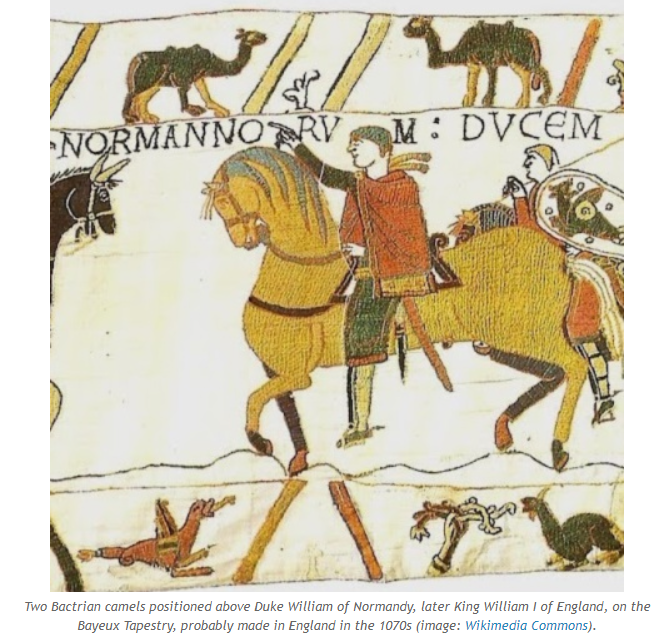
Also in the 11th-century, not long after the Battle of Hastings, the Bayeux Tapestry was a gift to William the Conqueror, it’s believed by his half-brother, Bishop Odo. However, the exact year isn’t known, nor if it was anything to do with Christmas, but it was a gift and it does have illustrations of camels. (https://smarthistory.org/the-bayeux-tapestry/.) The above image taken from the Bayeux Tapestry shows two camels above William. At Christmas 1066 he had his coronation.
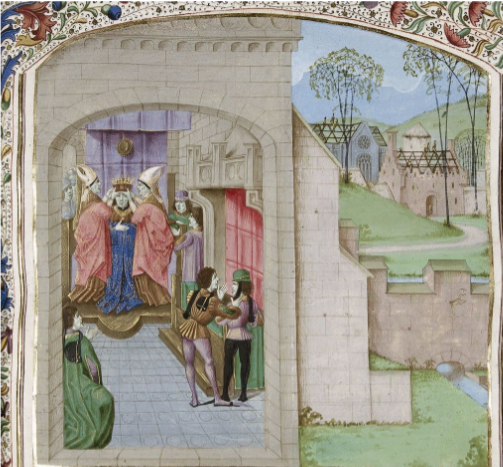
It would seem that from the time of Henry I the medieval English royal menagerie regularly included camels, but of course they weren’t all that our monarchs received or gave. The Christmas period of 1170 was the time of the final denouement between Henry II and Thomas à Becket, culminating in Becket’s murder in Canterbury Cathedral on 29 December.
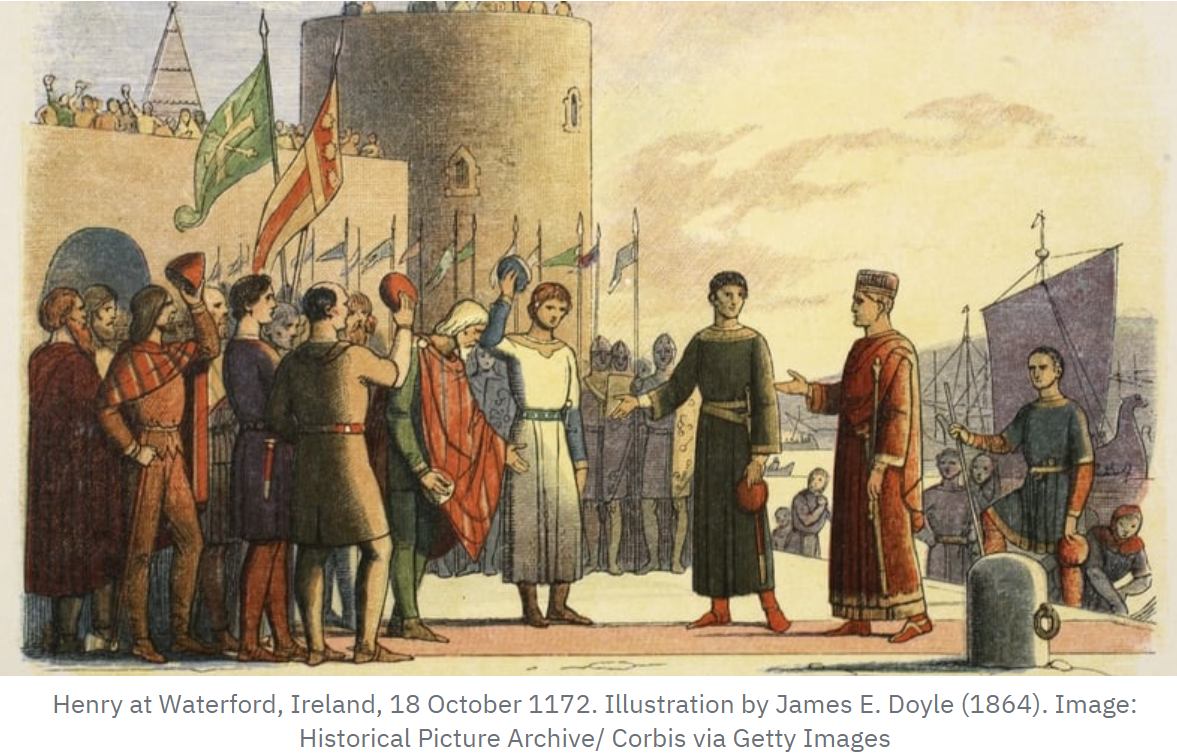
The following Christmas Henry II spent in Dublin, and had a new palace built for the occasion. What one-upmanship! Was he perhaps consoling himself after the awful events of the previous season? This Christmas saw cranes being eaten for the first time in Ireland. Other delicacies included herons, peacocks, swans, and wild geese. So I guess his gift was given by whoever coughed up for his fancy new palace. Not a camel in sight.
“….A.A. Milne’s popular children’s poem, “King John”, portrays the friendless king on the eve of a lonely Christmas, reduced to displaying tattered greeting cards from seasons past and wondering if, alas, he might count on receiving even one measly present this year. A fitting way for one of history’s most villainous monarchs to spend the holidays … but historically highly inaccurate. If there was one time of year that an English sovereign could count on being surrounded with all the trimmings and trappings of “fondness” and “friendship” – however forced they might be – it was during the Twelve Days of Christmas, which stretched from December 25 through Epiphany (or Twelfth Night) on January 6….” If you’d like to know the full lyrics, read them here https://www.poetrynook.com/poem/king-johns-christmas. Again, no camels mentioned.

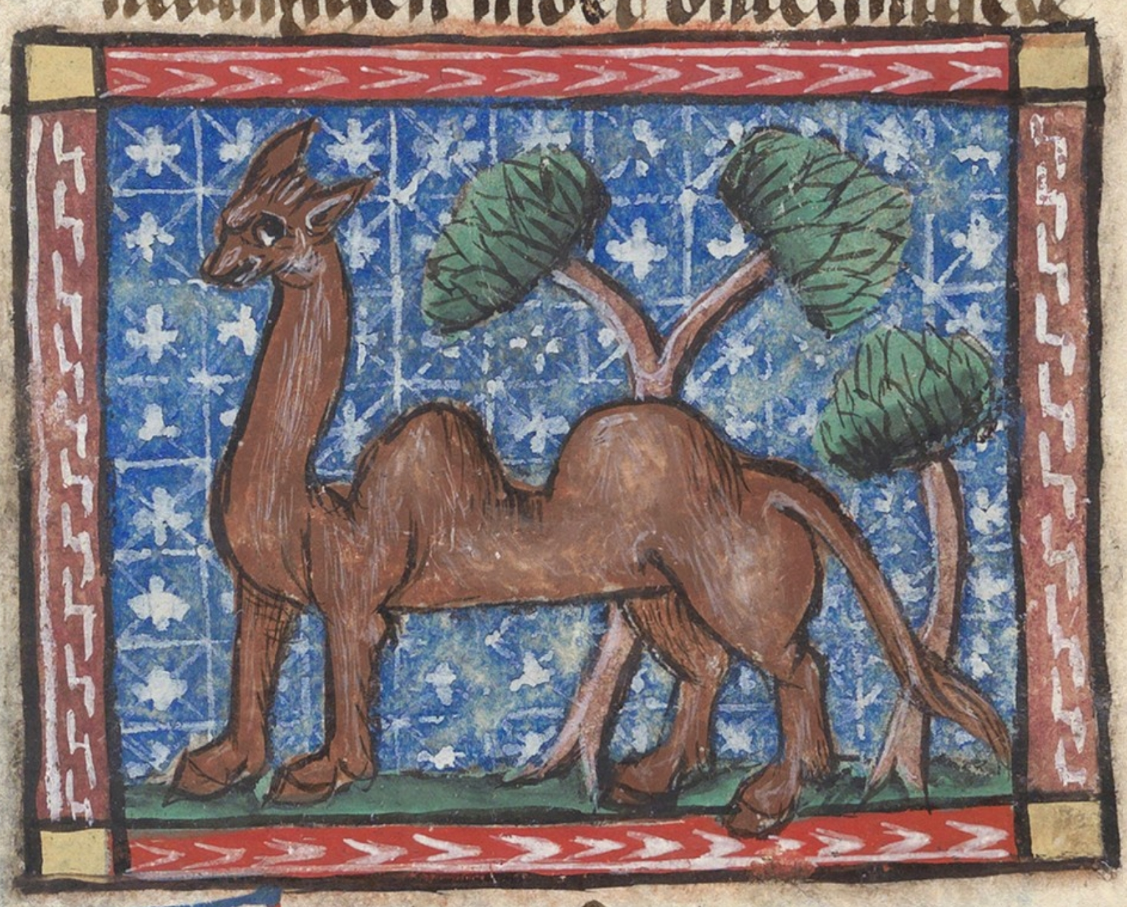
But Henry III received a camel in 1235! The year before, when he spent Christmas at Woodstock Palace. “….The Sheriff of Oxford supplied 30 oxen, 100 sheep, five boars, nine dozen fowl, salted venison from Wiltshire, salmon and lamprey from Gloucester, six tuns (or large wine casks) of new wine from Bristol and 13 from Northampton….” Good grief. Henry also filled the royal menagerie started by Henry I, with—among other things—an elephant, a leopard and a camel. The latter was sent to Henry III in 1235 by the Holy Roman Emperor Frederick II ‘as a token of the continuation of his regard’.
Henry III’s Christmases drew some unwelcome comments from Matthew Paris, who had been invited to join in one year, see here https://murreyandblue.org/2020/12/25/a-royal-christmas-invitation-for-matthew-paris-of-st-albans/. The result was this: “….Meanwhile, the Benedictine monk and chronicler, Matthew Paris, (c. 1200 – 1259) was biting in his criticism of the materialism of King Henry III’s court, comparing it (using a classical analogy) to a prostitute hired out for gain. For Matthew, good kings were incorruptible; they could not be won over by gifts; when they did receive gifts, they focused on what inspired the gift, not its material value….” Hmm, I’ll bet Matthew stayed until the very last crumb, just to be sure of covering all of the Christmas wingdings. If Henry III had realised he was being assessed like this, he probably wouldn’t have invited Matthew to anything at all. From https://scholarworks.iu.edu/journals/index.php/tmr/article/view/32215/36021.
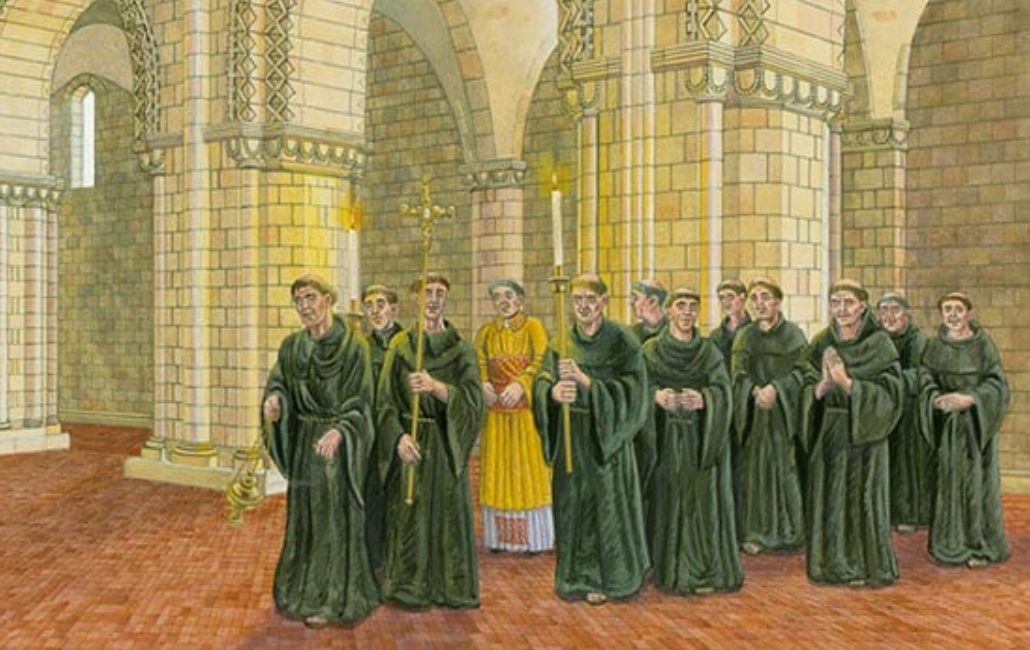
The way monks celebrated Christmas during the reign of Edward III can be read here https://aleteia.org/2019/12/17/heres-how-medieval-monks-prepared-for-christmas. The monks of Christ Church, Canterbury, for example, once gave the archbishop of Canterbury 785 hens at Christmas. https://www.medievalists.net/2021/12/holiday-gifts-middle-ages/. No camels though.
Henry III’s son was Edward I, Longshanks, the Hammer of the Scots, who kept a camel at Kings Langley palace for the entertainment of his children. He was a fond father? It doesn’t seem to go with his ferocious reputation!
Edward’s son, the unfortunate Edward II, also kept camels at Kings Langley. “….His camel-keeper was called Ralph Camyle [how original!] and the animals’ feed included hay, beans, barley and oats, with the area of the royal park responsible for producing the camels’ fodder apparently being subsequently known as Camylesland. Edward II is also recorded as being the recipient of two camels in 1317 from the wealthy Genoese merchant Antonio di Pessagno in return for appointing him steward of Gascony….”
Edward III had a camel too, as did his grandson, Richard II. Indeed, the latter “….granted John Wyntirbourne ‘the keepership of the king’s camel’ for life in January 1393 , apparently receiving a camel and a pelican from the people of London at around the same time….”
Elsewhere this gift from London is described as follows: “….On Twelfth Night, 1392, the citizens of London, anxious to bury the hatchet with Richard II, bestowed upon the king and Queen Anne a one-humped camel and a pelican, novelties for the royal menagerie at the Tower of London….”
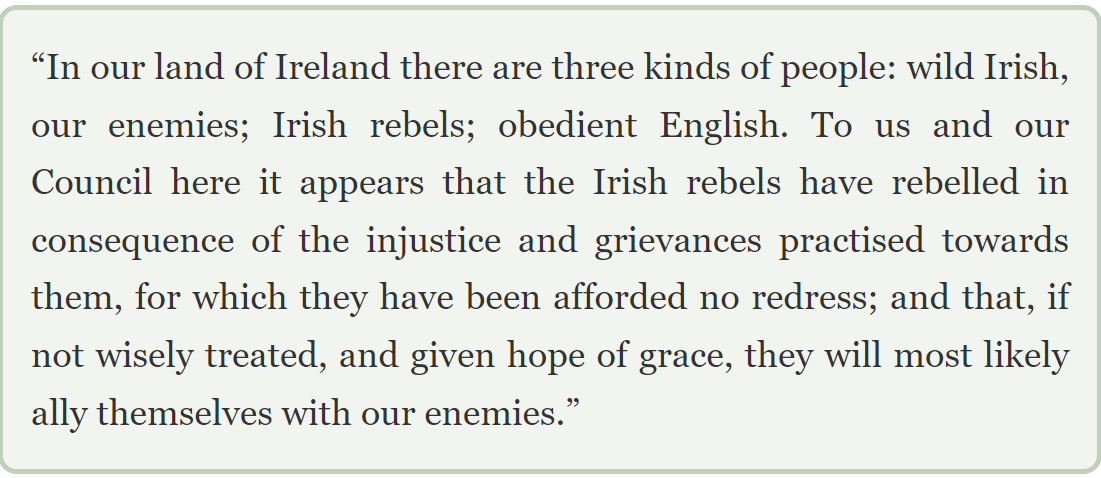
In 1395 Richard II went to Ireland to try to solve the trouble that had flared up there yet again. He spent one Christmas in that land, as had Henry II before him. And also like Henry II he spent it in Dublin “….in a sumptuous palace fitted up on Hoggin [College] Green where he entertained such of the native chiefs as paid court to him….” Another palace built for this single occasion? But then, for a medieval monarch, money was no problem.
Richard was far from indifferent to the wrongs done to Ireland, and where the blame lay, as you can read just below in a letter he wrote to his uncle in England, Edmund of Langley, Duke of York:-
Moving into the 15th century, we find that Henry VI received three camels and an ostrich from Turkey in March 1443 “….from an Italian merchant named Nicholas Jone of Bologna….”
Now we come to Edward IV, who in 1472 sent a camel to Ireland. Then “….In 1482, a Christmas guest noted that Edward IV – a notorious clothes-horse – strode into court ‘clad in a great variety of most costly garments, of quite a different cut to those which had usually be seen hitherto in our kingdom’….” That’s what you call an entrance! 1482 was also Edward IV’s final Christmas, see https://murreyandblue.org/2019/12/28/king-edward-ivs-last-christmas/) and his association with camels has appeared on this blog before, see https://murreyandblue.org/2022/10/08/edward-ivs-camel/.
The next monarch would be Richard III, of course, but his Christmases had a post to themselves yesterday, so I’ll move on to Henry VII (Boo! Hiss! And Bah! Humbug!) See here: https://murreyandblue.org/2019/12/24/christmas-under-henry-vii-complete-with-foot-sheets/ and here https://murreyandblue.org/2018/12/23/henry-vii-banned-card-playing-except-at-christmas/.

Henry’s notion of a St David’s Day gift to one of his daughters was a real LEEK. Yes, the vegetable. (See here https://murreyandblue.org/2021/03/01/henry-viis-lavish-gift-to-his-daughter/) Can you imagine him being on the receiving end of a Christmas vegetable? A cabbage, perchance? Or a turnip, Baldrick style? No, nor me, unless it was studded all over with emeralds and diamonds, of course. And in case you’re wondering, yes, the leek was the emblem of Wales back then. See here https://www.historic-uk.com/HistoryUK/HistoryofWales/The-Leek-National-emblem-of-the-Welsh/.
If ever Dickens needed inspiration for Scrooge, I’ll warrant he’d have found it in our dearly beloved first Tudor king.

Here are some friends’ wry notions of suitable gifts for the Tydder: https://murreyandblue.org/2023/05/27/what-would-you-give-henry-vii-for-christmas/.
Henry VII’s even more obnoxious son, Henry VIII, was presented with a “New Year’s Gift” by John Leland, the bibliophile and antiquarian. (https://www.tudorsociety.com/itinerary-john-leland-antiquary/) The gift was a book that described Leland’s many and varied travels and all he’d learned from them. The text was probably offered to the king as a gift at New Year, in the hope of gaining further support for this work. Nothing about camels though.

On New Year’s Day 1511 Katherine of Aragon brought a son into the world. The overjoyed Henry VIII named the boy after himself and prolonged the Christmas celebrations at court to include a grand tournament and pageant. I have no idea if he remembered Katherine’s part in it or bothered to give her a present too. But the poor little baby only lived seven weeks and we know the awful dramas that resulted. Heaven spare us from the Tudors. (https://www.britainexpress.com/History/medieval/christmas.htm)

Can we include Elizabeth I in our medieval gift-giving period? Well, I will anyway: “….Robert Dudley, Earl of Leicester, was one of the most successful gift-givers of the Tudor era, lavishing original and expensive gifts on Elizabeth year after year ( a good thing, since Glorianna would have expected nothing less). On the first Christmas of her reign, she was presented with elegant silk stockings – henceforth she never wore wool stockings again. Dudley also gave Elizabeth what is believed to be the world’s first wristwatch … appropriately bedecked in glittering jewels…..” No camels.(https://www.britainexpress.com/History/medieval/christmas.htm)

As a parting dart aimed at the Tudors, I had a whale of a time tearing into Lucy’s Worsley’s Christmas Odyssey! So if you have a fancy for a giggle, please go here: https://murreyandblue.org/2021/12/26/my-reaction-to-lucy-worsleys-christmas-carol-odyssey/.
I will end on that note, but not before pointing out that as I was finishing this post I came upon a website that obliged me do some rewriting! It proved of tremendous help and I thoroughly recommend it here https://www.caitlingreen.org/2018/09/were-there-camels-in-medieval-britain.html. It contains a lot of information and links about medieval royal camels!

As I step out of the door now I will leave you with an overload of other links concerning the English medieval Christmas season. If you’ve had enough already, read no further!
For medieval royal Christmases in general:
- https://royalcentral.co.uk/royal-christmas-celebrations/royal-christmas-celebrations-from-history-puddings-tournaments-and-unruly-bishops-195358/
- To create some delicious medieval Christmas fare yourself, see here https://murreyandblue.org/2018/12/22/ill-have-what-shes-having-a-medieval-christmas-tasting-menu/.
- https://www.english-heritage.org.uk/christmas/medieval-christmas-food/
- https://www.royal.uk/history-royal-christmases
- https://www.historic-uk.com/HistoryUK/HistoryofEngland/A-Medieval-Christmas/
- https://www.britainexpress.com/History/medieval/christmas.htm
And some links to medieval Christmases in general:
- https://murreyandblue.org/2021/12/24/from-yule-log-to-buche-de-noel/
- https://murreyandblue.org/2021/12/23/from-st-nicholas-to-sir-christmas-to-old-father-christmas-to-santa-claus/
- https://medievalbritain.com/type/medieval-life/activities/medieval-christmas-gift-presents-for-each-other/
- https://thehistorypress.co.uk/article/christmas-in-the-middle-ages/
- https://medievalhistory.info/the-twelve-days-of-medieval-christmas/
- https://thecrownchronicles.co.uk/history/history-posts/medieval-history/christmas-new-year-traditions-medieval-tudor-england/?msg=fail But be warned, “medieval and Tudor” means “only Tudor”. Carols didn’t exist before them. Hmmm…..
- https://www.medievalists.net/2023/12/medieval-christmas-traditions/


 The New Murrey and Blue blog

Leave a comment