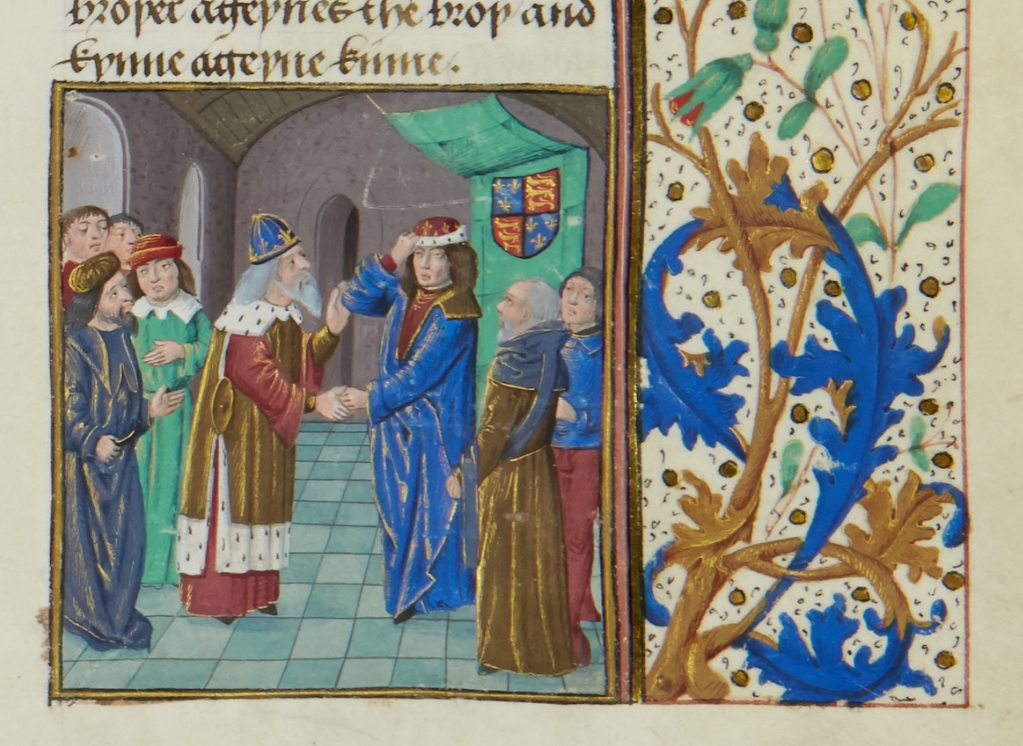
Manuel II Palaiologos meeting with Henry IV of England, depicted in a 15th-century chronicle – Wikimedia Commons

In the above image Bolingbroke/Henry IV looks as if the crown (for which he’d murdered the true king, Richard II) is prone to slipping off his unworthy head! No one else in the picture looks particularly comfortable either. Oh, dear. Please relax, for I’m not going to say anything more about this. Honest. My hobby horse stays in the stable this time because it’s the distinguished visitor with whom I’m concerned, not the odious Bolingbroke.

“….On Christmas Day 1400 the English king Henry IV and the Byzantine emperor Manuel II Palaiologos sat down to their festive dinner at Eltham Palace in southeast England. The embattled emperor had arrived four days earlier, on the final leg of a desperate tour across Europe, a last-ditch effort to encourage the emerging powers of Western Christendom to come to the aid of his empire in the event of a (highly likely) Ottoman conquest; the imperial city [Constantinople] was already enduring an extended siege….”

The above extract is from this link https://www.historytoday.com/archive/feature/christmas-save-byzantine-empire, which isn’t very long but which whetted my appetite to learn a little more about the emperor. That is how I found this other link https://www.medievalists.net/2024/09/travels-manuel-ii-palaiologos-emperor/ which is much more detailed about Manuel II Palaiologos and his desperate travels to gain assistance from the western rulers in his struggle against the Ottoman Empire. [http://www.theottomans.org/english/family/beyazid.asp]
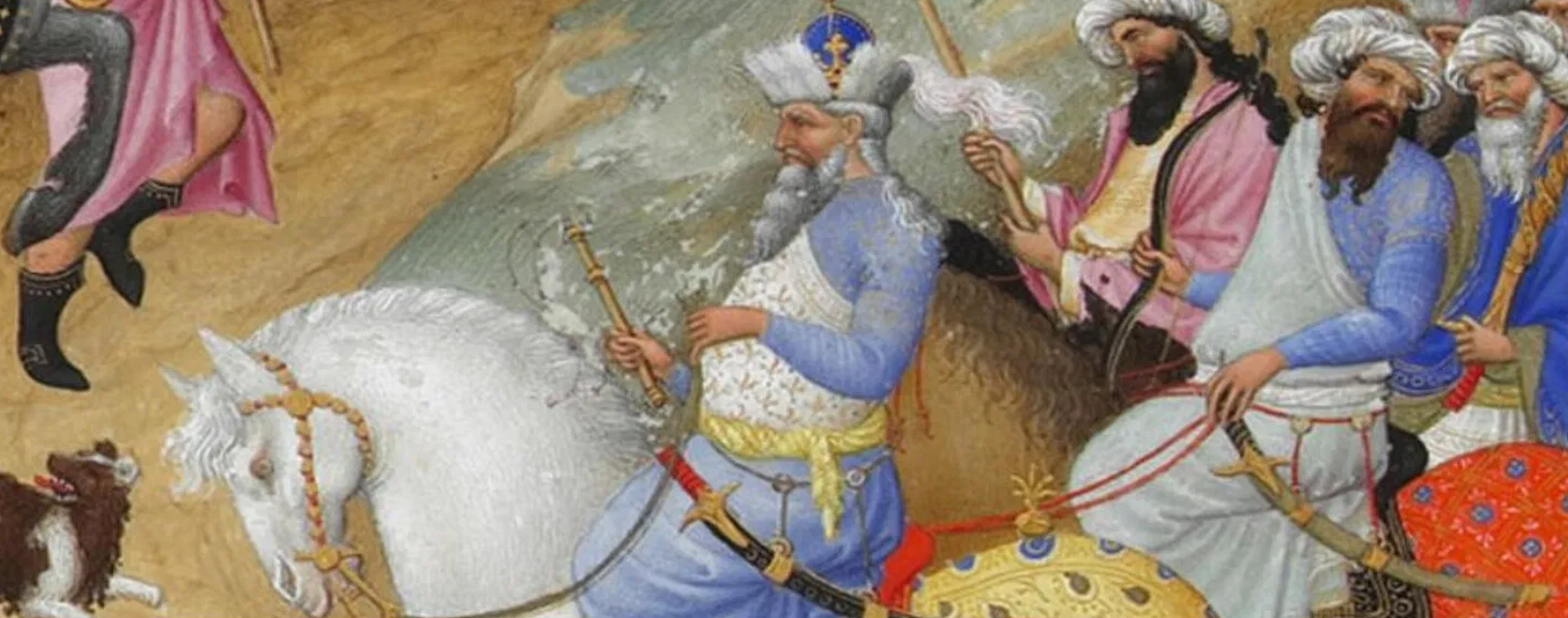
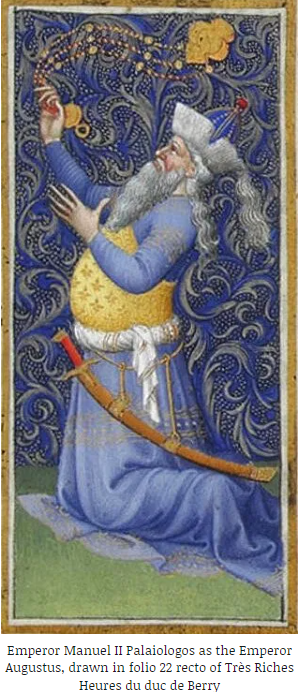
Manuel II Palaiologos – from medievalists.net I think the way he wears his luxuriant grey/white hair in a long pony-tail over the upturned base of his headwear is very striking. You can see it again in the image at the end of this post.

Manuel II was in England for two months and formed a very good impression of the land and its people. Nothing of consequence was to come of his perambulations because of “….the surprise deliverance of Constantinople by Bayezid’s defeat at the hands of Timur/Tamerlane at the Battle of Ankara in July 1402 [https://www.britannica.com/event/Battle-of-Ankara-1402] relieved [him] of his responsibility to bring promised Latin help back home with him. Although his tour of Europe achieved nothing meaningful politically, he left a great impact culturally….” He was no longer a spring chicken and never again wandered very far from home.

But now it seems there was more to Manuel’s troubles than just the Ottomans. It was something so slowly and relentlessly malign that it was to bring about the end of the once mighty Byzantine Empire. I will write about it tomorrow.

Subscribe to my newsletter

  1. […] about the 1402 visit to England of the beleaguered Byzantine emperor Manuel II Palaeologus, see https://murreyandblue.org/2024/12/14/in-1400-england-played-host-to-a-byzantine-emperor/. He was travelling around the western kingdoms desperately seeking support because he was having […]

    Like

  2. This is from Chris Given-Wilson’s (Emeritus University of St. Andrews) biography of Henry IV published in 2016 by Yale University Press: “The cost of entertaining him [Manuel] and his fifty-strong household for two months was a heavy burden, and in the end the emperor departed with no more than than L2,000 [sorry, I don’t have a key for the British pound] Richard II had promised to his envoy some years earlier but never paid. In exchange, Henry kept for himself the money donated to the crusade in collecting-boxes set up in churches around England, the sum of which probably exceeded L2,000 even if gathering it in was no easy matter.” (Page 180)

    Widely admired historian Given-Wilson feels Henry had the makings of a great king and was much better suited to the job than his cousin Richard whom he characterizes as grasping and vindicative in line with most historians (and also a thief of the Lancaster patrimony–no hint of it being reclaimed by Henry when his exile sentence was up). No doubt Henry deserved to keep the money donated in all the English churches by common parishioners because of his own heroic crusading background and the expenses he had to dole out on entertainment. In late 1399 Henry had not only his own enormous Lancaster patrimony but also everything Richard had, so he was remarkably wealthy when he promised to rule wisely and frugally and keep taxation low. (Many people mistakenly thought he promised not to tax them at all) It must have been a nasty surprise for some Englishmen within a very few short years when Henry’s money was gone and taxes soared even higher than when Richard ruled. Given-Wilson points out that Henry wisely spent lavishly on what we would now call Public Relations (foolish waste when done by Richard) but Henry also did something very clever: he declared that the Duchy of Lancaster was his private income and not to be used for public (i.e. royal) expenditures. Which it is to this day! So he could keep his Lancastrian followers paid (more or less) even when the royal exchequer was empty.

    Liked by 1 person

  3. 😡 Don’t start me on pro-Bol, anti-Richard bias! I am not responsible for my language on this particular subject. Bolingbroke was a scheming ratbag! But thank you for taking the trouble to post from Given-Wilson’s homage. I cannot understand how today’s respected historians think nothing of omitting known facts in order to fit their particular agenda. It demolishes faith in all their conclusions!

    Thank you again! Honest.☺️

    Like

  4. You are very welcome! The professional historians’s reviews for Prof. Given-Wilson’s biography of Henry IV were glowing (as were the reviews for Prof. Nigel Saul’s book on Richard II) but nowhere did anyone mention Prof. Anne Curry’s findings or those of Prof. Christopher Fletcher. And of course the inimitable late Terry Jones’ book, Who Murdered Chaucer, is beyond the pale!

    Like

    1. My opinion of certain so-called top historians has sunk considerably, whereas Terry Jones remains superb. He’s a terrible loss.

      Liked by 1 person

Leave a comment