
The earliest mention of a bridge at this spot across the Ouse was way back in the 10th century. This timber structure served as a critical crossing point over the River Ouse, facilitating trade and movement between the bustling marketplaces of York and the surrounding regions. The necessity for a robust and reliable crossing became increasingly apparent as the city flourished as a commercial hub.
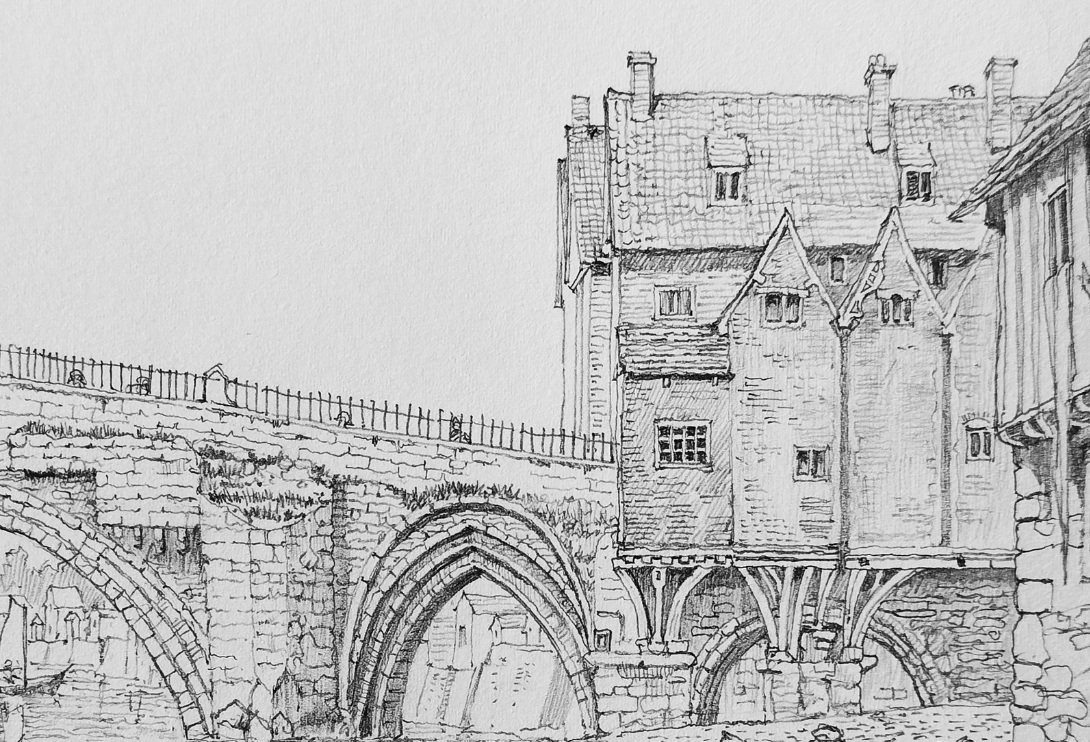
In the early 14th century the original timber bridge was replaced by a Gothic stone structure with pointed arches and elaborate detailing. At first it consisted of three large arches to allow the passage of boats and relieve the risk of flooding due to constricted flow. Well built and well surfaced, it allowed traffic to move easily to and fro on top, as well as the Ouse to flow freely below. It was “….lined with shops and houses, which created a bustling atmosphere and contributed to the economic vitality of the area….These buildings, with their overhanging timber frames, provided a unique charm and character, as well as additional shelter for traders and travellers….” (from https://www.exploringgb.co.uk/blog/old-ouse-bridge-york).

Things were going well, and York had become one of the major trading cities in the land, until the winter of 1564, when a disastrous flood caused the collapse of the central arches with the loss of twelve houses that fell into the river and took as many people with them. A new bridge commenced in 1566, this time with five arches, to give the river even more freedom to flow beneath. The central arch was “…a remarkable engineering feat, spanned 81 feet in width and rose more than 17 feet high…” This bridge remained in place until the 19th century, when it became beyond repair and was demolished, to be replaced by the bridge that is there today.
The following three magnificent drawings are the work of Allen T Adams, BA FSA FSAI, about whom you can read more here https://www.flickr.com/photos/56545646@N07/, and here https://thelonggallery.blogspot.com/2017/12/highlighting-not-so-lost-arts-allan-t.html. He has created many such fine drawings, of which some can be seen at the above links.


Other posts on this blog concerning the River Ouse include https://murreyandblue.org/2020/07/16/what-really-happened-in-1385-when-the-earl-of-staffords-son-and-heir-was-killed-on-a-yorkshire-road/, here https://murreyandblue.org/2019/01/02/collecting-tolls-on-the-ouse-at-york/
If you refer to the links below you will learn a great deal more about the bridge and its history: http://www.historyofyork.org.uk/themes/tudor-stuart/ouse-bridge, here https://her.york.gov.uk/Monument/MYO4801, here https://www.yorkpress.co.uk/news/15630890.forgotten-york-great-victorian-sketches-of-the-old-ouse-bridge-lady-peckitts-yard-and-bootham-bar-with-its-barbican/ (with some lovely old illustrations of York), here https://www.yorkpress.co.uk/news/24470407.revealed-amazing-history-yorks-ouse-bridge/ and here https://www.british-history.ac.uk/rchme/york/vol3/pp48-68
And about the most famous of all England’s medieval bridges, Old London Bridge: https://murreyandblue.org/2020/12/12/old-london-bridge-a-medieval-wonder/
 The New Murrey and Blue blog
Leave a comment