
Isn’t it strange how connections crop up quite unexpectedly? I have recently posted on this blog about The Sobbing Spirit of Langley Castle. See https://murreyandblue.org/2024/11/03/the-sobbing-spirit-of-langley-castle/.

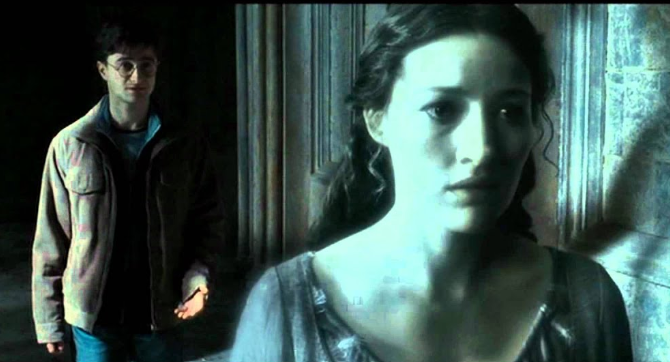
As the Sobbing Spirit title suggests, it’s about an unhappy ghost at Langley Castle near Haydon Bridge in Northumbria. She is believed to have inspired one of J.K Rowling’s ghosts, Moaning Myrtle or Grey Lady ghosts. As Moaning Myrtle is a 20th-century schoolgirl, it’s clear (to me anyway) that the Sobbing Spirit of Langley Castle was the inspiration for the Grey Lady.
But I’d recently crossed (figuratively) the North Sea to Norway, where I learned that in 1938 the remains of a medieval man were found in a well at the castle of Sverresborg. I wrote about it here: https://murreyandblue.org/2024/11/02/dna-proves-a-12th-century-norwegian-saga-was-true/. The Norwegian discovery verifies a historical incident from 1197 AD when a man suffered the fate of being thrown down into a well. The incident is related in Sverris Saga, which dates from the 12th to 14th centuries. See here https://en.wikipedia.org/wiki/Sverris_saga, here https://www.nbcnews.com/news/world/skeletal-remains-castle-well-man-norse-saga-rcna177551 and here (for very technical information) https://www.cell.com/iscience/fulltext/S2589-0042(24)02301-0#fig1.
“….A passage in the Norse Sverris Saga, an 800-year-old account of King Sverre Sigurdsson, details a military raid that took place in AD 1197. During this attack, a body was thrown into a well at Sverresborg Castle, located near Trondheim in central Norway, likely in an effort to poison the main water supply for the local population….” from https://scitechdaily.com/800-year-old-mystery-solved-scientists-reveal-the-identity-of-norways-well-man/
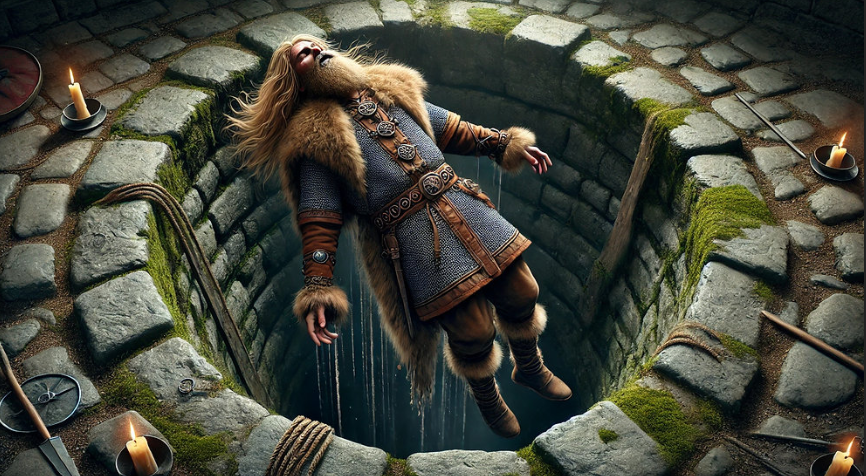
Modern science has now indicated that the remains in the well belong to the man referred to in the saga and therefore the saga is deemed to be fact, not fiction. He is often referred to as Well Man. Obviously there’s more to it than these bald statements, but they’re the gist of it.
It was while reading of these events in Norway that I wondered about other medieval folk who may or may not have been correctly identified long after death. (I’m not referring to That Urn at Westminster Abbey, the contents of which are not what is claimed!) Anyway, my thought about the identification of long lost men and women took me straight back to Langley Castle and the Sobbing Spirit. There are several candidates to be her original living self, including Maud de Lucy, sister of Anthony de Lucy, 3rd Baron Lucy of Cockermouth Castle. (See https://www.british-history.ac.uk/magna-britannia/vol4/pp40-45.) He died violently in 1368, it’s believed while on crusade in Lithuania. Maud was the second wife of Henry Percy, 1st Earl of Northumberland, and also her brother’s heir. She was eventually laid to rest in beside him at St Bees Priory.
That brings me to another odd connection. You see, Anthony is known as St Bees Man, because it’s thought that he is “…the extremely well preserved….medieval man discovered in the grounds of St Bees Priory in Cumbria….” See more here https://stbees.org.uk/home/village/st-bees-man/discovery/ and here https://www.iflscience.com/st-bees-man-who-was-the-medieval-mummy-buried-in-a-lead-coffin-71421.
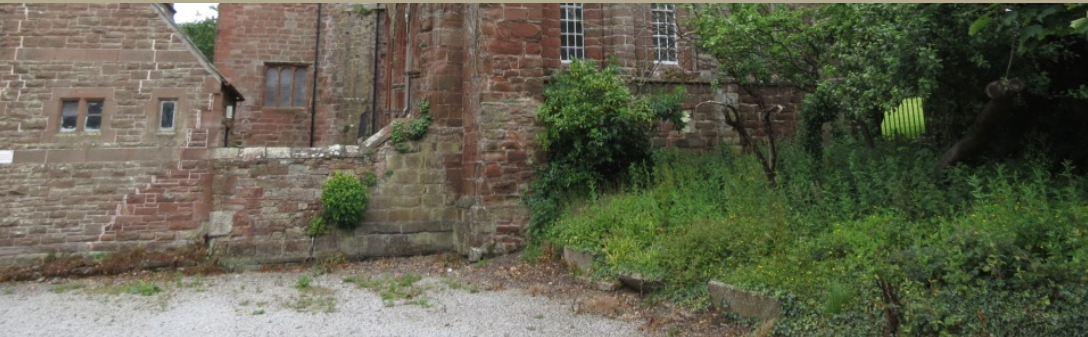
“….The name St Bees is a corruption of the Norse name for the village, which is given in the earliest charter of the Priory as ‘Kyrkeby becok’, which can be translated as the ‘Church town of Bega’. See here https://en.wikipedia.org/wiki/Saint_Bega. She was said to be an Irish princess who fled across the Irish Sea in the ninth century to St Bees to avoid an enforced marriage. Carved stones at the priory show that Irish-Norse Vikings settled here in the tenth century….” So nothing to do with honey or bees of the buzzing variety.
There you have the thread I’ve been following. From a weeping ghost in Northumbria, to the anonymous skeleton of Well Man in Norway. Then back to the Sobbing Spirit of Langley, where I learned that Maud de Lucy had a brother Anthony who was only identified when his tomb at St Bee’s Priory was found centuries after his death. He is known as St Bees Man. His sister, who was most likely the origin of the Sobbing Spirit, was entombed alongside him. All this with a nod to Hogwarts along the way!
The location of J.K. Rowling’s renowned but fictional school of magic is unknown, of course, except that it’s somewhere beside a Scottish loch. My thread didn’t actually lead me there (I do know fiction when I see it!) Any supporter of Richard III soon learns to recognise the constant stream of untruths perpetrated by the House of Tudor!😄
But who knows what new connection I might find if I stand at the entrance of the cave below and hold on tightly to the silken rope as I venture inside….?😮

 The New Murrey and Blue blog

Leave a comment