
According to Anthony Emery (Greater Medieval Houses of England and Wales Volume III Southern England, pp394-397) it was when Richard II married his second wife, the little Princess Isabella of Valois, only seven, that he decided to upgrade Portchester Castle into a royal palace. His reason was for comfort during the hunting season….and to have a suitable palace to depart from and arrive home again when he and Isabella visited France. Work at Porchester began in April 1396, and the marriage was on 31 October 1396. Richard was determined on the match because the war now known as the Hundred Years War had been dragging on without an end in sight. Above all things he wanted peace with France, and union by marriage was (he hoped) a certain way to achieve it.
The above illustration is “….a reconstruction drawing of what the outside of Richard II’s palace would have looked like in the 14th century. As part of a reorganisation of the castle between 1396-99 Richard ordered the construction of a series of grand residential apartments for his use. The rooms included a kitchen, pantry, Great Hall, several chambers and a chapel. This property is now in the care of English Heritage (2012)….”
The picture below shows Portchester Castle as it was circa 1400, right at the very end of Richard’s reign.
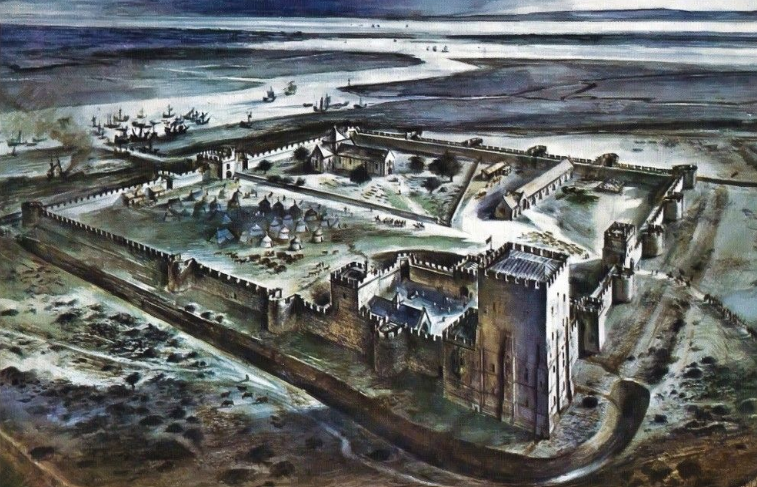
Of course, Portchester Castle was a lot older than Richard’s reign, as you can read here https://www.historyhit.com/locations/portchester-castle/, and I confess that whenever I hear the name it’s of the Romans that I think initially. What you see today is the medieval castle that grew up within the walls of the Roman Saxon Shore fort of Portus Adurni at Portchester, to the east of Fareham in Hampshire. It’s believed to have been built between 285 and 290 AD. The castle is thought to have followed in the 11th century. Today it is a flourishing tourist attraction in the care of English Heritage. See here https://www.english-heritage.org.uk/visit/places/portchester-castle/history-and-stories/history/description/, here https://www.british-history.ac.uk/vch/hants/vol3/pp151-161#h3-s2 and here https://en.wikipedia.org/wiki/Portchester_Castle.
In the medieval period Portchester was in a commanding position at the head of Portsmouth Harbour and was a very important port.

The castle certainly has quite a royal history, as you can read here https://www.english-heritage.org.uk/visit/places/portchester-castle/history-and-stories/history/: “….In 1346 Edward III (r.1327–77) stayed here before crossing to France and winning the Battle of Crécy. His grandson Richard II (r.1377–99) rebuilt the inner bailey as a miniature palace in 1396–9, creating a grand series of royal apartments around its south and west sides….
“….In 1415 Henry V (r.1413–22) launched another invasion of France from Portchester, which culminated in his victory at Agincourt on 25 October. During his stay here, a plot to depose and murder him – known as the Southampton Plot – was uncovered. It was almost certainly within the castle walls that he confronted the conspirators, who were found guilty of treason and executed….
“….Portchester was increasingly overshadowed in both economic and military terms by the developing town of Portsmouth, but was chosen as the landing place for Henry VI’s French bride, Margaret of Anjou, in 1445. The castle remained a significant coastal defence under the Tudor monarchs….”
The apartments were built in a corner of the courtyard, but no windows were situated externally, only in the walls facing inward. Work began in April 1396 under the auspices of master mason Walter Walton and master carpenter Thomas Clevere. There were painted glass windows in the hall, great chamber, chapel, exchequer and high chamber adjoining it, and the hall had a large central hearth. There were all the usual offices and all in all it was very comfortable, but far from spectacular and overall it was considered to be gloomy. Windows on the outer wall would definitely have helped. Emery gives a very in-depth description of it all if you have his Greater Medieval Houses of England and Wales Volume III Southern England book, as I do. It’s supposedly available online at https://archive.org/details/greatermedievalh0001emer but I haven’t been able to access it even though I have an account. Maybe you’ll have more luck.
According to Nigel Saul (Richard II, 339n) Portchester was probably Richard II’s most ambitious programme outside Westminster, but as work wasn’t completed until August 1399, just before Richard’s throne was usurped by his cousin Henry IV, Richard never had a chance to actually visit his project.
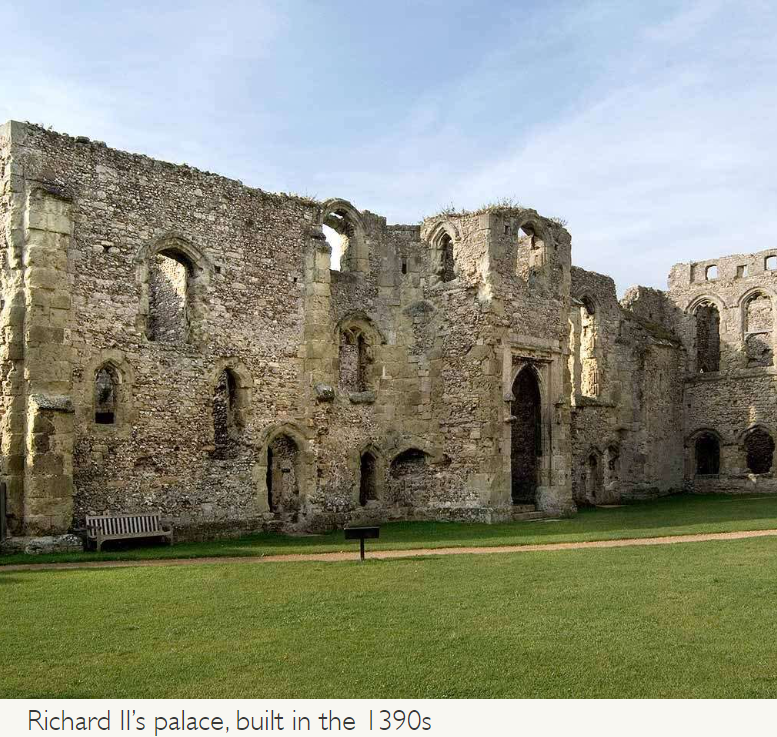
But by the 17th century “….the royal apartments built by Richard II [were] now too much out of repair to be fit for use….” The great west gate of the castle, now as always the chief entrance to the outer ward, is in a very fair state of preservation, and dates for the most part from the last years of Richard II’s reign, though the lower parts of its walls may be older. In the first storey are traces of the arrangements of a drawbridge and portcullis, the castle ditch having been doubtless continued from one end of the west side of the fortress to the other. This gate is now the only inhabited part of the castle, being occupied by a caretaker.

Here are two more links: https://www.welcometoportsmouth.co.uk/Portchester-Castle-in-Hampshire.html and here https://www.historyhit.com/locations/portchester-castle/
 The New Murrey and Blue blog
Leave a comment