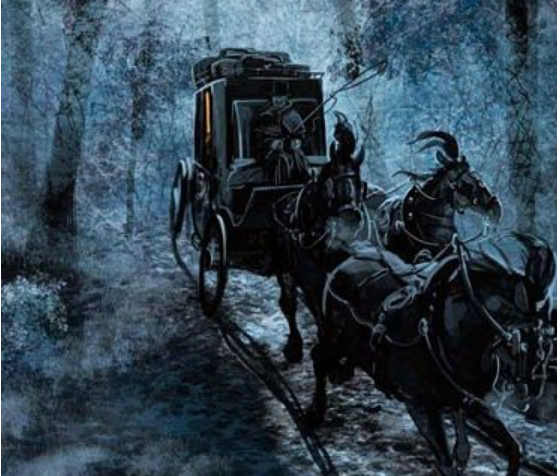
It would seem that the county of Oxfordshire isn’t content with having the 16th-century ghosts of wicked Lord and Lady Tanfield (see The evil spirits of Lord and Lady Tanfield… – murreyandblue) hurtling around in the skies above Burford in their coach and horses. Oh no, if you go to this link, A Wilcote Haunting | Dark Oxfordshire, you’ll meet their 14th-century rivals, Lord and Lady Wilcote of Wilcote, who did exactly the same two centuries earlier! And “….like Lord and Lady Tanfield at Burford, they were despised in life and featured in notable hauntings after their deaths….” But while the Tanfields required only seven clergymen to sort them out, the Wilcotes needed no fewer than twelve!
Oh, before I forget, there’s also the ghostly coach and four of Sir George Cobb of Cobb Hall, Adderbury, also in Oxfordshire, who drowned in an accident in 1762. He apparently drives back vengefully whenever changes to his house meet with his disapproval. There are a number of other such spectral visions, all in Oxfordshire, so it seems wiser to stay inside at night if you happen to be in that county. See more information see page 146 of Folklore of Oxfordshire by Christine Bloxham.
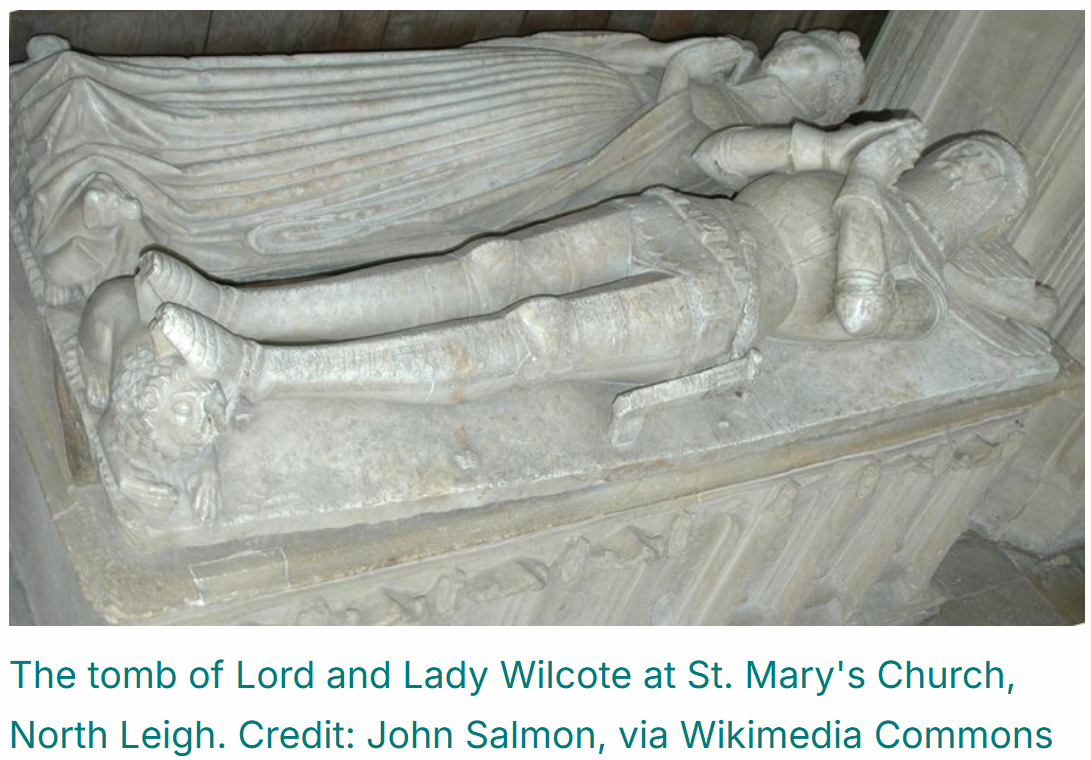
The above tomb of Sir William Wilcote and his wife Elizabeth is in a chantry chapel in the originally Anglo-Saxon church of St Mary in North Leigh. The chapel was built by Elizabeth, William’s widow. She’d been widowed twice and lost two sons. The chantry chapel was for the celebration of mass for them.
Now I’m not quite sure about the Wilcotes being despised in life, because this same page 146 by Christine Bloxham relates the following about their haunting: “….The Wilcote coach haunted to right a wrong: inside was Lord Wilcote, who it is said left land for the poor, but when his wishes were not respected his soul could not rest. His horses breathed fire and he cried ‘Cast up, cast up!’ Clergymen asked his lordship how they could lay him to rest and he told them to destroy the bell in Wilcote church, which was duly recast and the clapper thrown in the pond. The coach of Wilcote House, drawn by four grey horses, stops in the avenue and after six ghostly passengers have alighted the coach duly proceeds, dragging chains behind it….”
Unfortunately for this 14th-century story, records show there weren’t any bells at St Mary’s until the 16th century. And leaving land to the poor doesn’t quite smack of the act of a despicable person. Unless, of course, he was an unpleasant man who was hoping for absolution! What crimes his wife might have committed is a mystery too.
So why, exactly, does the Dark Oxfordshire link above describe Lord and Lady Wilcote as despicable? Their coach and four is said to be seen driving up and down the avenue in front of their old home, Wilcote House. So that explains where the six passengers are said to alight in the paragraph above. Although, other versions of the story have the coach flying above Wilcote and then to their graves at St Mary’s in North Leigh.

Sir William’s ghost is also said to have caused a considerable nuisance by ringing the bell at St Peter’s at night—the one that didn’t exist until the 16th century. Ah, perhaps that was the problem! Now and then the ghost liked to rest quite peacefully, but some nitwit installed a bell at the church. There was no rest at all because of the racket.
Such was the ghost’s annoyance that a visiting rector had to summon considerable courage to question it. The entity’s answer was that it couldn’t rest while there was a clapper in the bell. In other words, “Keep your bell but keep it quiet too!”
“….The haunting stopped when the clapper was removed and thrown into a local pond. A belief persisted that if ever the pond was drained and the clapper recovered, bad things would befall the village….According to Violet Mason, quoted in Westwood & Simpson’s The Lore of the Land, the pond was at one point drained for cleaning. Untoward and unaccountable things hindered the work. The work was eventually completed but no clapper was found and as a result, the village seems to have escaped any major calamity….”
The Dark Oxfordshire link goes on to relate various different accounts of what happened. All involve clappers. Now, it seems there was another such story from Wilcot in neighbouring Wiltshire. Might that have inspired the legend of Wilcote in Oxfordshire? Or vice versa? I imagine it’s the apparition mentioned here The Lodge | Haunted Places | England.
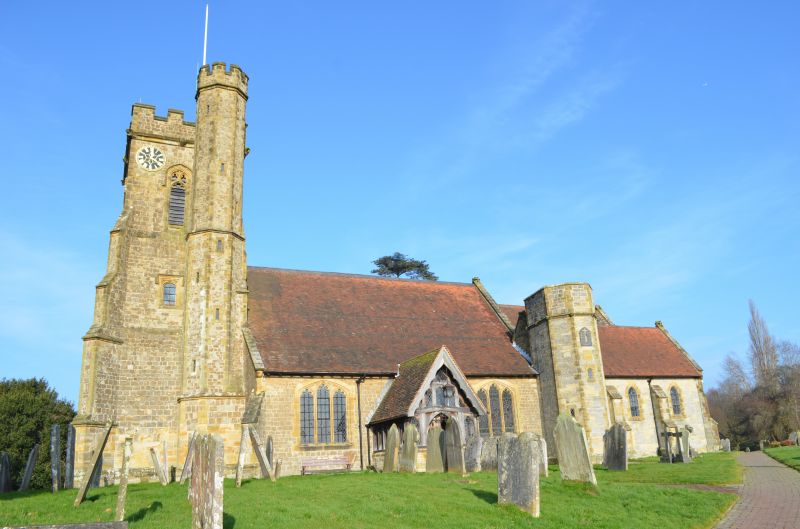
You can read about the hamlet of Wilcote here Wilcote – Wikipedia and here North Leigh – Wikipedia. And if you go here North Leigh: Manor and other estates | British History Online (british-history.ac.uk) you’ll find a lot about the history of this part of Oxfordshire, including Sir William and his wife Elizabeth.
But I still can’t find out why they were both supposedly so awful in life.
 The New Murrey and Blue blog
Leave a comment