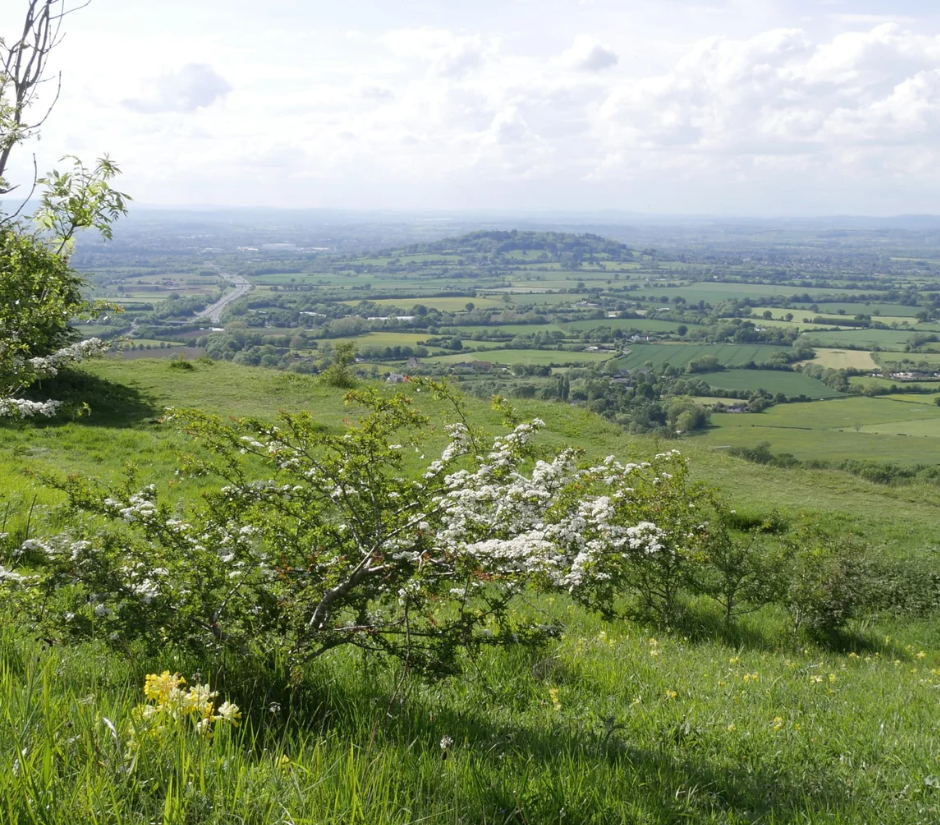
Today I’m starting way back in time before “our” period. Into the mists, in fact. I live next to the western edge of the Cotswolds (to the right of the isolated hill in the above view), and we have numerous prehistoric sites in Gloucestershire that are, perhaps, not quite as famous as they ought to be. And as indicated in this post’s title, my county also receives mentions in the historical works of the Bard. 🙄
The ancient monuments I show below are merely a sample of what’s to be found along the western edge of this part of the Cotswolds escarpment (also known as the Cotswold Edge). It’s a striking geological feature that faces over the wide vale of the Severn as that river nears its fearsome tidal estuary. It also looks toward the Forest of Dean, the Black Mountains and farther into Wales.
I began to write this post when I read this site https://www.mysteriesofmercia.com/post/the-mysterious-stones-of-avening, the opening paragraph of which is as follows:
“….The Cotswolds area of England has some of the highest concentrations of ancient sites in the whole of Britain. Stone circles, standing stones, barrows, chambered tombs, there are literally hundreds of them scattered across the region, and those are just the ones we know about. Archaeologists and historians group a lot of them together as the “Cotswold-Severn group” – although they continue to widen this net to include places in Herefordshire like Arthur’s Stone….”
Here are four of those Gloucestershire monuments.
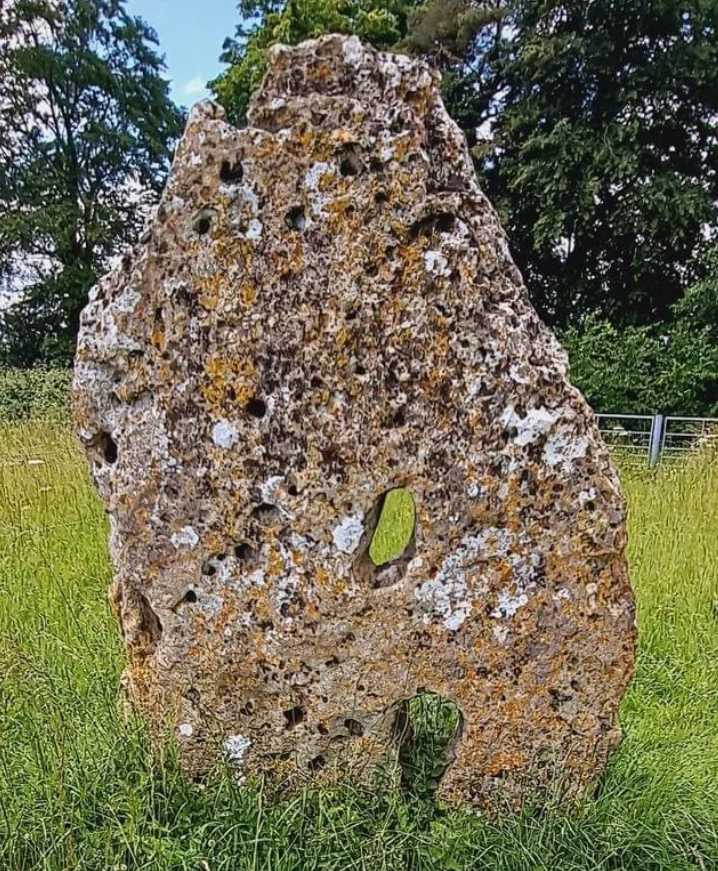
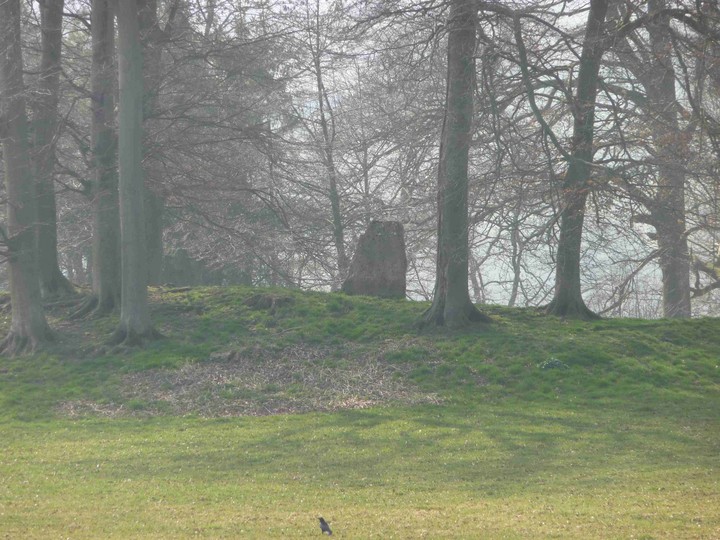
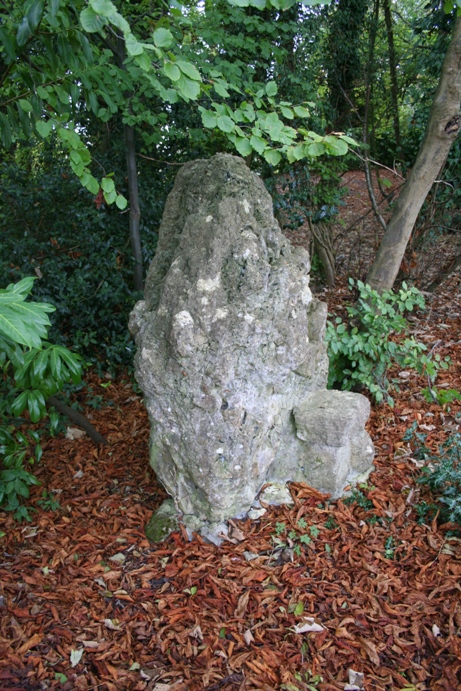
The fourth link is the Uley Long Barrow aka Hetty Pegler’s Tump, see here https://www.english-heritage.org.uk/visit/places/uley-long-barrow-hetty-peglers-tump/ .
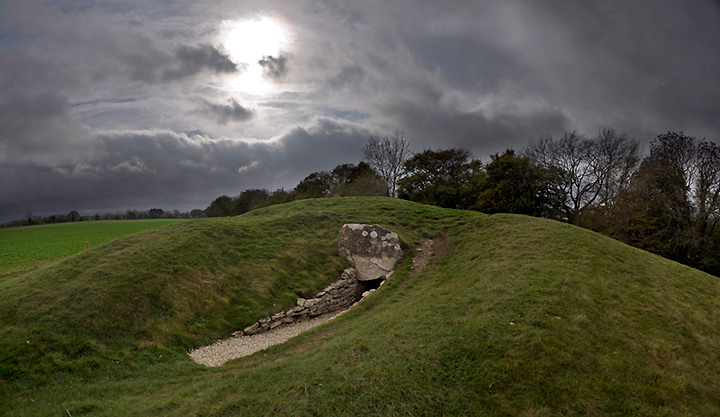
The barrow is apparently named after Hester Pegler, who owned the land in the 17th century. But perhaps it isn’t just a barrow….?
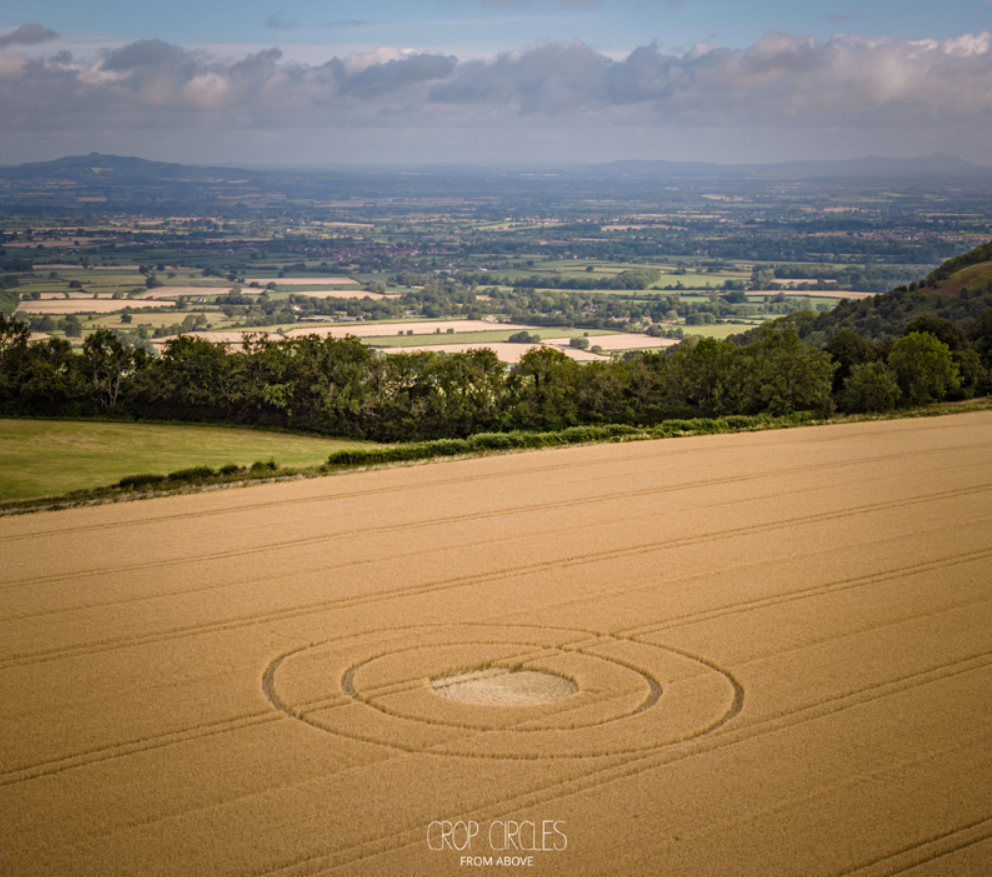
If you go here https://www.youtube.com/watch?v=rmWydPbKmsk you’ll find a video about the above crop circle and also see views that show how Hetty Pegler’s Tump is right on the lip of escarpment. Maybe crop circles are a hoax….but what if they’re real? What if there is a mysterious connection between them and sites like Hetty Pegler’s Tump? Just how far back in time might that connection reach? Or should we be looking forward in time?
I saw my first crop circle in around 1963, from a car driving over the southern Cotswolds on the way to Bath. There it was about 20 feet away, a perfect solid circle in a field of wheat sloping up from directly next to the road. No fancy tweaks, no elaborate elongated designs, just a flattened circle about 10-15 feet in diameter. I can still see it clearly today.
There are other monuments on the escarpment, of course (for example the skeletons discovered in a stone-lintelled tomb at Barrow Wake in 1879. You can read about the site here https://walks.walkingworld.com/Walk/Barrow-Wake—Buckholt-Wood—Cranham—Birdlip—Barrow-Wake.aspx).

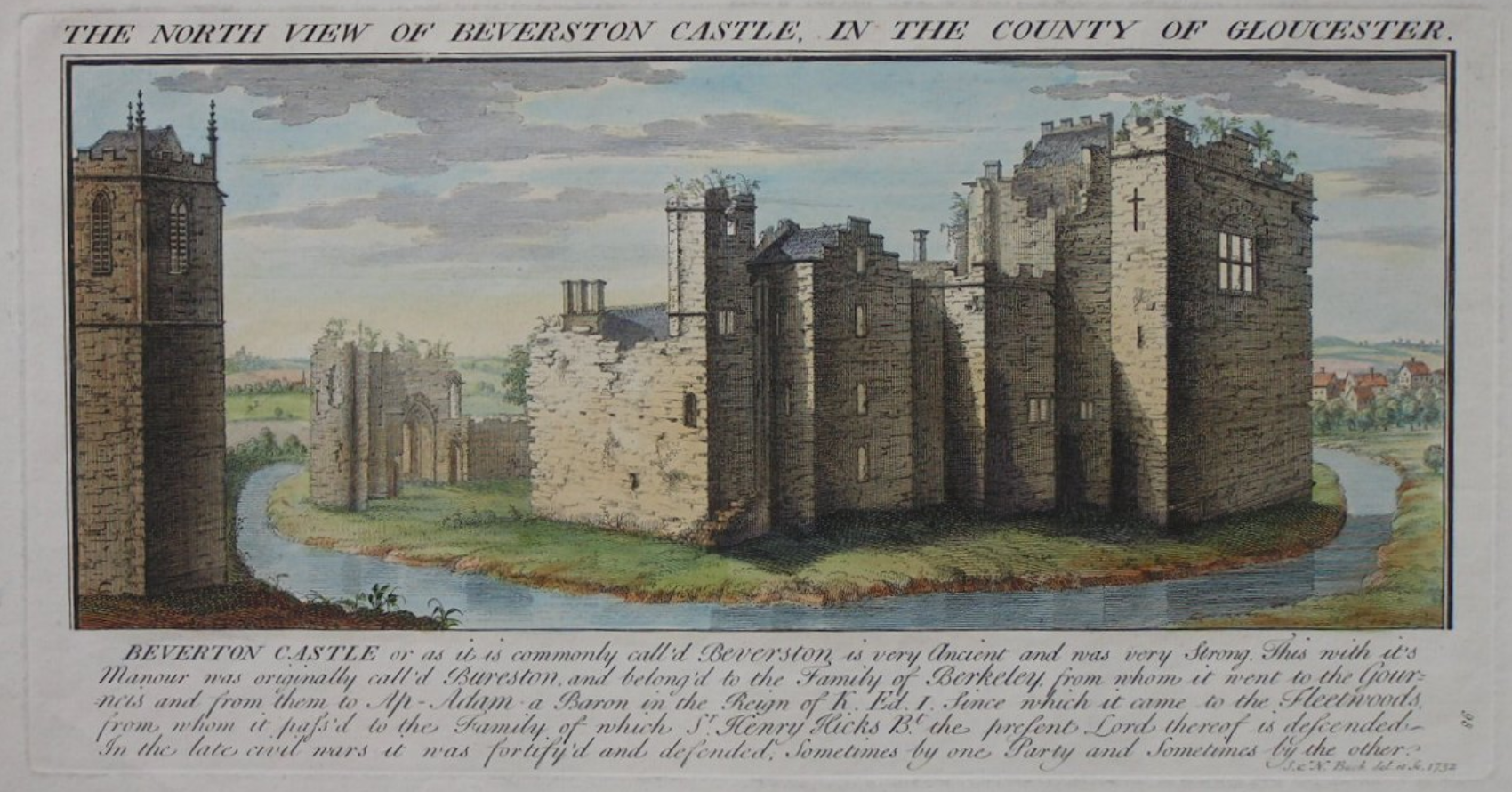
We boast a magnificent medieval castle down in the vale at Berkeley, and another, Beverstone Castle, up on the escarpment close to the village of Birdlip. See here https://wikishire.co.uk/wiki/Beverston_Castle .
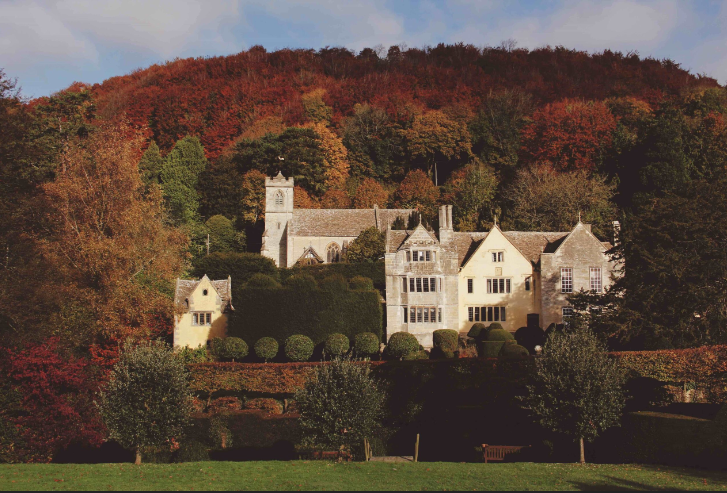
Or if spooky mansions are more your thing, we can provide those as well. Owlpen Manor is said to play host to a spectral Margaret of Anjou, who stayed there at some point around the Battle of Tewkesbury in 1471.
We also have Woodchester Mansion, but its outward appearance is a little misleading because it’s an unfinished Victorian house (see here https://www.woodchestermansion.org.uk/) It’s renowned as being very haunted indeed. Well, who knows what was on the site centuries before the mansion? You wouldn’t catch me there after dark, that’s for sure. See also here https://thelittlehouseofhorrors.com/woodchester-mansion/.

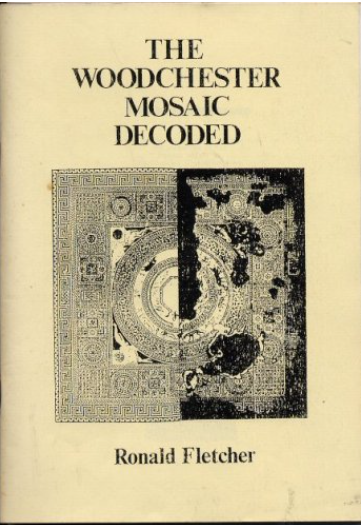
Some local lore connects King Arthur with Woodchester, and there was a wonderful Roman mosaic found there, see https://www.bbc.co.uk/news/uk-england-gloucestershire-45625115 and here https://en.wikipedia.org/wiki/Woodchester_Roman_Villa. If you go here https://www.stroudlocalhistorysociety.org.uk/people-places/people/k-arthur/ you will find a newspaper clipping about historian Ronald Fletcher and his little book The Woodchester Mosaic Decoded, which I have. Mr Fletcher is convinced of Arthur’s connection with Woodchester and the surrounding area. I’d like to think he’s right!
Now to Shakespeare’s (practically modern!) association with the area. He was acquainted with Gloucestershire and the Cotswolds, and his wider family is still here. One of my good friends, a lady from Stonehouse in the vale, was born a Shakespeare and her ancestry was traced back to the Bard’s kin.
If you go to this interesting site https://www.greatbritishlife.co.uk/magazines/cotswold/23253387.search-shakespeare-gloucestershire/ you can see how the county and medieval politics feature in the great man’s works (ahem, politics with more than a wee touch of fiction!) Richard of Gloucester/Richard III gets a good few Bardic mentions, of course (don’t we just know it? 😏) and the author of the article nominates Richard as “…my favoured historical dinner guest, as I’d love to ask him what he really got up to….” You and thousands of others, sir!
I think Richard would truthfully and vehemently deny murdering his nephews. He’d eat a large bowl of strawberries without problems, then raise both perfectly formed arms and roll his eyes in disbelief at the idiotic myth that he fought in battle (I forget which one) at the age of only two and a half! Come now, that’s going a little far. He was four at the very least! 😄
Did the Bard himself—or some of the actual people who feature in his works—ever ride past an ancient site on the Cotswold escarpment? It’s a fact that anyone who travelled from London to Gloucester would have reached the lip of the hills and then descended the steep incline to the vale, where on a good day they’d see Gloucester Abbey/Cathedral gleaming white in the sun.
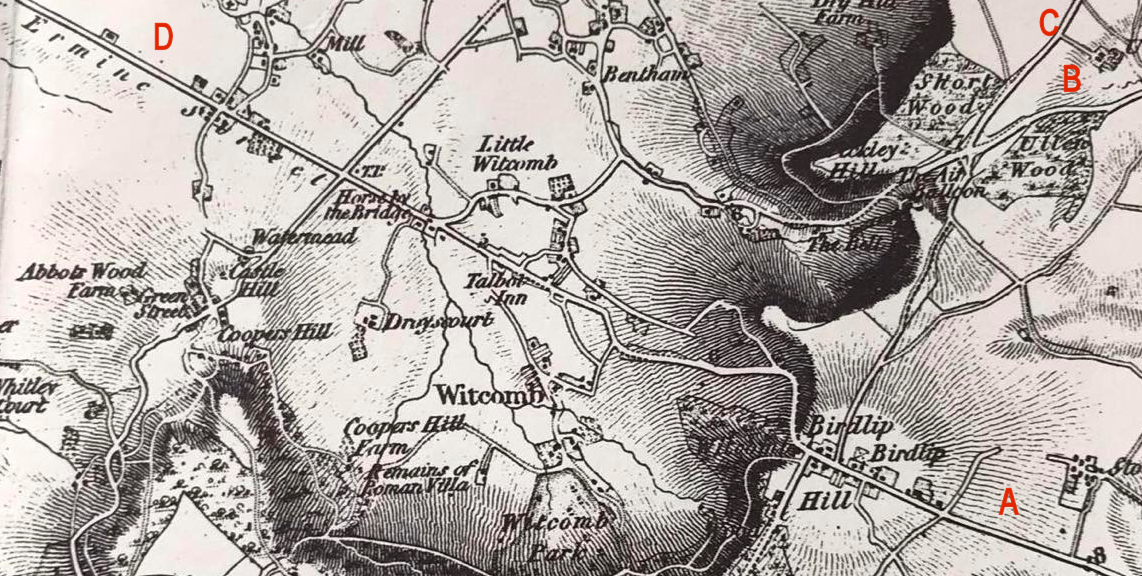
The present-day main descent to Gloucester is at Crickley Hill, see here https://www.nationaltrust.org.uk/visit/gloucestershire-cotswolds/crickley-hill/history-of-crickley-hill. This route originally catered for travellers from London through Oxford (B), and is also joined by the road to Cheltenham (C). Use is then made of a slightly easier slope down from the escarpment provided by a draw between the two adjacent hills of Crickley and Birdlip. See the above map.
The Birdlip route (A) came about because the Romans built one of their major roads, Ermin/Ermine Street, between Cirencester and Gloucester. For this Birdlip provided the desired straight line. (see https://travelcotswolds.com/birdlip-a-village-soaring-with-beauty/) Crickley Hill would have meant a detour.
Whichever route you travelled, in 1698 both were classed as turnpikes and on reaching the foot of the escarpment the roads became one anyway.
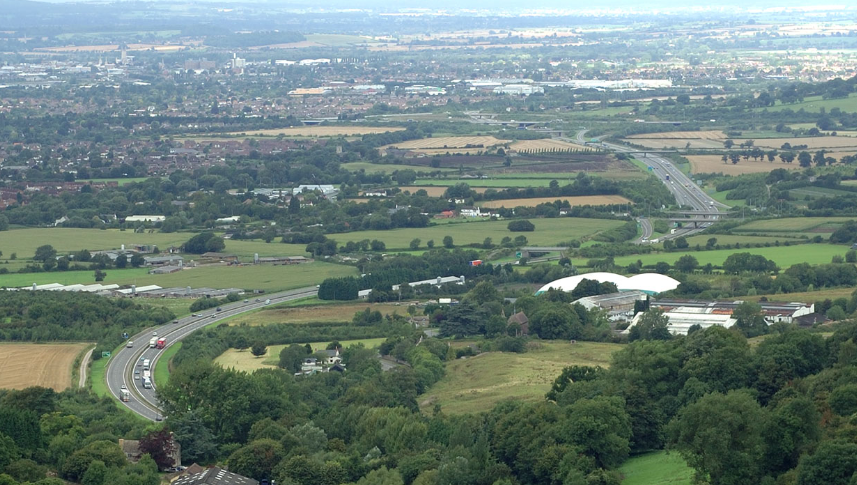
As medieval travellers from Cirencester reached Birdlip the precipitous descent must have had them praying for good conditions. That incline is steep! Heavy rain would mean rushing rivulets, worsening ruts in the road and a lot of slippery mud. Low temperatures meant ice, rock-hard ruts, and snow too…. Travel wasn’t an easy business back then.
When they neared the bottom they wouldn’t have known they were passing the site of a yet-to-be-discovered Roman villa. (See here https://www.english-heritage.org.uk/visit/places/great-witcombe-roman-villa/history/).
Did they glance back at the escarpment because of sensing the presence of the many ancient stones and other monuments of their forefathers? Did the air currents playing around the hilltops carry soft whispers from an infinitely more distant past?
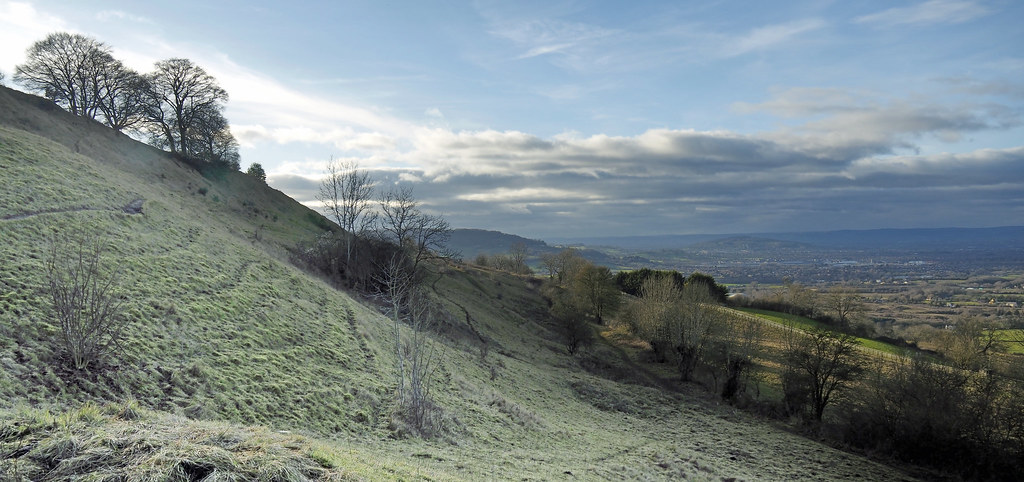
Whatever their thoughts, the descent was a hazardous and wearying experience in the eras of Richard III and the Bard. Gloucester’s many hostelries would have been very welcome indeed. Very welcome!
Richard III’s reputation suffered greatly because of Shakespeare’s brilliance, but our king would certainly have been greeted gladly by the people of Gloucester. He was, after all, our duke and as king he had granted our city its charter. He was Richard III, King of England and Duke of Gloucester!
PS: Since writing this post I have come upon the following article, which also deals with the ancient monuments of the Cotswolds, with splendid aerial photographs: https://www.greatbritishlife.co.uk/magazines/cotswold/24525561.stunning-aerial-photography-ancient-cotswold-landmarks/

 The New Murrey and Blue blog


Leave a comment