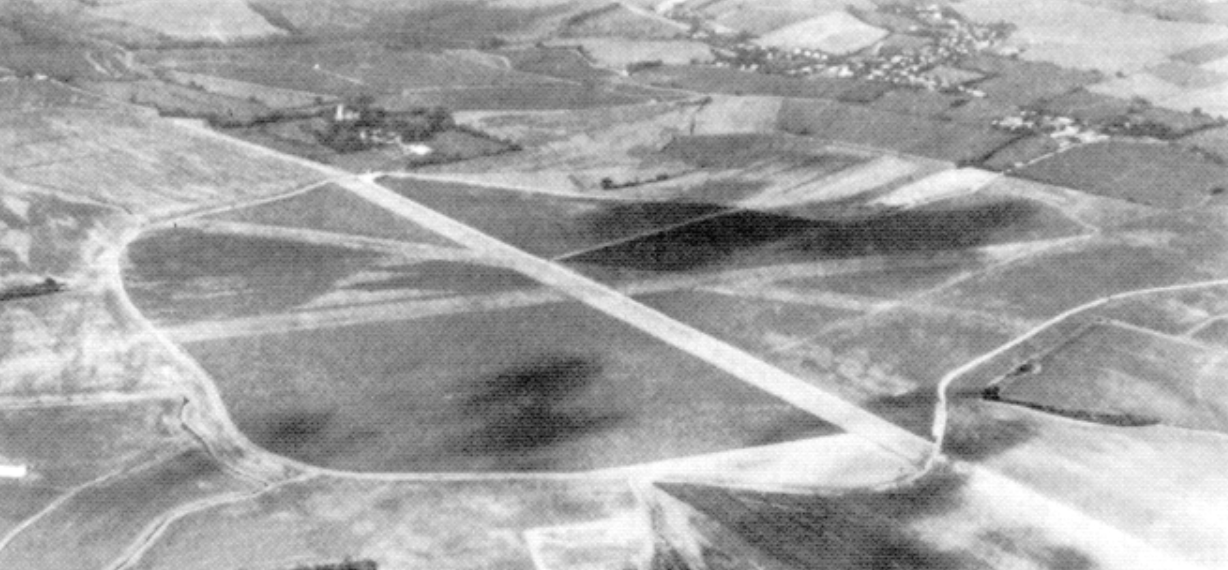
Castle Camps in Cambridgeshire is probably best known today for its World War II RAF airfield, and the heroic squadrons that operated out of it.
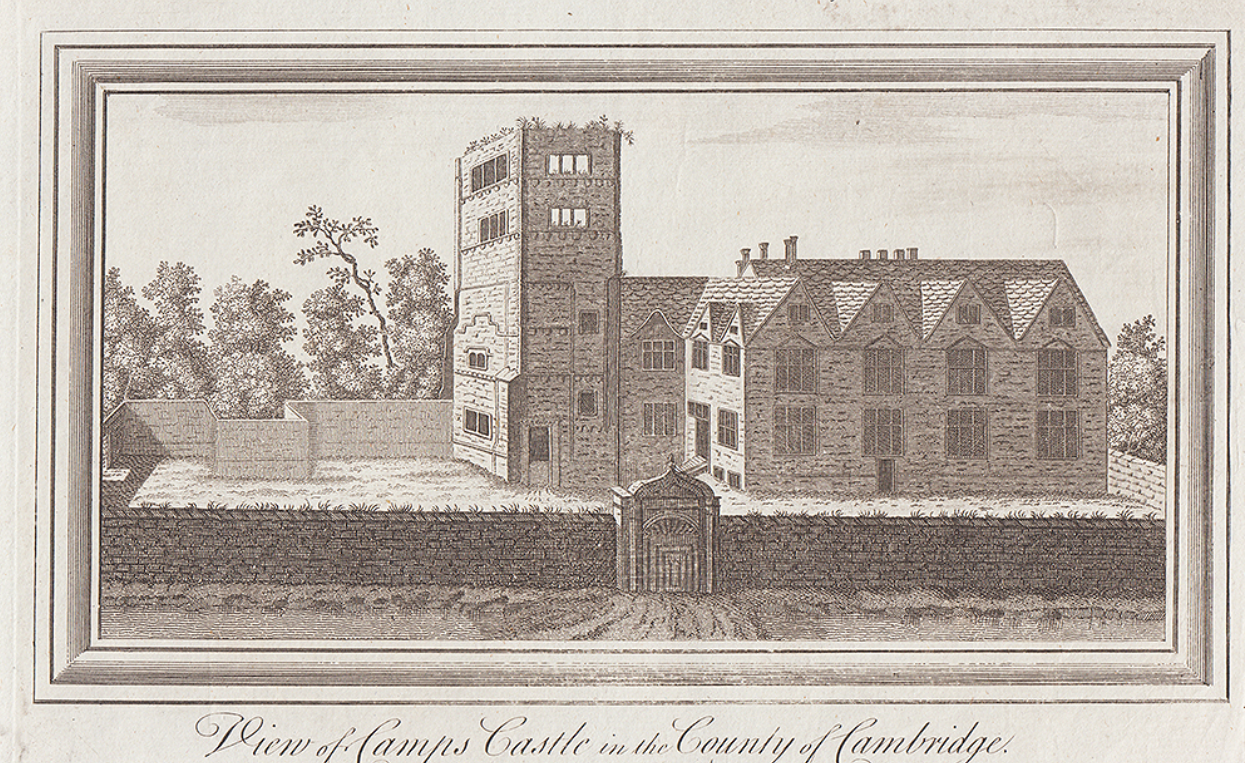
There is certainly little sign now of the castle from which the Cambridgeshire village of Castle Camps acquired its name. If you go to this link you’ll read: “….The village is known for its historic castle ruins, which date back to the 11th century. The castle was built by the Normans and was used as a stronghold during the medieval period. Today, the castle ruins are a popular tourist attraction and are open to the public….” They are now a scheduled monument.
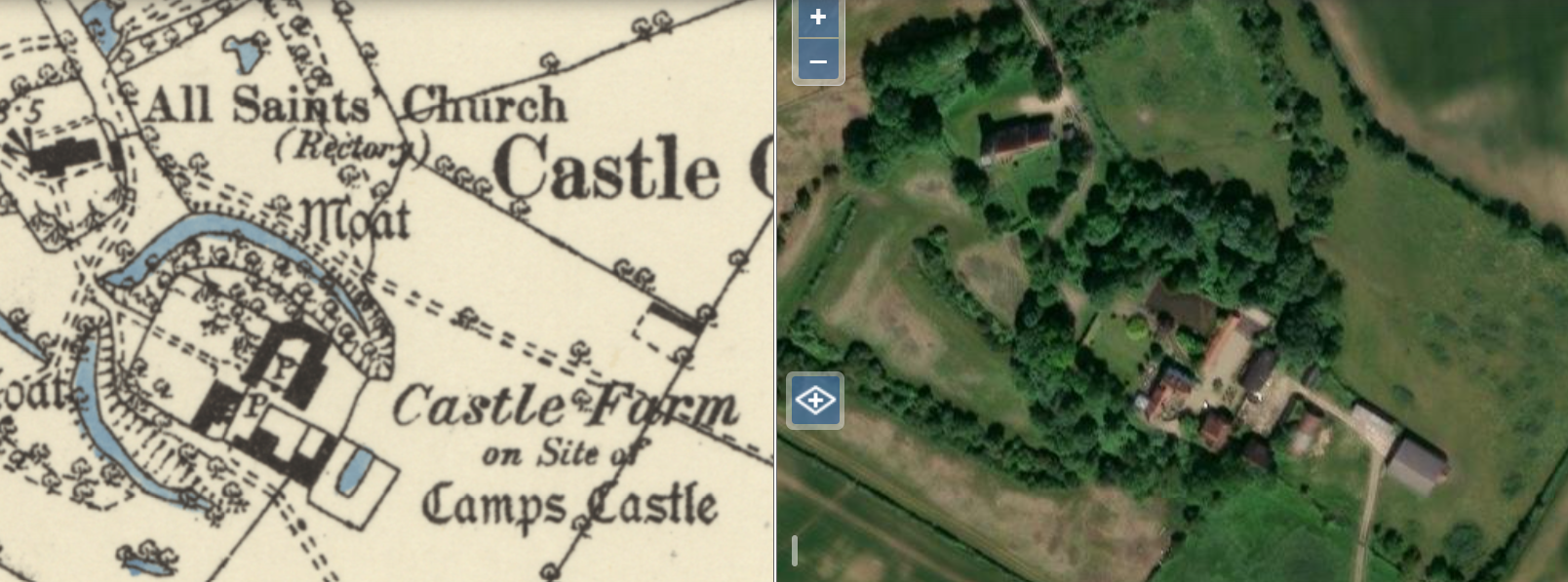
The ruins mentioned in the previous paragraph are described elsewhere as “….a piece of rubble in the yard to the South of the present farmhouse….” There’ll be more to be found under the ground, of course, but to all intents and purposes the castle at Castle Camps has disappeared. I haven’t been able to find a photograph of this rubble. The farm in question appears to have been known as Castle Farm, although I don’t know if it still is. See the map/aerial image below:-
The castle site began as a Saxon manor belonging to Wulfwin, one of Edward the Confessor’s Thanes. Two years after the 1066 invasion, the holder of the first Norman castle was Aubrey de Vere, from whom the Earls of Oxford were descended. The earls were at first known as the Earls of Oxenford.
In the 15th century the de Veres were Lancastrian supporters, and when the Yorkist king Richard III came to the throne he seized de Vere property, including Castle Camps. And so he should! The House of Lancaster had come to power due to the usurping regicide Henry IV, and it continued to cling to power through the House of Tudor, whose Beaufort ancestors had been illegitimate! It was the House of York that had the right to the crown and won it from the Lancastrians, so if the Yorkist Richard III seized de Vere property, good for him!
But there had been a little more to Richard of Gloucester’s connection with Castle Camps, as can be read here: https://www.british-history.ac.uk/vch/cambs/vol6/pp36-48 “….In 1388 it [Castle Camps] was briefly forfeited by the attainder of Earl Robert, (fn. 59) but was restored in 1393 to his uncle and heir Earl Aubrey. (fn. 60) When Aubrey’s grandson Earl John was executed in 1462 the manor was granted to [the then 10-year-old] Richard, duke of Gloucester, (fn. 61) but was restored in 1463 to John’s minor son and heir John. (fn. 62) Following the latter’s attainder in 1471 Castle Camps was again granted to Gloucester (fn. 63) who, as Richard III, granted it in 1484 to Sir Robert Percy. (fn. 64) Earl John was again restored in 1485, (fn. 65)….” So it was held by Richard from 1471 until 1484. The de Veres were then back in favour as soon as Henry Tudor usurped Richard’s throne.
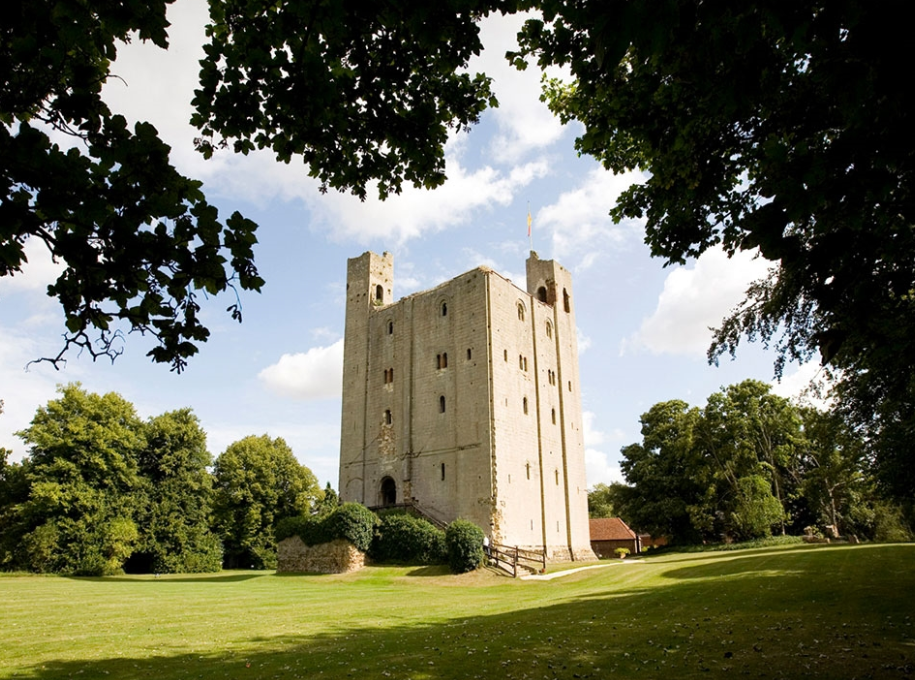
To return to the Norman baron Aubrey de Vere, we find that he had many holdings and that his family’s main seat at Castle Hedingham can still be visited, see here https://www.hedinghamcastle.co.uk/visit. A lot more of Castle Hedingham can be read here: https://www.british-history.ac.uk/rchme/essex/vol1/pp47-61.
It’s believed that from among his estates he chose to build a castle at Castle Camps because of it “….being mid-way between his chief seat at Castle Hedingham (and there is evidence to suggest an underground tunnel connected the two Castles), and Cambridge, on the N.W. slopes of the Eastern Ridge….” See https://www.tntcarden.com/tree/ensor/CastleCamps.html.
A secret tunnel? Oh, how often do we hear of such things. If they all existed there’d be a veritable rabbit warren beneath England’s surface. We’d be forever falling through the crumbling roof of one or another. Now, I’m prepared to believe there were indeed many such underground passages providing handy escape routes, but I can’t believe all of them. I started reading about secret tunnels in my Enid Blyton days. They were fictional and the haunts of smugglers, spies, robbers and all manner of ne’er-do-wells who were trapped and caught by Blyton’s plucky child-detectives, but now I can’t shake off the suspicion that far too many of the tunnels claimed today are also fictional. Jaundiced? Moi?

Well OK, I concede that I’m being something of a party-pooper here. If Aubrey did have a tunnel constructed between Castle Camps and Cambridge, and there’s evidence of this, as mentioned in the tntcarden.com link above, what is that evidence? According to this following link http://www.shanty.co.uk/castlecamps/castle.htm, in June 1744, during one of the incarnations of the castle site “….when digging in a cellar at the East end of the house, many coffins and bones were found, which led to the supposition that the cellar had been a vault. Also in the cellar were found a blocked-up arch, said to have led to the tunnel….” Could this cellar have once been a castle vault?
The phrase “said to have” is always a little iffy. Was there a tradition that the arch led to the tunnel? Or did someone know it did for certain and simply confirmed the fact in June 1744? What’s more, is this blocked-up arch the above-mentioned evidence for the tunnel? According to this book, Cambridgeshire Village Book (Villages of Britain S.) : Cambridgeshire Federation of Women’s Institutes: Amazon.co.uk: Books, “Evidence is hard to establish.” No kidding!
A blocked-up arch doesn’t sound as if the entrance was a secret. To be secret there’d have to be some attempt to hide where the tunnel began, not simply fill the entrance leaving the arch clearly visible. A new false wall would do it.. The same at the other end in Castle Hedingham. But I can’t find anything more about the tunnel.
Next, why would Aubrey have a tunnel created? But wait a moment, I’m rushing ahead of myself. Was it Aubrey who built it? There’s no hint of the age of this blocked-up arch, I simply think it’s to do with Aubrey. But he was only the first Earl of Oxford who might have been responsible. Ownership of both Castle Camps and Castle Hedingham would seem to have been a necessary requirement for a tunnel between them, and the de Veres certainly did possess both. Such a tunnel could therefore have been built at any time during the de Veres’ more than 500-year tenure.
And why a tunnel at all? Being halfway between Castle Hedingham and Cambridge would surely mean it would be quicker to travel overland between the two than underground! According to Google Maps, as the crow flies and travelling via Castle Camps, it’s somewhere around twenty-two miles from Castle Hedingham to Cambridge. About twelve of those miles are from Castle Hedingham to Castle Camps. Mileages are approximate.
My questions mount. Twelve miles is a l-o-n-g tunnel. How high was it? High enough to be walked along? Or for horsemen? From whom was it concealing those who used it? In Aubrey’s time the Normans were well and truly in control of the realm, so the only foes must have been the local populace. Unless, of course, Aubrey had upset some among his own kind?
Did Aubrey have enemies? Well, he doesn’t seem to have peeved any more lords than had other Norman baron. According to this link https://en.wikipedia.org/wiki/Aubrey_de_Vere_I “….[Aubrey and his wife were] accused by Domesday jurors of expansion into Little Maplestead, Essex. Aubrey’s seizures or questionable right of possession to estates included Manuden, Essex; Great Hemingford, Huntingdonshire; and Swaffham, Cambridgeshire. (Counties given are those of Domesday Book.)….” Would this be sufficient to prompt the precaution of a twelve-mile tunnel? Somehow I can’t think so, but then I can’t possibly comment knowledgeably across so many centuries.
I found the following link, https://eprints.oxfordarchaeology.com/5035/. It mentions an archaeological dig at Manor Farm in October 2000. Manor Farm is on the site of the former castle. “….Six trenches were monitored and recorded across the site to determine the presence or absence of archaeological remains. The subsequent investigation of the trenches revealed archaeological features in only one trench, located close to the modern farmhouse, which contained some of the wall foundations of an earlier 15th century brick building on the site at Castle Farm. No other archaeology was observed in any trenches and this appears to confirm that the top of the motte was demolished during the 15th and 16th centuries ahead of the construction of the later medieval buildings. No traces of the medieval castle or fortifications survive….” No rubble? No mention of a cellar where a blocked-up arch might have been? Or would that be a different farm? And if the top of the motte was demolished in the 15th/16th century, it can’t have affected the cellar and blocked-up entrance which were extant in 1744. So were they constructed post-16th century?
Without any more information about the tunnel, not even a photograph/drawing/description of the blocked-up arch, I’m done for. “Aubrey’s” tunnel and the reason it was built must remain a mystery.
One thought though, was it there during the periods when Castle Camps was in Yorkist hands? Did they know about the tunnel? Might it even have been Richard who ordered the entrance to be blocked? We’ll never know, I fear, and I confess that my grey cells have been known to ramble a little…. Yes, truly they have. 🙄
The River Granta, a rare chalk stream connected to the River Cam, flows close to the west and south of the castle site, and can be read about here https://www.wildtrout.org/news/good-for-the-granta-river-habitat-project-in-cambridgeshire. You can read more about Castle Camps here https://en.wikipedia.org/wiki/Castle_Camps, and about the de Veres here https://www.houseofvere.com/.
 The New Murrey and Blue blog
Leave a comment