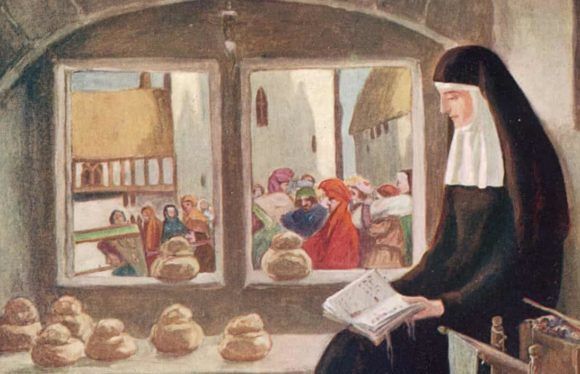
Recently I wrote about Richard Beauchamp, 13th Earl of Warwick, Henry VI and the anchoress Emma Roughton of All Saints-North Street York, see here (https://murreyandblue.org/2024/09/11/the-13th-earl-of-warwick-henry-vi-and-the-anchoress-of-all-saints-york/). It was intended to be a single stand-alone post….until I realised there was conflicting information about the whereabouts of Emma’s cell. It wasn’t important, exactly, but something about it soon had me chasing around in ever decreasing circles, so I’m writing about it separately.
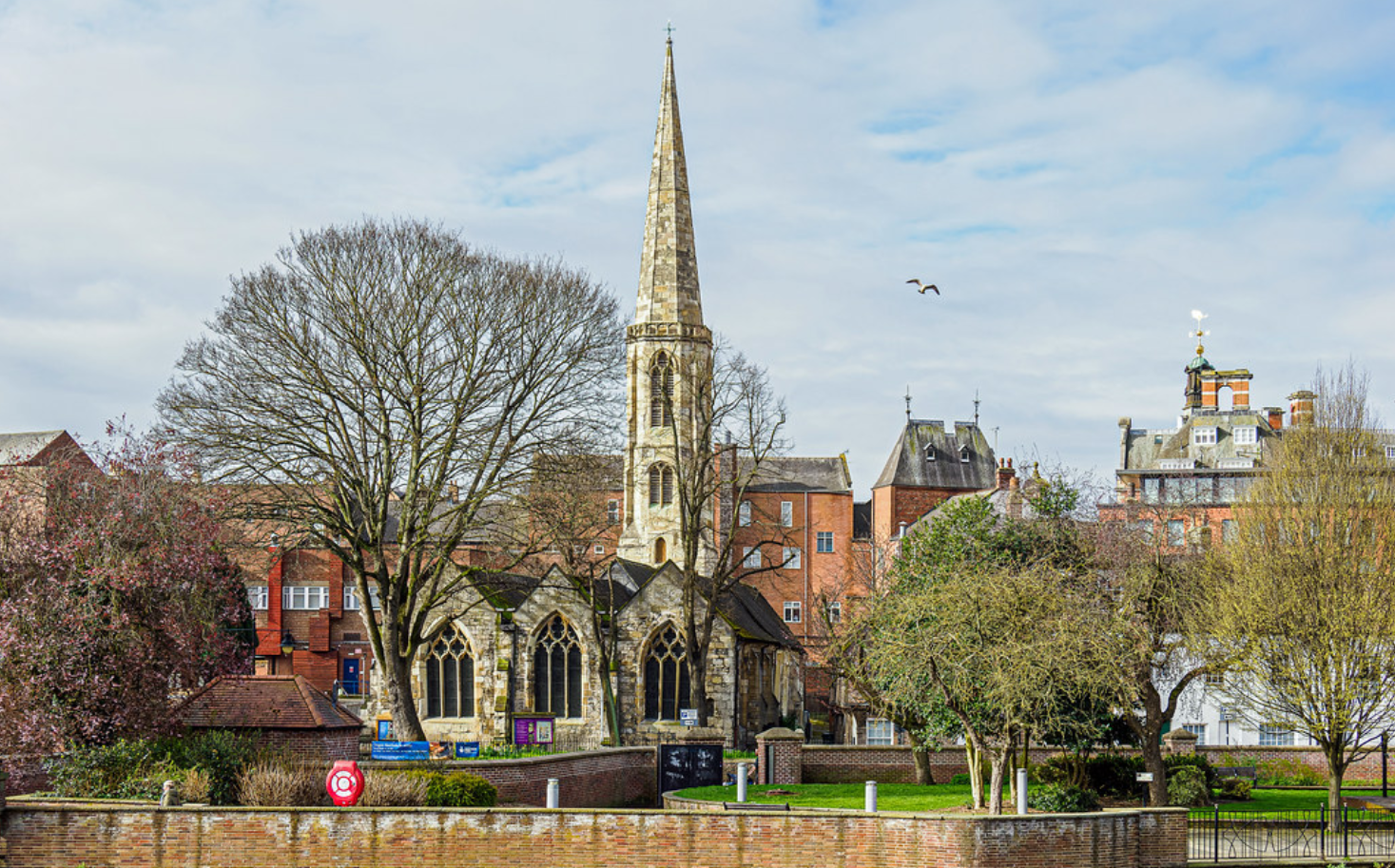
To begin with, in the previous post I quoted this link https://www.mysteriousbritain.co.uk/ancient-sites/early-christianity/the-parish-church-of-all-saints-north-street-york/ in which Emma Roughton’s cell is described thus: “….The anchorhold [cell] at All Saints North Street had two stories and was in the churchyard adjoining the west end of the north aisle and one of the squints or small windows she used to witness mass can still be seen….”
That seems clear enough, right? The same description is repeated elsewhere….Emma’s cell was in the churchyard, abutting the west end of the north aisle.
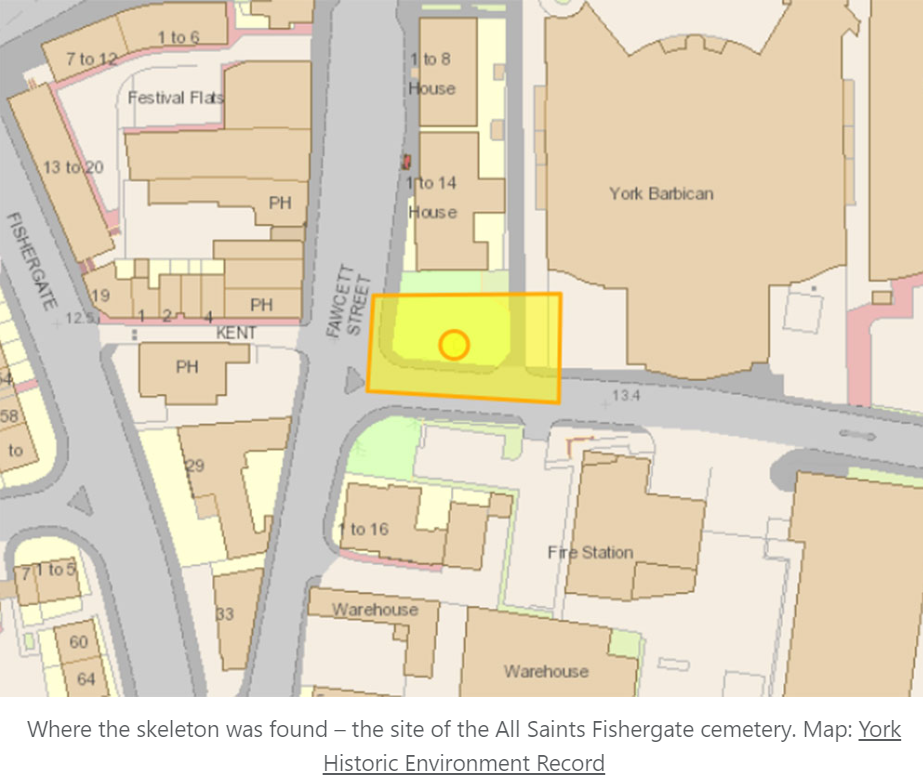
Well, my problem began with discovering there were two anchoresses at All Saints, each with a cell of her own. If you go here https://www.bbc.co.uk/news/uk-england-york-north-yorkshire-64571638 you can read about the discovery of the skeleton of the anchoress Lady Isabel German. Hers “….was one of 667 complete skeletons discovered in a dig at the site of a former church [All Saints] at the York Barbican….The skeleton was found in the apse of the church foundations, a small room located behind the altar, where only clergy or wealthy people were buried….” There are links to more about Isabel at the end of this post.
I haven’t seen the BBC 2 Digging for Britain episode referred to in the bbc.co.uk link above, so I can’t comment on it further, but I was a little perplexed, because the medieval All Saints that I been concerned with (but haven’t visited) is definitely not a former church. It’s very much still here and flourishing.
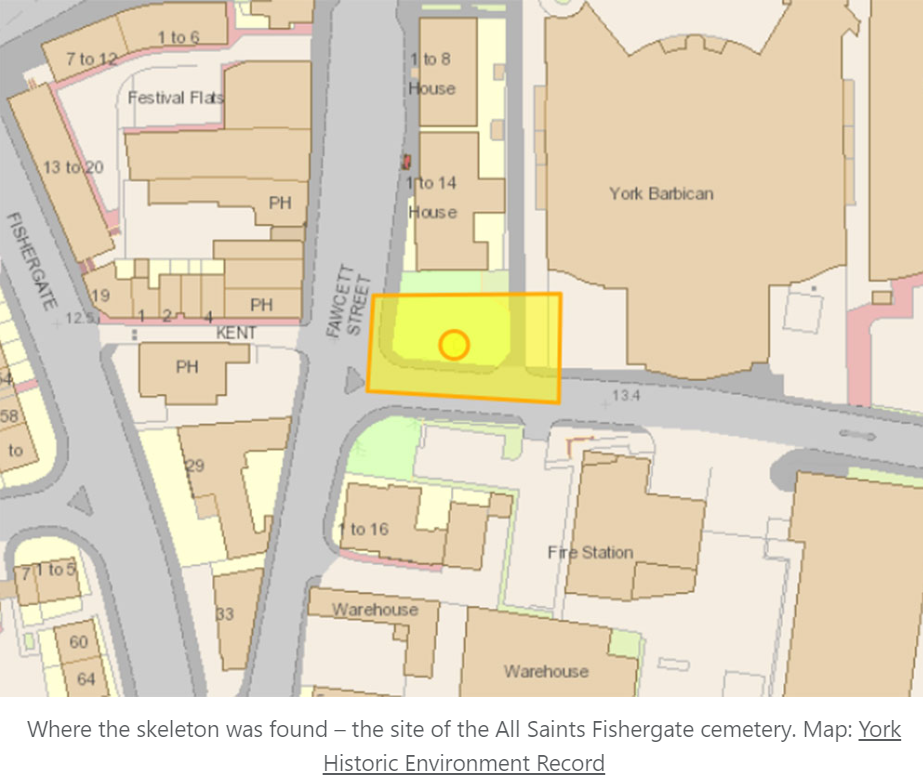
But there’s more than one All Saints church in York, including one that’s now disappeared from it’s site across the Ouse from North Street. Turning to https://www.british-history.ac.uk/vch/yorks/vol3/pp106-107 revealed that from the 11th century there had been an All Saints Priory Church for Benedictine monks, but it is no more. It stood at Fishergate (see street plan above). The present All Saints in North Street dates from the 13th century. It was at the site of this long-gone priory church that Lady Isabel’s remains were identified among hundreds of others. She died 31 August 1448.
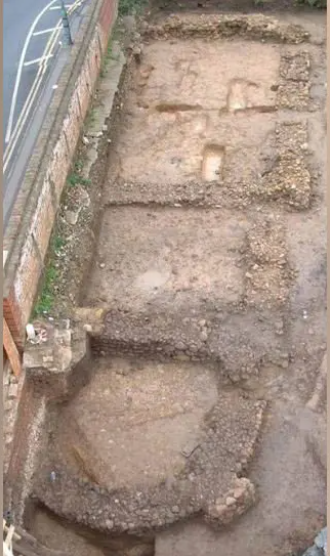
I’m quite relieved that Isabel was at this second church, because I’d been trying to pinpoint the cells of both anchoresses in All Saints-North Street. A wild goose chase when only one of them was ever there! But if you read on from here, you’ll perhaps understand why, even though I now knew there were two churches, each with only one anchoress, I was still unclear about the who, what and where of it all. Emma Roughton’s cell would prove elusive.
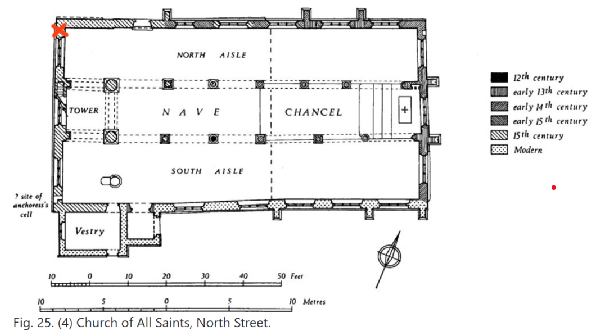
Despite Emma’s cell being described hitherto as overlooking the north aisle (see the red X on the floor plan below), there’s another cell in the church, but it’s overlooking the south aisle and it too is associated with Emma. The author of the floor plan has drawn it in the bottom left corner. Emma would only have one cell, not two!
As you can read here https://www.british-history.ac.uk/rchme/york/vol3/pp3-48: “….The W. wall is of one build with the rest of the W. end; the three-light window has vertical tracery. At the S. end internally is a small oblong opening with chamfered reveals; beyond is an archway with a four-centred head. High up in the wall is another small opening like the first. All three were probably associated with the cell of the anchoress mentioned in 1430….” In 1430 Emma was mentioned in a will, so this south end cell must be associated with her. If so, what happened to the cell that supposedly overlooked the north aisle, of which, incidentally, there doesn’t seem to be any sign today.
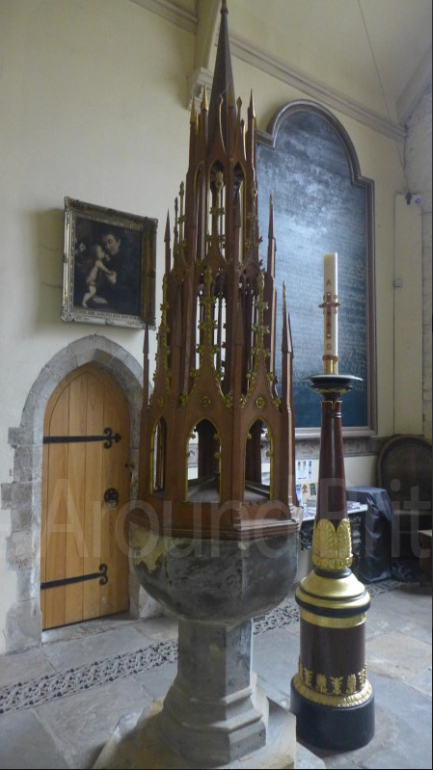
But features have been reconstructed or moved around in the church, and that’s a problem for me. This link https://allsaints-northstreet.org.uk/wp-content/uploads/SOM-talk-april-07.pdf tells that the south-aisle cell was reconstructed circa 1910 in roughly the same place as its medieval counterpart. It has more than one squint/peephole, the differing heights for which suggest two storeys. So it’s “roughly” in its original position. What, exactly, does “roughly” mean? How much of a margin of error was allowed? And the reconstructed cell is “probably” smaller than the original. Then there’s the medieval door of the Victorian sacristy/vestry (see the last picture below) which [door] was taken from its original place and rebuilt where it is now. Where was it originally? “….Archaeological evidence indicates that the doorway was not external, and so perhaps it was the door into the anchorhold, or into a servant’s antechamber….” So what else might have been moved around or rebuilt?
If there was rebuilding/reconstruction work in 1910, had it been decided that the north-aisle cell would be better placed by the south aisle, close to where the Victorian sacristy/vestry is now? Hmm, but then it would be stretching it to say the reconstructed cell was “roughly” in its original position. The opposite end of the west wall isn’t roughly, it’s a complete repositioning on the other side of the church!
So which, what and where? East, west, north, south….I’m more and more confused. What’s going on with these squints and cells in All Saints-North Street? Is my hopeless state of bewilderment self-inflicted because of my relative ignorance of the finer points of church architecture? Or have the writers of these sources confused themselves as well as me?
Enough already! Where is/was Emma Roughton’s cell? I decided to go straight to the horse’s mouth. No, not the lady herself (although she would indeed have the definitive answer) but another part of the All Saints-North Street website at https://allsaints-northstreet.org.uk/our-lady-of-north-street/. I found the following:- “….The cult of Our Lady and the focus of that devotion at an image in All Saints is no new thing. From the late Middle Ages her cult was focused on her statue in the ‘lady quire’ or Lady Chapel of the church, which was situated at the east end of the north aisle….” I know this refers to the east end of the north aisle not the west, but might it explain the references to a cell on that aisle? Was the statue placed on the north aisle because of Emma’s cell and visions having been there? Conjecture, I know, but I’m scratching around here! Perhaps a shrine would be situated in that particular position anyway.
And then:- “….There is another important angle to consider when evaluating the devotion to Our Lady in All Saints. In the 1420’s and 1430’s a dwelling attached to the church was the home to Dame Emma Raughton, an anchoress or hermit, who received visions of Our Lady. Emma’s house was probably a two-storied building attached to the west end of the south aisle with openings called squints that allowed her to view the interior of the church and to hear mass at the altars. These squints are still visible and one was re-opened in the early twentieth century when Father Pat Shaw employed Ridsdale Tate to reconstruct Emma’s house. Emma lived in the church for quite sometime, she was there in 1421 and was still resident in the church in 1430, when John de Richemonde gave twelve pence in his will to ‘Emma, an anchoress in the parish of All Saints’….”
I’ll take the horse’s word for it. Those at the church should surely know what’s where in their own church. I realise there’s another “probably” in the extract, but the position of the squints/peepholes looking onto the south aisle is definite enough. Emma’s cell was on the west wall, by the south aisle, bottom left of the floor plan. It has been reconstructed, but can still be seen more or less where it always was, and its original doorway might now be the one to the sacristy/vestry. Period. Mystery solved. Well, as much as it’s going to be. I hope.
But the descriptions of her cell abutting and overlooking the north aisle continue. They seem to have taken root, a little like the maligning of Richard III, although not on such a huge scale. But then, she wasn’t a betrayed monarch and hasn’t been mauled by Shakespeare, More and the collective guilty conscience of the entire House of Tudor and its toadies!
WHY does this contradiction persist? Have I been misreading the whole north aisle thing incorrectly from the outset? If so, please let me know, because I can’t get to All Saints-North Street to see it all for myself.
If you go here https://seearoundbritain.com/venues/sarah-the-shrine-parish-church-of-all-saints-north-street-york/pictures you can see a great many excellent photographs of the church, both inside and out. And the following article is very interesting and detailed https://www.british-history.ac.uk/rchme/york/vol3/pp3-48.
You can read more about the discovery of Lady Isabel’s skeleton here https://yorkmix.com/extraordinary-identity-revealed-of-human-remains-found-at-york-barbican/ and here https://www.ancientpages.com/2023/02/07/mysterious-skeleton-of-unusual-lady-anchoress-of-york-barbican-discovered-by-archaeologists/
To learn more about anchorites/anchoresses in general try https://www.thecollector.com/medieval-anchorites-immured-walled-up-alive/.
 The New Murrey and Blue blog


Leave a comment