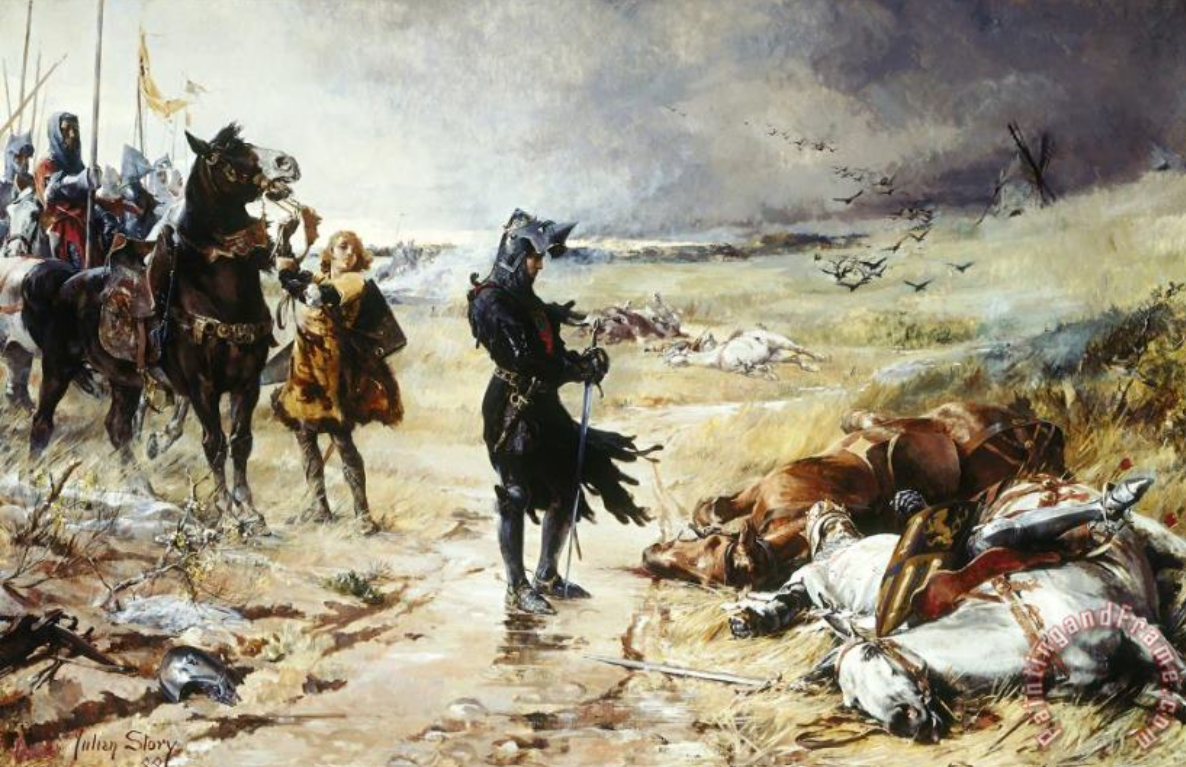
There are all sorts of stories about why Edward of Woodstock, Prince of Wales, was called the Black Prince, from the colour of his armour to his reputation as a ferocious warrior and the grim expression on his face. I’ve also read that it wasn’t a name given to him until well after his death.
Which is correct? Well, I have now come upon the version that is known in the area of France close to the site of the Battle of Crécy, which took place today, 26 August, in 1347. You can read about it here https://www.britishbattles.com/one-hundred-years-war/battle-of-crecy/. It was at this battle that the prince, aged only sixteen, first displayed his immense martial talent.
According to page 13 of Memorials of the Most Noble Order of the Garter by George Frederick Beltz:-
“….At the Battle of Cressy, which was fought on the 26th of August following [the landing of Edward III and his forces at La Hogue on 12 July 1346] king Edward, desirous that his noble son should ‘win his spurs’ gave him the command of the van, with the counsel and assistance of the earl of Warwick and sir John Chandos. The tradition near the spot is, that the king had ordered the prince to wear on that day a black cuirass, richly ornamented; and that, from this incident, he retained the surname attributed to him in history*. The defeat of the enemy is known to have been complete; and the delighted father, embracing his son on the field of victory, eulogised his valour, and pronounced him worthy of empire….”
*Histoire d’Abbeville by F-C Louandre, page 131.
According to Merriam Webster, a cuirass is “….a piece of armour made originally of leather and covering the body from neck to girdle especially : one consisting of a coupled breastplate and backpiece —usually used in plural<a pair of cuirasses>….”
So it was the colour of his armour after all. Wasn’t it?
For a very informative discussion of who, why, where and when the name Black Prince came into being, go to https://en.wikipedia.org/wiki/Edward_the_Black_Prince, which does include the Histoire d’Abbeville story that prompted me to write this article.
Footnote: Although the battle of Crécy itself took place on 26 August 1346, the presenting of the cuirass by Edward III to his son seems as likely to have happened the previous month, on 12 July, when the English army came ashore at Saint-Vaast-la-Hougue. On landing the king knighted his son and other young noblemen. This seems to me to be an ideal moment to give the special cuirass. But then, so does the day of the battle itself. But I felt I should mention the possibility of Saint-Vaast-la-Hougue.
The late owner of this site, Stephen Lark (Super Blue) scheduled this post for today during his illness.
 The New Murrey and Blue blog
Leave a comment