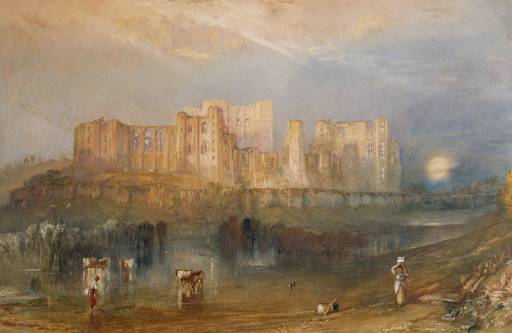
Recently English Heritage have been doing some work around the perimeter of Kenilworth Castle, proving accessibility for visitors. While doing so, they stumbled upon eight medieval stone shot, fired from catapults or trebuchets, at the famous Siege of Kenilworth, which took place on June 25, 1266. The stones were of varying sizes and weights, one being a whopping 105 kg (231 pounds!) and could have come from either the defenders or attackers, as both had a number of engines hurling them at each other.
The Siege of Kenilworth took place during the Second Barons’ war the year after Simon de Montfort‘s death. De Montfort’s loyal supporters refused to give up the castle and surrender to the King. Henry attempted to negotiate, but when he sent a messenger to the castle, and got only the poor man’s severed hand in return, he knew the time for talks was long past.
The royalist forces gathered and marched to Warwickshire, but unfortunately the delay in getting there enabled the large garrison of Kenilworth to stock up on supplies. They also had obtained their own engines to fire missiles on those gathered outside the walls.
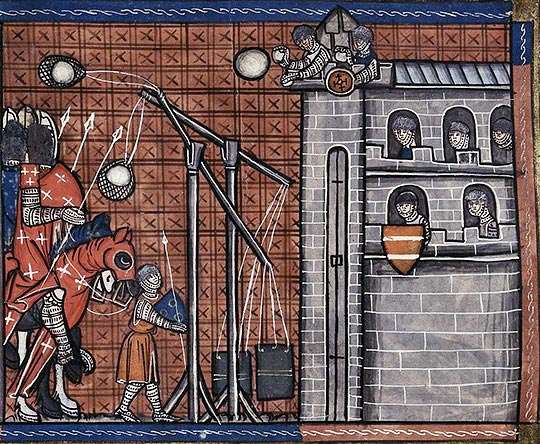
Henry’s forces did not come unprepared themselves–they had six siege engines, masses of hurdles, wooden towers, and 60,000 crossbow bolts.
The battle took place on a warm June day, the King’s engines hurling shot constantly at the walls in a constant stream. The garrison retaliated with their own engines, some of which were of a design not seen before, and these seemed superior to those of King Henry. The shot from both sides clashed and collided with thunderous noise in mid-air…and one of the garrison’s missiles smashed down one of Henry’s wooden siege towers, which contained 200 crossbowmen.
Henry decided to try a different tactic, to approach by water (the castle back then had a huge lake around it) in a series of barges. That, too, failed under bombardment from the walls.
By October, the garrison was still inside the castle and Henry and his sons, Edward and Edmund, increasingly concerned about the situation. If the King could not take the castle, it would destroy his kingly authority which had already been dinted by de Montfort. So, he called a parliament near the castle where he offered the defenders peace terms. However, the garrison thought the terms too harsh and refused to surrender.
Six weeks on, the end came, not through new engines and assaults, but through starvation and illness. The garrison surrendered and were allowed to leave with only their weapons, harness and horses. There was only food left for two days in the castle’s stores.
The castle was now firmly in royal hands, although it came at a hefty price. The siege was so expensive Henry had to pawn the jewels from Edward the Confessor’s shrine in order to pay for it. The King decided to give the fortress to his younger son, Edmund Crouchback, through which it became a Lancastrian stronghold.
https://www.bbc.co.uk/news/articles/c1vvkxwg11zo
BBC ARTICLE ON THE NEW KINDS AT KENILWORTH CASTLE
 The New Murrey and Blue blog
Leave a comment