Reblogged from A Medieval Potpourri @sparkypus.com
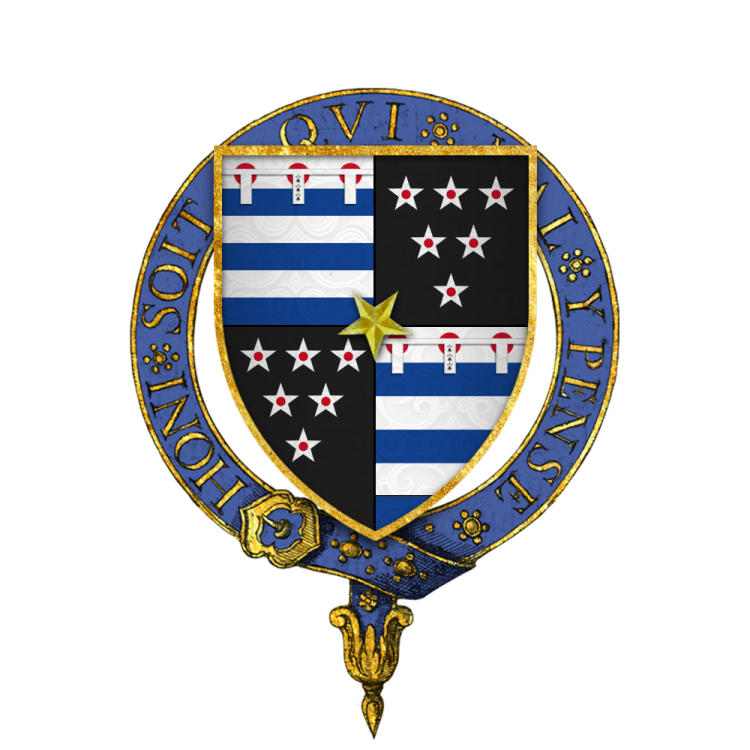
Arms of Thomas Grey, Marquess of Dorset (c.1455-1501). Wikipdia.
Well, well, well. What can I say about Thomas Grey Marquess of Dorset (c. 1455–1501)? A member of the voracious Wydeville/Woodville family he lived through the tumult of the Wars of the Roses, at one time ending up in a bit of a pickle after managing to irk a suspicious Henry VII and for which he spent some time in Tower of London but with remarkably good luck managing to die in his bed in 1501. Husband to the extremely wealthy Cecilia Bonville, (c.1460-1529) suo jure Baroness Bonville and Harrington, with whom he had a massive brood of children. I will return to this marriage below. My favourite portrayal of him was in the mavellous 1972 BBC broadcast ‘Shadow of the Tower ‘in which he was portrayed as a peevish, whinging and truculent medieval Billy Bunter. But what was he really like? Has he been dealt with unkindly by history while actually possessing a capacity for bravery or was he just basically inept? And was the family motto a ma puissance (according to my power) appropriate in his case or perhaps a tad ambitious? Or was he merely multifaceted as so many people were and still are?
He was the elder of the two sons that Elizabeth Wydeville (c.1437-1492) had with her first husband Sir John Grey (c.1432-1461). Sir John would die fighting for Lancaster at the second battle of St Albans on 17 February 1461. With his mother’s amazingly fortuitous second marriage to Edward IV, Thomas and his brother Richard would eventually gain a large brood of half brothers and sisters the most famous of which were, of course, Edward V and Elizabeth of York. His grandmother Jacquetta of Luxembourg (b.1415-1472) was from high status noble stock – being the daughter of Pierre, Comte de St. Pol She had been married at 16 to the much older, extremely rich and powerful John of Lancaster, Duke of Bedford, a brother to Henry V. Her husband dying quite soon after their childless marriage she promptly married Richard Wydeville, clearly a love match with him being a mere knight and way below her social status. The couple married without permission from Henry VI, for which they would later be issued with a massive fine. Some sources say this fine was later rescinded but presumably if it was ever paid it would have been done so by Jacquetta as she was the one with the dosh. Richard, with his new wife, returned to England to live – probably at Grafton – ancestral home of the Wydevilles. There they raised their children including the daughter who had the luck of turning the head of a young testosterone loaded Edward IV who would please himself as to whom he would marry , unwisely as it transpired, for the marriage turned out to to be the rock that the House of York foundered upon. But back to Thomas…..
PERSONAL LIFE

Astley Castle, Warwickshire. Marital home to Sir John Grey and Elizabeth Wydeville later Queen of England, parents to Thomas Grey. It’s unclear whether Thomas Grey was born at Astley but he would most certainly have spent much of his childhood there. Photo Astley Parish Council.
Thomas’ place of birth is unknown. John Ashdown-Hill suggested it was somewhere in London although it also seems likely it may have at Astley Castle, Warwickshire – think more fortified manor house than ragged castle – ancestral home to the Grey family. He has been described by the historian T B Hugh as a man of ‘mediocre abilities as well as ‘shifty‘ who managed to attain his position solely through his mother marrying a king rather than via pluck or ability although it is true he had a vague connection to Edward I (1). It should however in all fairness be remembered that Virgil described him as vir bonus et prudens (a good and prudent man) although it should also be remembered that Virgil was prone to sometimes speaking a load of old cobblers – well quite frequently to be honest (2) . Now while I have no wish to cast aspersions on the integrity of Polydore Vergil it would serve us well to remember that history is written/dictated by the victors – in this case Henry VII’s fan club i.e. Morton, Foxe, Bray and Urswick and this should be viewed with some caution. For those who wish to read more about Virgil’s reliablility click here.
Once Elizabeth Wydville had become queen she sought to make advantageous marriages for her children and for her eldest man cub she succeeded in doing so in 1466 when Thomas married Anne Holland (c.1455-c.1474), the daughter and heiress of Henry Holland, duke of Exeter and whose mother was Edward IV’s sister, Anne of York(1439-1476 ). It has been said that this marriage, which took place in October 1466, exacerbated the already simmering fury of Richard Neville, later known as ‘The Kingmaker’, after a proposed marriage between his then infant nephew and male heir, George Neville (I465-83) and Anne Holland was scuppered in order for her to marry Thomas (3).
Shortly prior to this Richard Neville had already been outraged over the clandestine marriage of the king and Elizabeth Wydeville, the ensuing secrecy of which had left him looking foolish as he had, oblivious to the true situation, carried on in his negotiations for a French bride of suitable rank for Edward. Warwick would get his revenge in 1469 when he managed to execute a couple of Wydevilles, Thomas’ grandfather and uncle, Richard and John Wydeville.
Sadly Anne was to die aged 18 and childless. Nothing daunted another marriage and another great heiress soon loomed on the horizon and in 1474 Thomas, aged 19 married 13 year old Cecilia Bonville.whose stepfather was none other than William Hastings, first Baron Hastings (c. 1430–1483).
It was through Cecilia that Thomas would gain the vast estates that had come to her via her grandfather William, Lord Bonville (c.1392-1461) as well as the Harrington barony. Didn’t he do well? And no doubt stepfather – Edward IV – breathed a massive sigh of relief as his stepson became self sufficient. However the Bonville marriage would bring Thomas head on in collision with Cecilia’s stepfather, the formidable William Hastings, first Baron Hastings (c.1430-1483) who had risen to dazzling heights because of his close friendship with Edward IV. Possibly this caused a few headaches for Cecilia who may have felt as if she was stuck between a rock and a hard place. Nevertheless Cecilia’s and Thomas’ marriage would prove to endure successfully if the number of children the couple produced is anything to go by. Casting that aside though it has to be said that Thomas was far from a faithful husband and it’s recorded that one of the reasons he fell out with Hastings was over a mistress/mistresses, which I will return to later.
There is also some reason to believe that he had an affair with Lady Anne Stonor nee Neville, wife to Sir John Stonor and daughter of John Neville, Marquess of Montague – brother to Richard Neville, Earl of Warwick. Perhaps fortunately for him both Neville brothers were dead at this time haven fallen at Barnet in 1471. The newly wed Anne Stonor’s behaviour does seem rather strange when she hastened to Thomas’ home, Taunton Castle, immediately after her marriage in late 1481 to Stoner, where she remained for several months, presenting her husband with a son nine months later (4). Furthermore it would seem that Thomas had taken a shine to yet another of Montague’s daughters because there is also the intriguing bequest made in the will of his daughter Elizabeth, Lady Scrope of Masham (d.c.1518) when she bequeathed a bed to an illegitimate daughter of Thomas: ‘Mary, daughter in base unto Thomas Grey Marquess of Dorset my bed that my Lord Marquess was wont to lie in….’ (5). Now far be it for me – as I’ve said before – to cast aspersions – but it does indeed sound a tad dodgy. Anyway onwards….
Besides rumours of possible liaisons with Montague’s daughters there are also statements by the chroniclers of the times that both Thomas and his stepfather-in-law, Hastings, shared the same mistress i.e. Elizabeth/Jane Shore née Lambert. Following the coronation of Richard III in 1483 the Great Chronicle of London recorded that ‘Shortly afftyr (Richard’s coronation) was a woman namyd Shoore that before days, after common fame, the Lord Chambyrlayn (Hastings) held, contrary to his honour, called to a reconnyng ffor part of his goodys & othyr thyngys…and she lastly as a common harlot put to opyn penaunce’. Following on from this on the 23 October 1483, in a public proclamation issued by Richard III, Thomas was denounced in the following words: ‘Thomas Grey, late Marquess of Dorset, not fearing God, nor regarding the peril of his soul, hath devoured, and deflowered many maidens, widows and wives, and holding the unshameful and mischievous woman Shore’s wife in adultery. ‘ (6).
POLITICAL AND MARTIAL LIFE
Thomas fought – for York obviously – at the battle of Tewkesbury in May 1471 where it has been suggested by some sources he was in suspiciously close proximity to Prince Edward of Lancaster when he met his demise. He was soon after ‘created earl of Huntingdon on 14 August 1471, a dignity which he subsequently resigned before he became a marquess’ (7). He was also present on Edward IV’s French expedition in the autumn of 1475. He would also later benefit from the death/judical murder of George, duke of Clarence in 1478 and it has been said that he treated George’s son, the young tragicEdward Earl of Warwick, with undue harshness during the period he was his ward.
To continue reading click here
 The New Murrey and Blue blog
Leave a comment