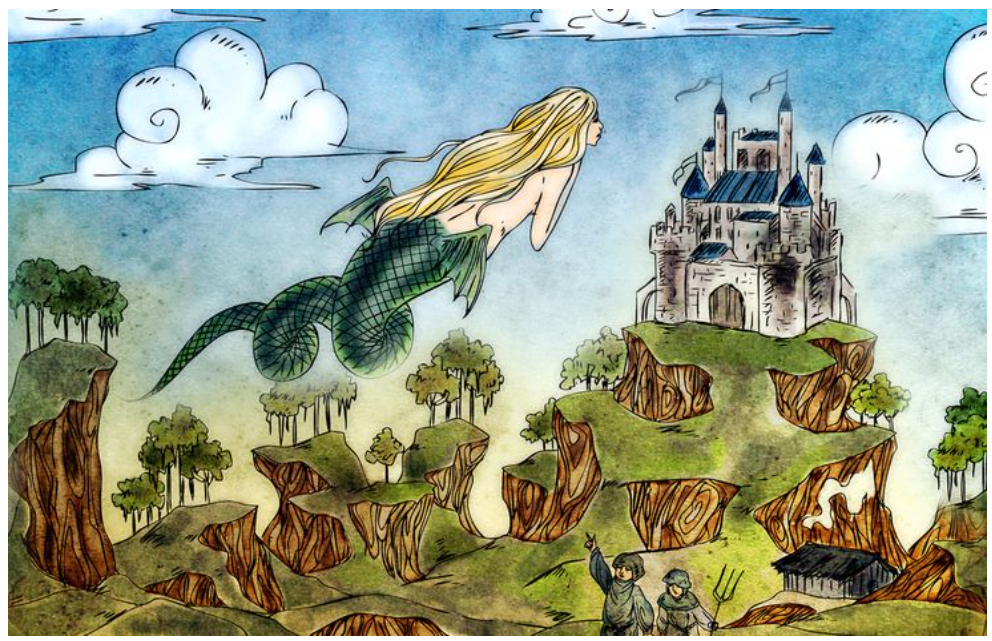
About seven years ago I wrote a piece for this blog about Edward III’s belief that his line was descended from the fairy, Mélusine. In a nutshell, the story of Mélusine as I knew it then was as follows, and I quote from my Murrey & Blue article: “….Edward III told his friends, the founder of his line, Count Fulke the Black, ruler of Anjou [Fulke III, 970–1040, ancestor of Geoffrey Plantagenet, Count of Anjou, see here Fulk III, Count of Anjou – Wikipedia), travelled to a distant land and returned with a bride whose beauty was unsurpassed in all the world. The four children she bore him were brilliant and handsome, like all Plantagenet sons and daughters after them, but they carried also a darker heritage. She kept it secret for many years, living a life more secluded than a nun’s. Then one day the count demanded that his wife accompany him to Mass, a thing she’d repeatedly refused to do. She did so this time, pale and trembling. When the priest raised the Host, the countess let out an unearthly shriek, rose into the air, flew out of the chapel window, and was never seen again. The truth was out. She was Melusine, daughter of the Devil!…”
Edward III, it seemed, gave credence to this tale, and as I pointed out in 2017, his grandson Richard II definitely had unusual, slanting eyes. It could also be said that Edward did himself, as did his eldest son, Richard’s father, the Black Prince. So, although the story of Mélusine has more recently become rather attached to the so-called witchery of the likes of Elizabeth Woodville and her mother Jacquetta of Luxembourg, it was actually around a long, long time before then.
Well, it was an intriguing anecdote about Edward III, but that was all. I had little cause to investigate the story further, until—while trying to find out all I could about the capture in 1369, near Lusignan, of Sir Simon Burley.This was how I came upon the following extract from this Wikipedia page Lusignan, Vienne – Wikipedia:
“….Lusignan (French pronunciation: [lyziɲɑ̃]) is a commune in the Vienne department in the Nouvelle-Aquitaine region in western France. It lies 25 km southwest of Poitiers. The inhabitants are called Mélusins and Mélusines….”
The relevance of those names couldn’t be mistaken. Indeed, the name of Lusignan itself comes from Mélusine, as I found on digging a little further and finding this link MELUSINE – Dragon at the End of Time: “……..According to the book The Serpent And The Swan: The Animal Bride In Folklore And Literature, the name Melusine was used as an abbreviation of the words ‘Mere des Lusignan’ or ‘Mother of the Lusignans.’ The House of Lusignan was a royal house of French origin, which at various times ruled several principalities in Europe and the Levant, including the kingdoms of Jerusalem, Cyprus, and Armenia, from the 12th through the 15th centuries during the Middle Ages….images of Melusine are still seen in the Vendée region of Poitou, western France, where one can drink Melusine-brand beer and eat Melusine-style baguettes. In Vouvant, paintings of her and her sons decorate the Tour Mélusine, the ruins of a Lusignan castle guarding the banks of the River Mère, where visitors of the tower can lunch at the Cafe Melusine nearby….”

And again: “….The legends of Melusine are especially connected with the northern and western areas of France, Luxembourg, and the Low Countries. Her name derives from Mère Lusine (“Mother of the Lusignans”), connecting her with Cyprus, where the French Lusignan royal house that ruled from 1192 to 1489 claimed to be her descendants. The legend of Melusine, therefore, is related to the territorial and dynastic expansion of her descendants beyond Lusignan across the Mediterranean to distant Armenia during the crusades (1095 – 1291)….”
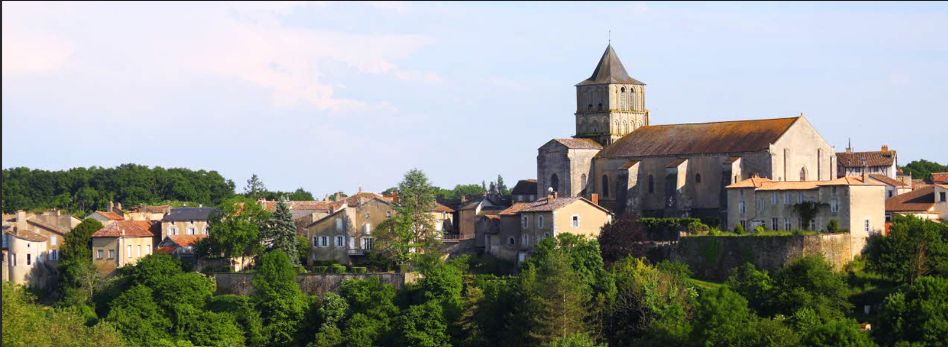
You can read more here Mélusine – Who is this mysterious fairy and what is her story? (sirenas.fr) and here https://www.sacred-texts.com/neu/celt/tfm/tfm177.htm. There is even a Mélusine trail, about which you can read here Lusignan – Visit Poitiers. (It is from this last link that the image of Lusignan at the top of this page is taken.)
Unfortunately for me I’m not much further forward with Sir Simon Burley. I don’t know exactly when or where he was captured in 1369, except that he was on the Black Prince’s business and it was in the Lusignan area. Nor do I know who in particular captured him, except that it was the French. I don’t even know exactly when in 1370 he was released, only that he returned to rejoin the Black Prince at Limoges.
But I do know a little more about Mélusine!
 The New Murrey and Blue blog
Leave a comment