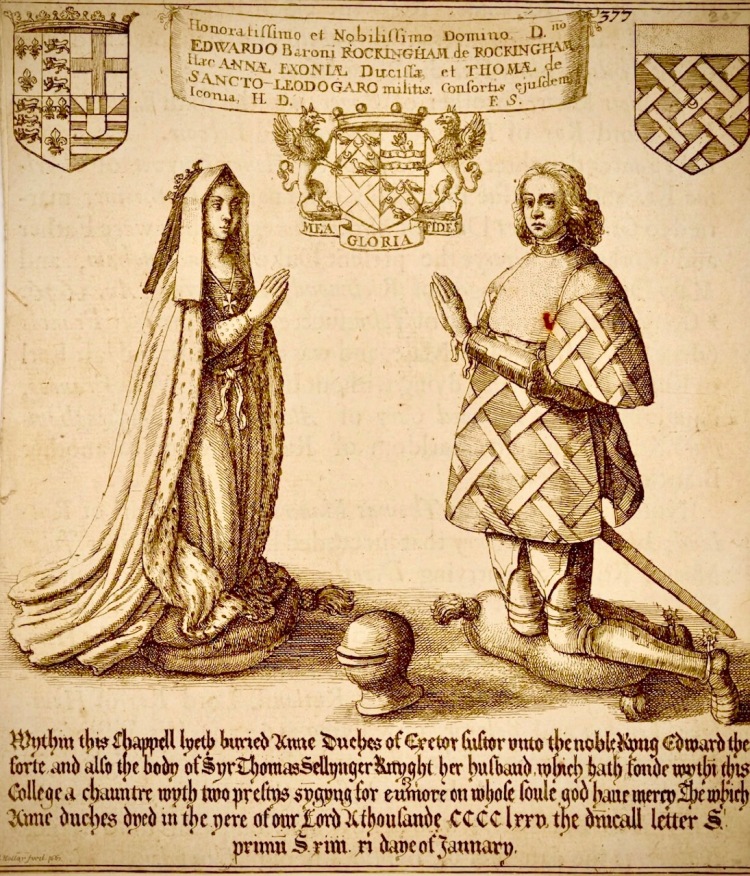
Wythin thys Chappell lyethe beryed Anne Duchess of Exetur suster unto the noble kyng Edward the forte. And also the body of syr Thomas Sellynger knyght her husband which hathe funde within thys College a Chauntre with too prestys sy’gyng for eu’more. On whose soule god haue mercy. The wych Anne duchess dyed in the yere of oure lorde M Thowsande CCCCl xxv.
Anne Duchess of Exeter and Sir Thomas St Ledger. Etching of the memorial brass in the Rutland Chapel, St George’s Chapel. Wenceslaus Holler 1667. National Portrait Gallery.
Anne of York (1439-1476) was born at Fotheringhay Castle on the 10 August 1439, the first born child of her parents, Richard Duke of York and Cicely Neville after what one chronicler described as a ‘tyme of longe bareyness’. (1). However from then on the York family nursery would go on to burgeon and she would eventually have eleven siblings, six of which, plus herself, would make it to adulthood. These siblings would eventually go on to become two kings, one earl, one duke and various duchesses. The various histories of these siblings have been described elsewhere and I won’t go into them here except a mention of Anne’s pivotal role, with other female members of her family, to bring George Duke of Clarence back into the fold after he had rebelled against his brother Edward IV in 1471.
‘By right covert wayes and meanes were goode mediators, and mediatricis, the highe and myghty princis my Lady, theyr mothar; my lady of Exceter, my lady of Southfolke, theyre systars; my Lord Cardinall of Cantorbery; my Lord of Bathe; my Lord of Essex; and moste specially, my Lady of Bourgoigne…’ (2).
The ties that bind were clearly at play here.
But we have come too far here and must backtrack to the 30 January 1446 when Anne then aged six would marry the fifteen year old Henry Holland (1430 -1475) in the Bishop of Ely’s Chapel in Hertfordshire (3). Henry was born in the Tower of London on the 27th June 1430… ah the irony. As was customary the small bride then moved into the household of the groom’s parents. Thus John Holland, Second Duke of Exeter (1395-1447) became Anne’s guardian. It was probably an indication of the esteem that John Holland was held in that persuaded Richard Duke of York to pay 4500 marks for the marriage although of course Henry’s close connections to the House of Lancaster – a very close relative to Henry VI who was later to dangerously wander in and out of severe mental illness – would also have been another strong motive. Whatever the reasoning Richard coughed up 1500 marks on the wedding day followed by 1000 marks annually thereafter. Henry’s wedding clothes were financed by his father but the rest of the costs of the wedding were covered by the bride’s father. However John Holland was to maintain the couple until Henry’s 20th birthday. These plans went awry upon Exeter’s death the following year whereupon the king granted York ‘the keeping of Henry, son and heir of John, duke of Exeter, from the said John’s death’ (4). It’s therefore fairly safe to assume that both Henry and Anne – now Duke and Duchess of Exeter – from then on lived with her parents or in one of their households until they were both deemed old enough to have their own. This should not lead us to conclude that Henry and his father-in-law would go on to enjoy a warm and convivial relationship. Indeed it is difficult to see how Richard of York could warm to a son-in-law whose own father found untrustworthy. Not only did John Holland have concerns regarding his son’s uncertain temper and conduct but there was also the fear that he might attempt to contravene his will (5). It’s likely that Anne found herself between a rock and a hard place as no doubt she tried, with little success, to play the part of peacemaker between her husband and her father.

Anne’s father Richard Duke of York. Contemporary image from stained glass window at Trinity College, Cambridge.
Anne’s mother – Cicely Neville from the Luton Guild Book.
They would have one daughter, Anne Holland (c.1455-1474) who would be contracted to marry George Neville, infant son of John Neville, Earl of Northumberland, and who was male hair to Richard Neville, Earl of Warwick later known as the Kingmaker. However the Duchess was persuaded by Queen Elizabeth Wydeville to renege on that agreement and instead consent to her young daughter marrying Thomas Grey later Marquis of Dorset, the Queen’s son by her first marriage. This marriage ,which would be childless, took place in October 1466 but sadly Anne Holland was dead by February 1474.
Long before the death of their daughter Anne and Henry – their marriage broken down – had been living separately although the date of separation is unknown. Indeed after the Lancastrian defeat at Towton on the 29 March 1461 Henry had exited England and joined Margaret of Anjou first in Scotland and later in France. He was, of course, attainted and Anne, by 1462, was granted her husband’s goods and his ‘whole Exeter inheritance for life, Rochford and lands in Exeter, Hadleigh and Essex with a regrant of August 1467 giving the remainder to their daughter Anne Holland’ (here becomes clear Elizabeth Wydeville’s eagerness to gain the young Anne Holland for her son). Anne initiated divorce proceedings on the 18 January 1471 when her husband was exiled and out of the country. In his thesis on the Holland family Dr Michael Stansfield writes ‘she may well have been fearful of her husband’s imminent return and his repossession of his estates; divorced, he would have no automatic hold over them. She was reafferming her Yorkist loyalties and her abhorrence of the Lancastrian cause her husband so fervently represented. A personal reversion to such an unamiable character as Henry must however also have been a major factor in Anne’s attempts to avoid being reunited with her husband (6).
THE ‘DIVORCE’
TO CONTINUE READING CLICK HERE.
 The New Murrey and Blue blog
Leave a comment