Normally, when a man married an heiress, he quartered his arms with his own. If you look at the arms of France and England, as borne by late medieval English kings, this is a good example of what I mean, except that in this case the female inheritance (France) occupies the place that would normally be occupied by the husband’s arms. This is because France was regarded as the more important kingdom of the two.

(Wikipedia Commons. This shows the version used after about 1408.)
Obviously, as families absorbed more and more inheritances it made shields of arms very complex. The alternative was the ‘escutcheon of pretence’ where the heiress’s arms were displayed on a small shield on top of her husband’s shield. The example below is that of Richard Beauchamp Earl of Warwick from the time when he was married to Isabelle Despenser.
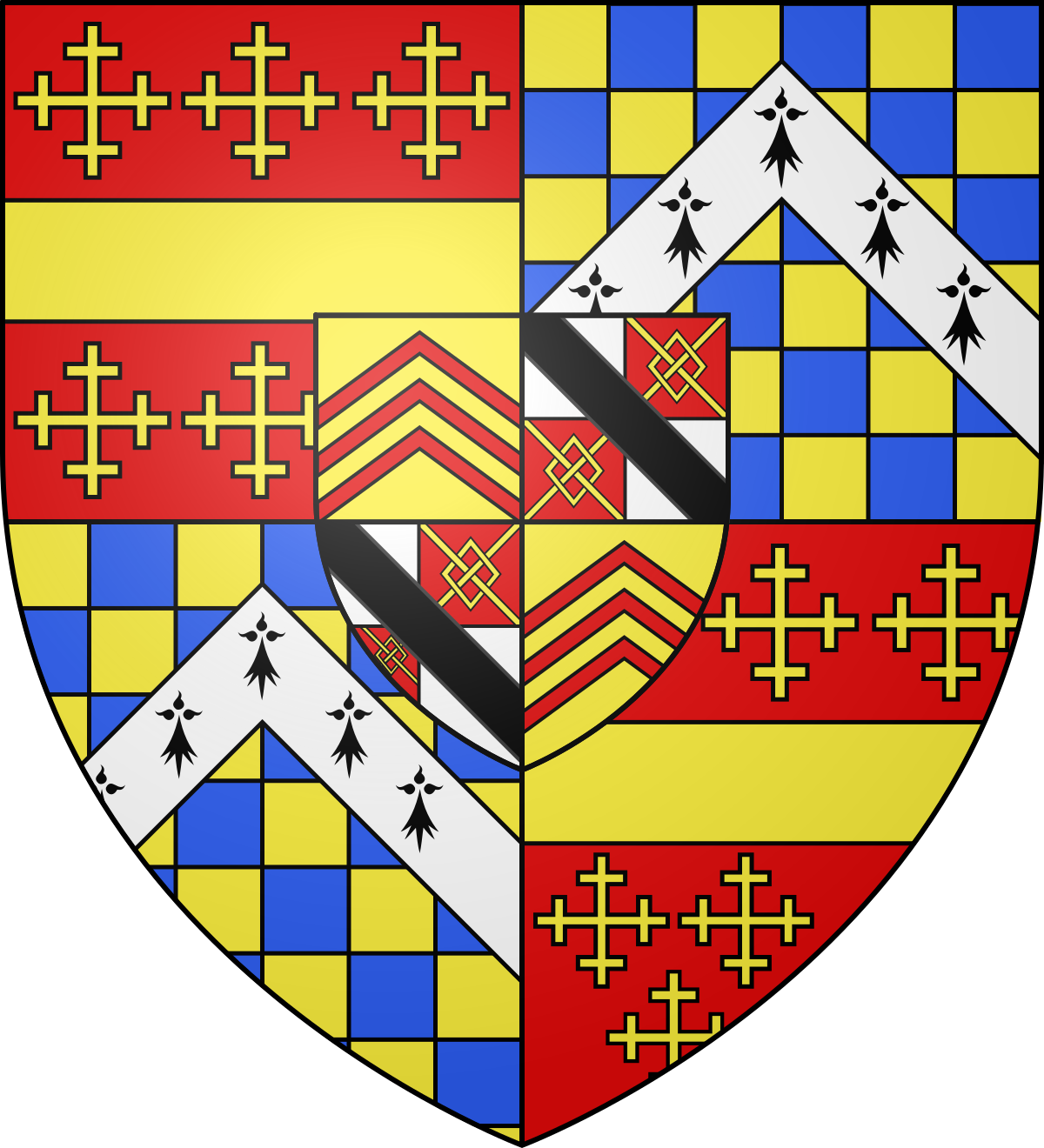
(Wikipedia Commons)
In this case, the Despenser arms sit on the Beauchamp (Warwick) arms. It will be noted that both are already quartered, displaying previous ‘takeovers’. The Despenser arms give precedence to de Clare over Despenser, because once again the female inheritance is seen as senior to the male. The Beauchamp arms are more conventional in that the Beauchamp (male) arms are given prominence over the Newburgh arms that came into the family via a heiress.
Another factor in this marshalling of arms may be that Isabelle had a child by her previous husband – also a Beauchamp! This meant that, at least in theory, Warwick couldn’t be sure of absorbing her whole inheritance. In reality, due to the successive power of Richard Beauchamp, Earl of Warwick, his son, Henry Beaufort, Duke of Warwick and his son-in-law, Richard Neville, Earl of Warwick (a.k.a the Kingmaker), they kept their mitts on the lion’s share. That, however, is another story.
 The New Murrey and Blue blog
Leave a comment