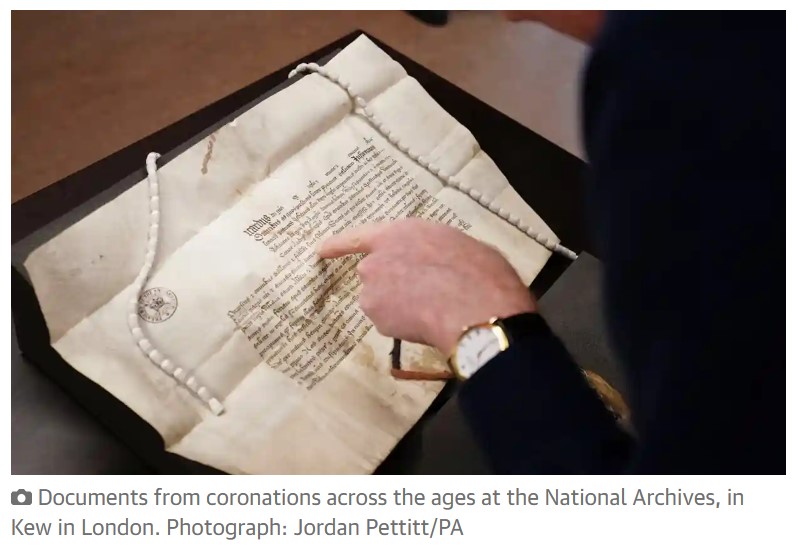
This article is courtesy of one Sean Cunningham, historian. 😠 The article is informative about various National Archive documents that concern past coronations. They are very interesting. For instance, they reveal the preservation of “….bills submitted to the exchequer for the robes worn by past monarchs such as Elizabeth I when she was crowned in 1559….”
However, when it comes to Richard III we get the usual nudge-nudge that he was as guilty as sin itself. I quote:
“….The records concerning Richard III’s coronation in 1483, written by the keeper of the Great Wardrobe, reflect all the changes of clothing required by the monarch during the ceremony, with orders for gold cloth and purple silks and velvets….” So far so good.
“….Richard is chiefly known for imprisoning his nephews, the ‘Princes in the Tower’ who had disappeared from public view. Yet there are references in the records to a bodyguard and clothing for the deposed Edward for the coronation. [Sigh]
“….’If indeed he did appear at the coronation,’ said Cunningham. ‘But this shows the politics of this too. It looks good for an uncle not to have removed his nephew.’….” [Groan]
Oh spare me. Why is Richard declared to have “imprisoned” his nephews? He installed them at the royal palace of the Tower of London. In the royal apartments, please note, not the deepest, filthiest most rat-ridden dungeon! What was he supposed to do? Kick them out on the streets? Hand them over to their traitorous Woodville maternal relatives?
Cunningham also insists that the provision of a bodyguard and clothing for the “deposed” Edward V is more proof of Richard’s duplicity. Looked at another way, it could be that Richard had genuinely expected to crown that nephew, but that the actions of the nephew’s father had put paid to it at the very last moment. The boy was illegitimate! Was Richard wrong to realise that little Edward couldn’t be crowned King of England? Of course he wasn’t, especially when he himself was the rightful king and his own son was therefore a legitimate future king? Why can’t the likes of Cunningham give both sides of the argument? Why does everything have to be a sign of Richard’s guilt?
So all in all, as a Ricardian I give the thumbs down to this Guardian article. But not to the records of the National Archives, of course.


 The New Murrey and Blue blog
Leave a comment