King’s Langley was once home to a massive Plantagenet palace, built out of the remnants of a hunting lodge of Henry III for Edward I’s Queen, Eleanor of Castile. She furnished it lavishly, with carpets and baths. There were shields decorating the hall and a painted picture of four knights going to a tournament, while the expansive gardens were planted with vines. After her death, the palace was held by Edward Prince of Wales (later Edward II) who spent a fair bit of time there, as did some of his sisters. Edward founded a Dominican friary in memory of his mother in the northern parkland near the palace. He also built a huge cellar under the castle known as ‘Le Cave’ which was so large it was rumoured he stabled horses there. It was in this friary that Edward had his favourite, and possibly his lover, Piers Gaveston, buried two years after Gaveston’s murder. He had the remains wrapped in cloth of gold at an enormous cost, and held a huge feast with many notables invited–although some chose not to attend.
Edward III also spent much time at the palace, adding or improving many buildings in the three courts. He added a counting house and piped hot water…and a camel was also in residence! A clock that struck the hour was given to the nearby Friary.
It was at the palace that Edward’s son Edmund of Langley, the great grandfather of Edward IV and Richard III, was born. He and his wife, Isabella of Castile, spent much of their married life at the palace. When they died, they were buried in the Friary, as was Anne Mortimer, the wife of Richard of Conisbrough.
Richard II also frequented Langley Palace, even holding Christmas there. He had spent much time at Langley in his youth and was very fond of the place. No doubt, though, he did not expect to be buried there after his deposition and probable murder, but the usurping Henry IV had Richard buried in the friary near his relatives–though only for a short time. His remains were later moved to a more fitting tomb in Westminster. The second wife of Henry IV then held the palace–and it was during her tenure that the buildings were ravaged by a great fire started by a candle.
The palace declined in importance after that–although Edward IV granted it to his mother, Cecily Neville, and Richard III confirmed her tenancy. Like Clarendon Palace, which also lost favour in the mid to late 1400’s, it probably began to fall into decay around this time. The last time it enters the records for a notable event is in 1476 when the Abbot of St Alban’s held a feast there.
With the coming of the Reformation, the great palace and the friary were both swept away. Part of the friary survived as a house that in recent times became a school (now closed.) When it became a private home, some of burials within were moved to the parish church–Edmund of Langley and Isabella now share his elaborately decorated tomb with a skeleton presumed to be his daughter-in-law Anne Mortimer. Gaveston did not join them, however, so is doubtless still lying wherever he was buried in the Friary. However, of the palace itself, almost nothing remains above ground–only a few scanty walls and windows remain in the front garden of a very modern home!
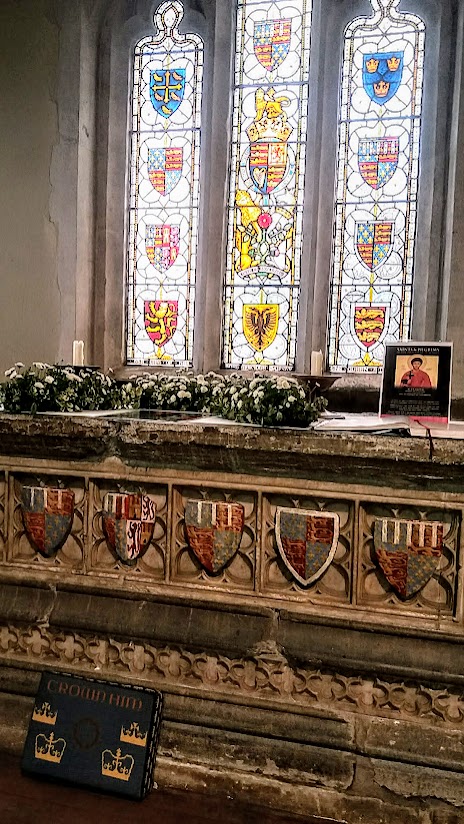
Edmund of Langley’s Tomb

The sad remains of the palace
THE FRIARY–yours for just 2 million!

 The New Murrey and Blue blog
Leave a comment