A part of Richard III’s life often overlooked in fiction is the brief time he spent in exile with his brother, Edward IV, from October 1470 to March 1471. Usually, this event is a mere footnote in most novels, no doubt because it might be seen as ‘slowing down the action’ and also because the documentary sources are quite jumbled and difficult to tease out. For instance, at one time it was thought the brothers left England together, but it now seems that Richard followed Edward from Lynn several days later, and it was then his ship was blown off course by a storm and ended up in Holland. It is known that upon his arrival, windblown and penniless, he managed to get a loan from the ‘Bailiff of Veere’ but who was that and what was his connection to the story?
In the last of the I, Richard Plantagenet Prequel novels, CROWN IN EXILE, the identity of the Bailiff is revealed—it was either Lord Hendrik Van Borselen or his son, Wolfert (Hendrik was quite elderly and had given many of his lands and positions to his son, but he remained reasonably active politically, and had once helped Edward in an attempt to captive Warwick at sea.) The Van Borselen family were also related by marriage to Louis de Gruuthuse, who put up Edward and Richard for most of their stay. Van Borselen’s daughter was Louis’ wife.
The novel attempts to show not just the journeys of the brothers, but the reticence of Charles of Burgundy to helping his Yorkist kin-by-marriage. It was by no means a certainty he would assist them at all. He had Lancastrian ancestry on his maternal side and had not long before invited the exiled Beauforts, Edmund and John, into his court, although they departed fairly sharpish when Edward arrived. However, when Louis of France started making incursions into his lands, Charles began to waver since Louis had connections with the Earl of Warwick. Charles’ wife, Margaret of York, no doubt also worked on convincing him to aid her brothers’ cause and raised quite a bit of money herself. We know Richard, on his own, visited Margaret at least once while he was in Bruges, riding to the palace at Lille.
By March 1471, Edward had a small force ready to sail, not really enough manpower, but he could waste no more time or he would lose his crown forever. Sailing through more storms, he ended up arriving at Ravenspur near the mouth of the Humber, a town that has now vanished under the sea, and began a journey inland toward York. However, he encountered much hostility, so he came up with a ruse—he would do what Henry IV did years before and pretend he was only returning to claim his ancestral lands. To make himself and Richard look more authentic, he had badges of the Prince of Wales (then Edward of Lancaster) made as well as hats adorned with white feathers. As strange as it may seem, people appeared to believe him or at least they pretended to! Before long, he more troops began to join him as various Yorkists heard of his return.
But Edward and Richard had one more object to deal with before the final clash with the Earl of Warwick at Barnet—and that object was George of Clarence, who was marching around *somewhere* while everyone guessed at what side he might now support…
CROWN IN EXILE LINK:
For anyone who is travelling to Bruges in Belgium, the house Richard and Edward stayed in, the Gruuthuse, is now a museum, and has a number of original features. The brothers no doubt visited the impressive church adjoining the house, as well as another chapel in Bruges that contained a holy relic—some of the holy blood, which was brought to town by a crusader.
There, of course, is an actual piece of art depicting Edward in the Gruuthuse, accepting a book from Jean de Wavrin. It is thought that Richard, William Hastings and Anthony Woodville are also in the picture, although it is debated which figure is which. John Ashdown-Hill thought it was the figure on the left, taking to the older Louis de Gruuthuse;, I, on the other hand think it is the man in a long golden-brown robe standing by the throne where Edward is seated. He looks younger than the others to my eye and the fact he is standing nearer to Edward may be indicative. The other two unidentified men are both wearing almost identical clothes, which would be more likely for Edward’s supporters than his brother.

The Gruuthuse Museum in Bruges
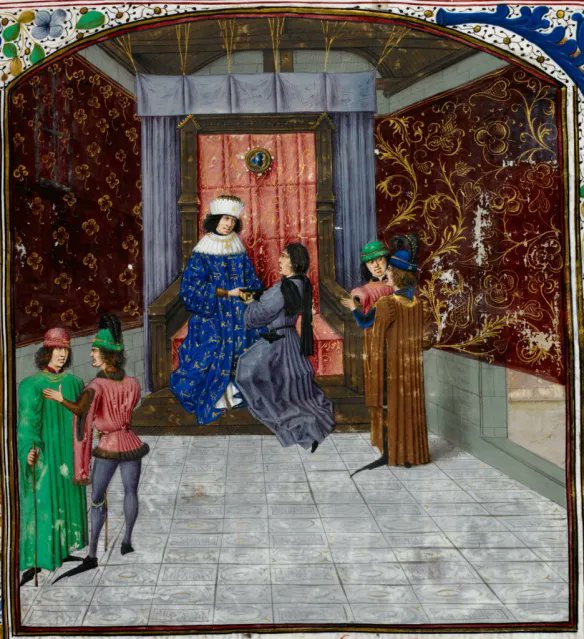
Edward accepts a book from Jean de Wavrin.


 The New Murrey and Blue blog
Leave a comment