Reblogged from MEDIEVAL POSY RINGS – GIVEN WITH LOVE…
‘Is this a prologue, or the posy of a ring?’
‘Tis brief, my lord’ *

This beauty is reputed to have been given by John of Gaunt (1340-1399) to his mistress and subsequent third wife, Katheryn Swinford (1350-1403). The inscription reads ‘alas for fayte’ which was probably a nod to Gaunt and Katherine’s illicit love affair.
Medieval Posy rings! What a delight they are and how I have longed to own one but the bank balance say No and unless I dig one up in my garden that is likely to remain the case. Posy, or poesy rings, took their name from the old French word poésy which alluded to the short poetic engraving – usually inside the ring but sometimes on the outside – and which worn next to the skin would only be known to the giver and recipient. Popular from medieval to the 17th century I am focussing here on the earlier medieval ones. How nice to think that in those times when, broadly speaking, only the lower classes were able to wed someone of their own choice – betrothed couples, who were often marrying the partner of their parents choice or even older couples where the status of their spouse was paramount – were often going into marriage with feelings of affection or that love grew later. Anyway its all extremely romantic and whats not to like? However to return to the ring said to have belonged to Katherine Swynford, Duchess of Lancaster.

The engraving, worn next to the skin and therefore only known to the giver and recipient, reads ‘alas for fayte’


Katherine Swynford, Duchess of Lancaster’s posy ring. All photos thanks to Berganza Jewellers who sold the ring to a private buyer.
Described as being set centrally with a cabonchon sapphire, the sprays of flowers were originally enhanced with enamel. C.1360-1400 with documentation relating to the provenance of the ring.
*********
A recently discovered posy ring found by a metal detectorist in Dorset:

Described as two intertwining gold bands symbolising two lives joined together. Set with a diamond in the centre and the inscription in French ‘leo vos tien foi tenes le moy’ which translates as ‘I hold your faith, not mine
After its discovery, the ring was sent to the British Museum to be dated and authenticated. Experts who researched the ring were able to identify the man who had owned the land where it was found – Sir Thomas Brook – and have gone on to speculate that he may have given this valuable ring to his wife, Joan, on the occasion of their wedding day in 1388. The ring was found in an area covering the site of a medieval bowling alley and possibly Lady Joan may have lost the ring while playing an early form of croquet. Who knows? It’s a charming story though and has a ring of truth about it (did you see what I just did there!). Anyway – it’s easy to image the lady’s horror, whoever she was, when she realised her beautiful ring was missing and mourning its loss long afterwards.
******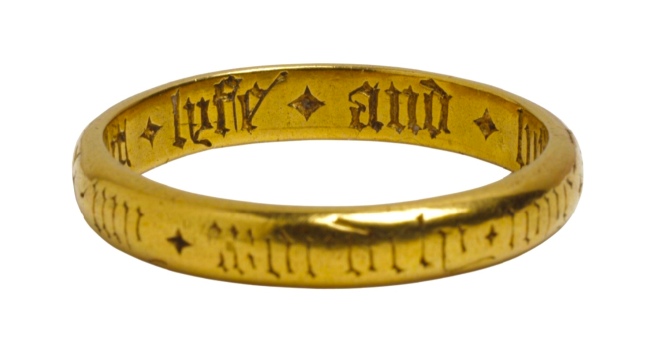 Gold band. Early 15th century. Engraved on the outside my.wordely.ioye+alle.my.trust on the interior +hert.tought.lyfe.and.lust. Victoria and Albert Museum.
To continue reading click here.
 The New Murrey and Blue blog
Leave a comment