Whenever we hear the name Woodville (various spellings) we’re inclined to think of Elizabeth Woodville and her grasping relatives. We’re told they had goodies thrust upon them by Edward IV, and that they were foisted in marriage onto almost all the leading families of the realm. One couldn’t go anywhere without encountering Woodvilles in high places.
Well, maybe this is true for Woodvilles in general, but there was one who doesn’t seem to have benefited hugely from his sister’s grand royal marriage. That was Elizabeth’s younger brother, Sir Richard Woodville, whose most important grant appears to have been being made a Knight of the Bath. Not for him a desirable match, and his only elevation into the aristocracy came through his own family when he succeeded his elder brother Anthony as the 3rd Earl Rivers. He died unmarried, aged 37 or 38, and was buried at the long-gone Abbey of St James, Duston, Northampton. (You can read a little about the abbey here.)
This Richard Woodville (his father was also named Richard) seems to have slipped through history’s net. Well, to a great extent anyway. I’ve happened upon him for a story I’m writing, and it would appear that there was a little more to him than met the eye.
At this site is a link to The Victoria History of the County of Northampton, Vol. 2; R.M. Serjeantson & W R.D. Adkins, eds. (London: Constable & Co., 1906),128….
Curiously, it also contains an interesting slant on Richard Woodville’s private life. But the origin of the slant is proving elusive. It appears in various places, usually with a link to http://coombermedia.com/15-articles/family-history/25-third-earl-rivers, which doesn’t seem to be available anywhere now. Well, put it this way, I can’t find it. So whether or not it contains/ed definitive sources I cannot say. Here is the aspect of Richard’s life to which I refer and which seems to have been taken from the coombermedia.com site above. I have broken it up into paragraphs.):
“….Richard Woodville was the last of his family to hold the title of Earl Rivers. He died unmarried and the Earldom became extinct.[4] The estates attached to the Earldom reverted to the crown.[5] His personal lands were bequeathed to his nephew Thomas Grey, 1st Marquess of Dorset.
“….Richard Woodville, 3rd Earl Rivers (1453—6 March 1491) succeeded his brother, Anthony Woodville, as the third Earl Rivers. He was the son of Richard Woodville, 1st Earl Rivers and Jacquetta of Luxembourg, and was the brother of Elizabeth Woodville, wife and Queen of King Edward IV of England. Richard Woodville was the last of his family to hold the title of Earl Rivers….
“….Some historians and geneaologists believe that Richard secretly married and had a son, also named Richard, who was raised as a commoner in order to protect him from the fate that had befallen many in his family. This child was passed off as the son of another Richard Rivers, steward in the household of the Dukes of Buckingham, and was raised as a servant by the dowager Duchess of Buckingham who had been sister to the late Queen Elizabeth Woodville and to Anthony and Richard Rivers. As a servant the child was not a claimant to the Woodville inheritance which was King Henry VII‘s goal (Henry was impatient to inherit the remainder of the Woodville money and estates he had not already confiscated). Sir John Rivers (born 1510 Penshurst, Kent died 1583 Hadlow, Kent) was the son of Richard Rivers. He married Elizabeth Barne and succeeded her father as Lord Mayor of London (in 1573-4). He attempted to prove he was Earl of Rivers during the reign of Queen Elizabeth I, but was unsuccessful in his effort….”
If the above is true, one has to wonder why Richard Woodville only married secretly. And why he would conceal an undoubtedly legitimate son. Or is the fact that the boy was given the Rivers name not because of the steward but because the boy was born illegitimately and therefore had to take his father’s title not the Woodville name?
Had Richard had enough of court politics, strife, executions and the rest of it? Was he a man who preferred a quieter life and wanted the same for his child? We’ll never know, of course.
He survived being on the wrong side when Richard III ascended the throne and executed Anthony Woodville, 2nd Earl Rivers. Richard Woodville even seems to have been a supporter of Buckingham’s rebellion, but was pardoned by Richard III. He lived on into the reign of Henry VII, and died with his head still attached to his body.
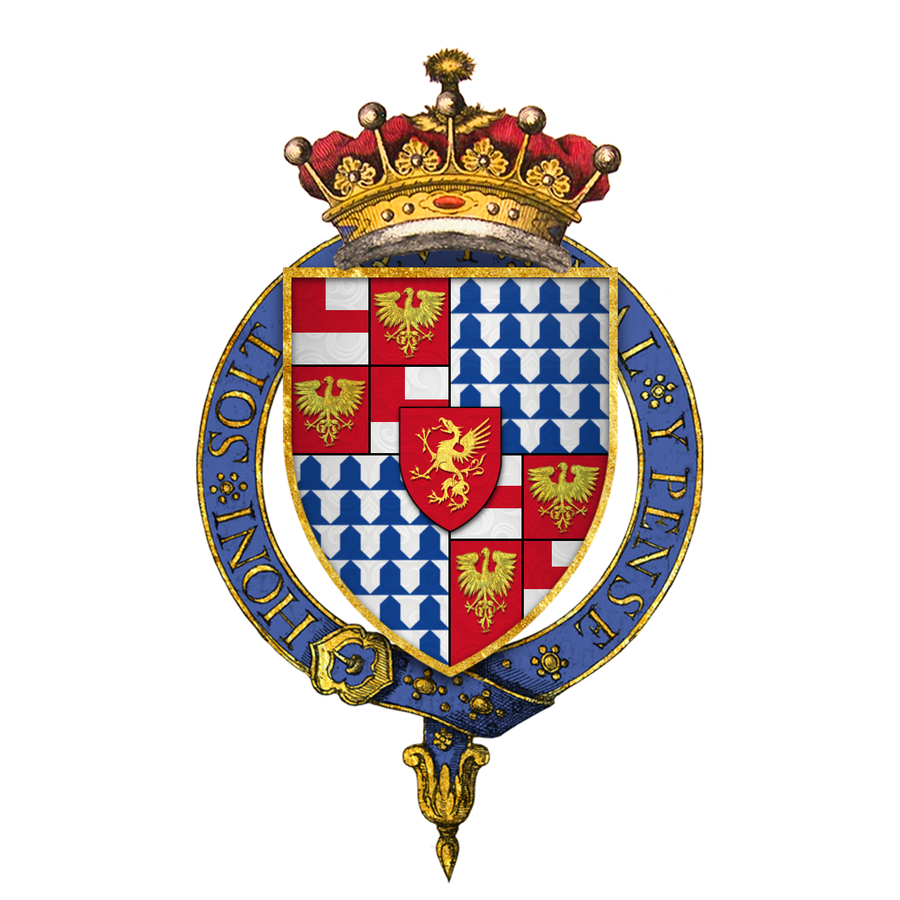
Unfortunately, finding a contemporary illustration of this Richard Woodville is well nigh impossible. All attempts to search turn up likenesses of his father, the 1st Earl Rivers, or elder brother, Anthony, 2nd Earl Rivers. I cannot even find a coat of arms specific to him, only to the first two Earls Rivers. The Richard that I’m seeking just does not feature anywhere. If he wanted to be the quiet Woodville, it seems he succeeded.
You can read more about him here.


 The New Murrey and Blue blog
Leave a comment