
When it comes to medieval ships, it’s sometimes difficult to imagine what they were like. Cogs, crayers, shallops, barges, balingers, wherries and many others abound. Well, wherries of various descriptions are still around now, as are barges, but what we may fondly envisage as a brightly painted narrow boat was no such thing. Perhaps it was more the sort of barge we see still see on the Thames, but with a sail? And barges and balingers, it seems, could really be one type of vessel, except that as well as a sail (later two), balingers could have from 40-50 oars. They were war ships.
At the moment my usual wadings through the Close Rolls of Richard II are turning up numerous orders from the king for “small barges called ‘balyngere’ with from forty to fifty oars” to be built pronto. If not before. The French were always a great threat during the 100 Years War.
At this site you will find balingers described as follows: “….The balinger was a clinker-built oared vessel, initially with a single mast, but in the 15th century larger vessels had a second mast. They were usually small vessels of 40–60 long tons (45–67 short tons; 41–61 t) but larger vessels of up to 120 long tons (130 short tons; 120 t) are recorded. Balingers were popular in the Bay of Biscay and English Channel and were used both for trade and warfare. Fast and with the flexibility of oars and sails for propulsion, they were commonly used by pirates….” I rather think the exceedingly young Richard II might have been amused to think of himself as a pirate king! The source given for this information is Susan Rose, (2013). England’s Medieval Navy 1066-1509. Montreal & Kingston: McGill-Queen’s University Press. ISBN 9780773543225.
I’d thought a balinger was a smallish sea-going sailing vessel, so it came as a surprise to learn that they were oared as well:
“….30 November 1377….To the mayor of the staple of Calais and the merchants of the fellowship of that staple. Order by March 1 next to build at their cost with all possible speed one small barge called a ‘balingere’ with fifty oars, so that it be ready etc. (as above), as the mayor and many of the said merchants have before the council charged themselves to do….”
Another such command to the Constable of Dover wanted five such vessels produced in the same time. “….at the cost of the most able and richest men only of the said ports and the members thereof, not charging….”
Not something any gentleman would enjoy receiving as he was sitting down in the great hall to enjoy his dinner. None of us like having to dip into our purse at the king’s/government’s command!
One example of building a balinger involved “….an agreement…to build a new vessel of good timber and planks called a ‘balingere’ with 42 oars of four ‘stroke’ of ‘Englisshbord’ and all the ‘sterne’ before ‘Englisshbord’ with ribs twelve feet long inside measure, finding all materials, a mast, sail, ‘seilyerde,’ oars, cables, ropes, three anchors with cables, one ‘wyndas’ and other gear, and grease (suesse) of mutton or beef fat (sue), and to launch the same in the river Thames by the ‘Wollekaye’ of London ready for the king’s voyage when the admiral shall appoint or within forty days….”
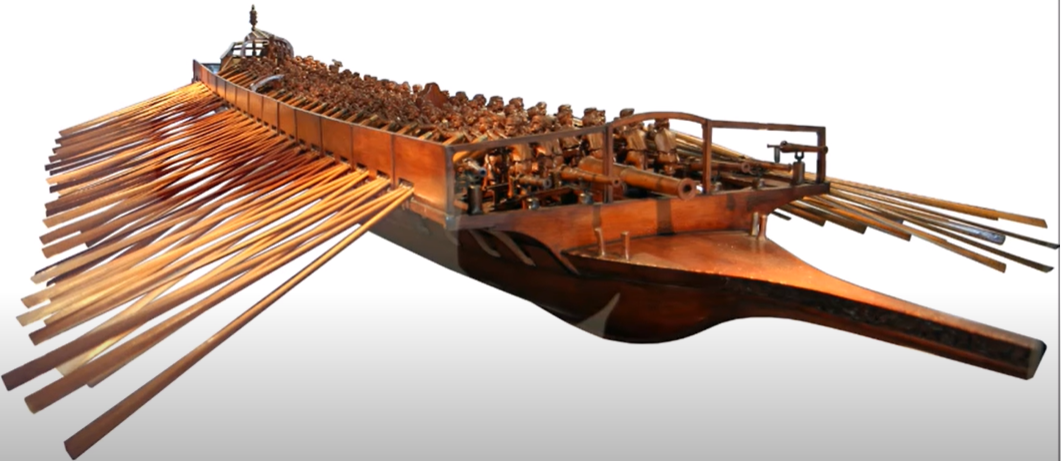
So, having been unable to find an illustration of a balinger, except for the sketch at the top of this page, I was left imagining that an armed balinger might have been something like a Venetian galley of the same period. Just with one or two sails and designed to be more suited to the North Sea and Bay of Biscay.
To read more about balingers, go to this site and to this one this one.

 The New Murrey and Blue blog
Leave a comment