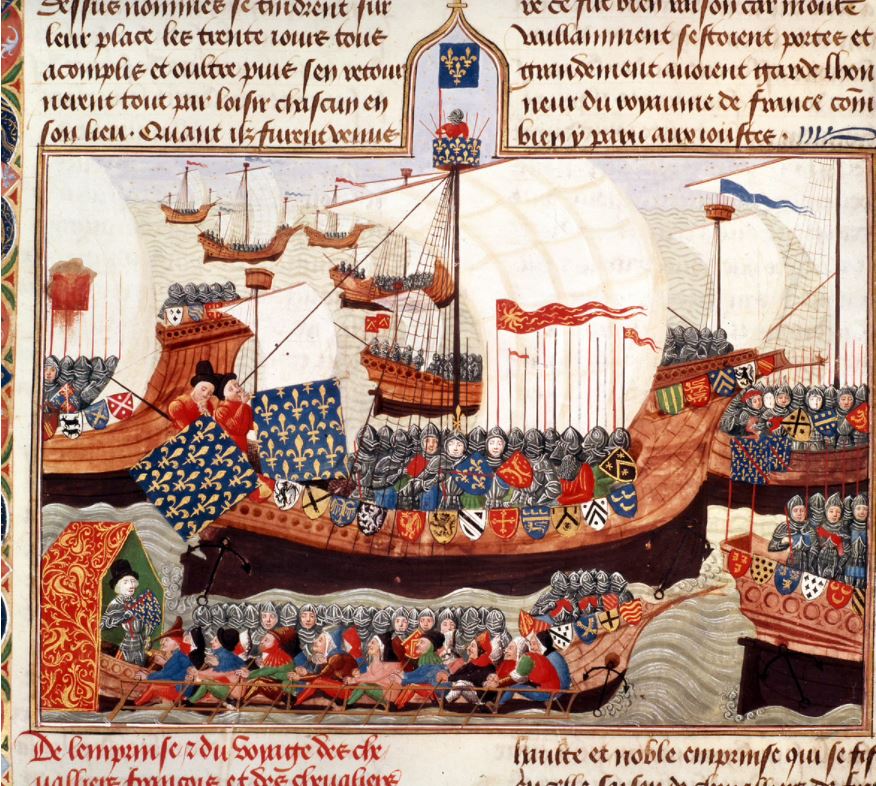
It seems that in 1386 a second “Norman Invasion” was planned by the French. And a “stupendous” part of the preparations included a portable wooden town to house and protect the invaders when they landed.
I found the following description in Barbara Tuchman’s A Distant Mirror, page 426 of my copy:-
“….A huge camp enclosing a place for each captain and his company, it was virtually an artificial Calais to be towed across the Channel. Its dimensions epitomized the fantasy of omnipotence. It was to have a circumference of nine miles and an area of 1,000 acres surrounded by a wooden wall 20’ high reinforced by towers at intervals of 12 and 22 yards. Houses, barracks, stables and markets where companies would come for their provisions were to be laid out along prearranged streets and squares….”
Great Heavens above! Was it really imagined such a gigantic thing could be hauled across the Channel? Surely it would have gone across in pieces, to be assembled on arrival? How on earth could something of nine miles’ circumferences be towed? I doubt it could be accomplished even now.
Aha, it was indeed a “to be assembled on site” construction. The following paraphrases Tuchman. In mid-September the sections were loaded on 71 ships in Rouen, and they set sail to join the armies on the Scheldt. It was attacked by a squadron of English ships out of Calais and three French ships were captured, “along with the master carpenter in charge of construction”. The captured vessels were too big to be taken into Calais, and so were hauled off to England, where their cargo of sections of the invasion town were exhibited in London, to the “awe and rejoicing of the English.
Then the weather had a say in the matter, with a terrible storm that broke many ships and spoiled stores that were waiting to be loaded. It was too much, and the invasion was called off for the time being. The perishable goods were sold to the Flemings at cost, and the remainder of the floating town was sold to the Duke of Burgundy, who used it for construction in his own domain.
Oh, deep joy and rapture. I’ll bet there was dancing in the streets in England!
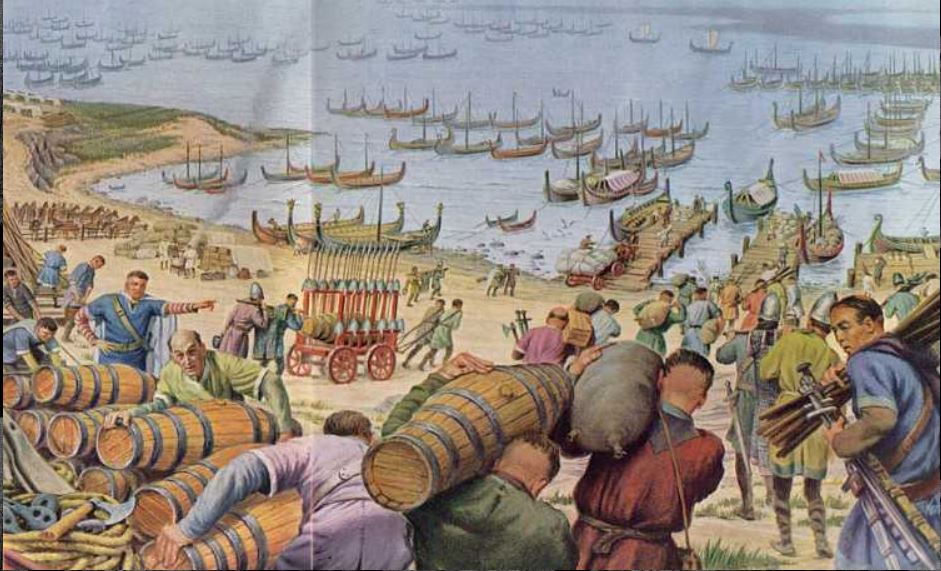
I know that the Conqueror brought a portable pre-fabricated wooden fort with him in 1066, which could be assembled at the beachhead in three hours (allegedly), but that’s one fort. An “artificial Calais” is on an entirely different scale. Could it even have been completed, let alone have been seaworthy?
The French were ever hopeful of invading the British Isles. Bonaparte got as far as building numerous vessels for the purpose—sneakily, under cover of a truce. Tut, tut! The German cast their eyes in our direction during World War II. That came to nothing either. But at least Bonaparte and Hitler kept their invasion ambitions within reasonable(ish) proportions. Well, sort of:-

To read more about the planned invasion of 1386, go to this article.
I find it almost impossible to envisage the floating behemoth, nor could I find an illustration of it, but I’ll bet the French included a drinking emporium or two!


 The New Murrey and Blue blog
Leave a comment