Sir Thomas Pilkington, of Pilkington, Bury and various other places, led his tenants and retainers to Bosworth to fight for Richard III. Whether they got there in time is not 100% clear but Sir Thomas was attainted and lost his Lancashire lands. You’ll never guess which family received them. Yes, those caring, sharing Stanleys, in this case Thomas Stanley Earl of Derby. Pilkington had a pardon in 1508 but did not regain the lands.
The first known Pilkington was Alexander de Pilkington, who died in 1180. He derived his name from his manor of Pilkington, part of the huge parish of Prestwich-cum-Oldham. The place name Pilkington is no longer in use but the manor included what are now Whitefield, Stand and Ringley to the NNW of Manchester. Indeed the property was held of the Lord of Manchester and valued at one third of a knight’s fee, which seems modest for so large an area of land. However, Lancashire at this time was thinly populated and the land was not notably fertile, so it may have been a perfectly reasonable valuation.
Sir Thomas inherited a manor house, now referred to as Stand Old Hall. It became a barn and was eventually demolished. He also owned Bury Castle which seems to have fallen into disuse very quickly under the new owners. (The manor of Bury had to come into the family by marriage to an heiress.) Pilkington Park, taking up most of the eastern half of the manor, was a hunting preserve and survived long enough to be shown on early maps of the district.
Sir Thomas gave good service to Edward IV and Richard III and was created Knight Banneret at the siege of Berwick (1482). A ‘conviction Yorkist’ he persisted in resistance to Henry VII and turned up at the Battle of Stoke on the Yorkist side, which may have removed any hope he had of getting his lands back. It is not at all clear when he died. His pardon of 1508 may simply have been a matter of his son trying to obtain a clean slate for the family. It is even possible that he died at Stoke. Alternatively, he may have lived with his son, semi-hidden for some years on the manors that remained to the family in other parts of the country.
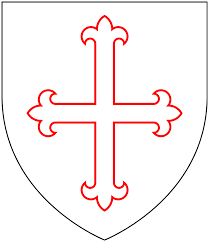
The Pilkington Arms were as shown. The crest (in the true sense of that word) was also used as a cognizance. It was a man equipped with a scythe and may be seen in at least one location as a pub sign to this day. (The Man and Scythe, Bolton.) The motto was ‘Now this, now thus’, the legend behind it being that a Pilkington had escaped his enemies by temporarily disguising himself as a harvester.
 There were various cadet branches. One of them was eventually to found the Pilkington glass business. Another was located in Yorkshire. Yet another, at Rivington, Lancashire, produced the first Protestant Bishop of Durham.

 The New Murrey and Blue blog
Leave a comment