Reblogged from A Medieval Potpourri sparkypus.com

Stained glass portrait of Cicely. Formerly in Canterbury Cathedral now in the Burrell Collection, Glasgow.
Cicely Plantagenet (b.1469 d.1507) daughter and niece to kings, and a prime example of a medieval noblewoman who endured and in this case survived the turmoil of the Wars of the Roses. Oh how that fickle wheel of fortune spun for Cicely – like a human yoyo – up, down, up again and then a levelling off as she married for the third time . It’s no wonder Sir Thomas More would describe her as Not so fortunate as fair although this may be over egging the pudding a bit as she seems to have fared much better than some other aristocratic ladies from those times as two of her marriages appear to have been happy plus she didn’t die in penury. After her third marriage she left England to live on the Isle of Wight, dying on the 24 August 1507. This last marriage is said to have made Henry Tudor, her brother-in-law, very, very annoyed. But more on that later.
Cicely’s early life was one of privilege most of her contemporaries would only ever have dreamed of. She lived the majority of her younger years with her siblings in Greenwich Palace, a favourite home for her mother, Elizabeth Wydeville, and which seems to have been used as a royal nursery for the brood of children she had borne Edward IV. Indeed it was while living at Greenwich on the 23 May 1482, Cicely’s 14 year old sister Mary died. This was the second death of a royal child in a matter of months at Greenwich for just six months earlier her even younger sister-in-law. the 8 year old Anne Mowbray, had died on 9th November 1481. Other times were spent at Westminster Palace when both parents were staying there.

A print by an unknown artist now in the National Maritime Museum, Greenwich depicting the Palace c 1487.
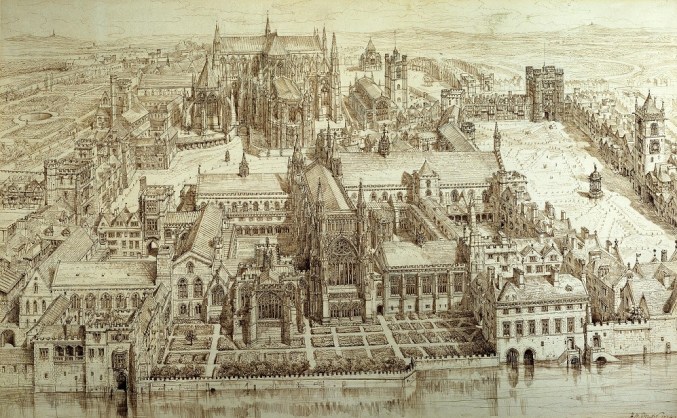
The Old Palace of Westminster. Westminster Abbey and Cheyneygates can be seen at the top of the picture.

Cicely’s father Edward IV motto, ‘confort et lyesse’, 1442-1483 Society of Antiquaries of London
Tragedy, and disaster, struck in April 1483 when her father died rather unexpectedly at Westminster. This led to a flurry of feverish activity from her mother and her Wydeville relations in a mad and unseemly scramble to get hold of the person of her brother Edward, now Edward V and living in Ludlow on the Welsh Marches. This was to enable them to get control of the kingdom before her uncle, Richard Duke of Gloucester took his rightful place as Lord Protector. When these plans went swiftly awry, the 14 year old Cicely and her siblings led by their mother rushed off to sanctuary in Cheyneygates, the Abbots House, Westminster Abbey where they would spend the next ten months. The Abbey and Cheyneygates was literally just across the road from the palace and, according to Sir Thomas More in an attempt by the soon to be ex-queen to take as much treasure and goods as possible with her, a hole was made in the wall of the Abbey.

A view of the ancient passage way leading to Abbot’s Court and Cheyneygates. The family would have reached Cheyneygates via this passageway and trod these very flagstones..
What went through the minds of Cicely we can only speculate. But it must have been disconcerting at the very least, this immediate and drastic change in lifestyle, and no doubt she would have picked up on her mother’s mood, who was said by Sir Thomas More to have been found by Bishop Rotherham sitting ‘ alone, low down on the rushes, all desolate and dismayed’ – hardly a reassuring sight for her children.
To continue reading click here.


 The New Murrey and Blue blog
Leave a comment