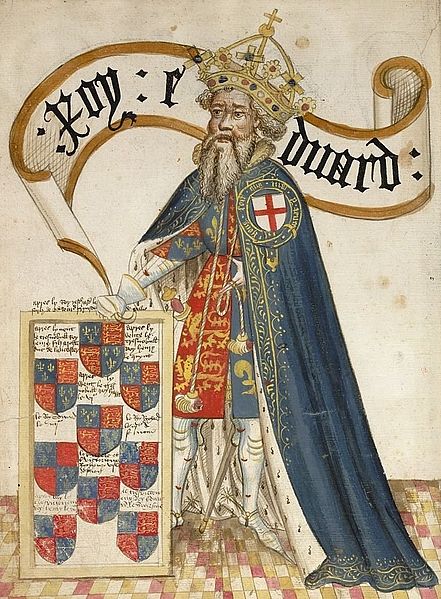
drawing c. 1430–40 in the Bruges Garter Book
Before you read the following (from The Rise of Alchemy in the Fourteenth Century by Jonathan Hughes) you should know that I have taken the liberty of breaking it up into paragraphs – in the book the extract is from one long, rather impenetrable paragraph. Otherwise the punctuation is original.
“….One of the most influential alchemical writers in the sixteenth and seventeenth centuries was George Ripley, a fifteenth-century monk. For Ripley exaltation was more than a term representing the creation of gold: it involved the exaltation of the flesh to spirit and the removal of the distance between body and soul.
“….Ripley’s strongly symbolic and allegorical writings were used by the House of York to justify Edward IV’s seizure of power in 1461 and his recapture of the throne in 1471. Alchemists in the service of Edward Earl of March meditated on genealogical rolls and the political forces that shaped royal lineages. Kings refined in the furnace of history were subjected to the same processes as metals in the alchemists athanor.”
“….The sun of March, Edward IV was the alchemical gold, the fruition of years of struggle that was seen in alchemical terms in the conflict between mercury and sulphur, the white and red roses. The emergence of a single nation from the disparate baronial factions in the Wars of the Roses was celebrated in alchemical terms as the emergence of alchemical gold from the chaos of civil war in the form of the sacred rose of alchemy combining the red and white roses of York and Lancaster.”
“….It can be argued that Henry VII, when he founded the Tudor dynasty, capitalized on the alchemical significance of this conjunction of the warring opposites of sulphur and mercury when he adopted the red and white Tudor roses as the symbol of his dynasty and anticipated the future national symbol of the red and white flag of St George….”

Well, where do I begin? I really don’t know. Did the House of York resort to George Ripley’s alchemical tracts to justify Edward IV’s coming to the throne? And while I’ve heard of Edward being referred to as a son of York, I’ve never heard of the sun of March or that he was “alchemical gold”. The white and red roses of York and Lancaster were actually references to sulphur and mercury? And Henry VII chose the Tudor rose in order to capitalise on this alchemical significance? Um, no, he merely put the two roses together in a brilliant publicity move.
As for Henry anticipating the future national symbol of the red and white flag of St George… Well, that’s nonsense, because it was Edward III, over a century earlier, who gave us that particular flag and patron saint.
I’ve written about this book by Hughes before, and every once in a while I go back to struggle with it again. It’s hard to read, with paragraphs over a page long, which makes it very difficult indeed upon the eyes, and as I’m not steeped in the mysteries of alchemy I can’t argue with Hughes’ technical details. But I can argue with some of his conclusions. The book contains some interesting bits and pieces, but these specific mentions of Edward IV, the Wars of the Roses and Henry Tudor seemed to me to warrant a comment on this blog.

 The New Murrey and Blue blog
Leave a comment