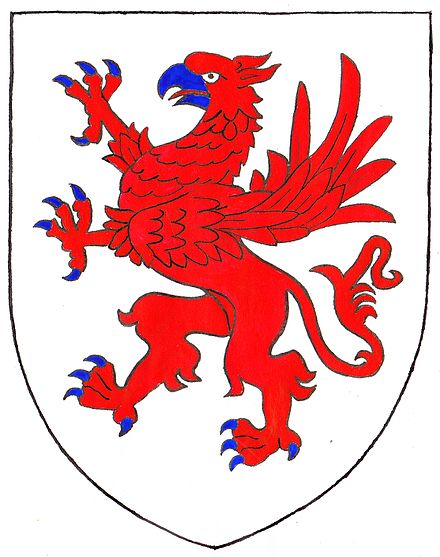
Here is another little puzzle to thwart my writing intentions. Always liking some background ‘colour”, I started chasing up the armorial devices of the Chadertons of Lancashire. I discovered the main one featured a griffin. So I resorted to my copy of The Royal Armory (the weight of which tests my aging muscles!)
There I found the following: Chaderton. Argent, a griffin’s head segreant gules. Their crest was also a griffin’s head.
Right, the first thing was to find out what, exactly, segreant means. I’ve come upon many heraldic terms, but this was a new one to me. According to Wikipedia: “….A creature segreant has both forelegs raised in the air, as a beast rampant, with wings addorsed and elevated. This term is reserved to winged quadrupeds (such as griffins and dragons). It is of uncertain etymology; it is first recorded as sergreant in the 16th century….” (The spelling sergreant appears to be wrong, or only 16th-century – The Royal Armory omits the first ‘r’.)
Well, that all seems clear enough. The Chadertons’ coat-of-arms was a red griffin’s head on a silver ground. But it was segreant. Um, I don’t want to appear picky, but how can a griffin’s HEAD be segreant? Does it mean the griffin’s head actually included its raised forelegs? The same with the crest?
Help please? Heraldry is definitely NOT my strong point. (Not that you’d notice, of course!)
 The New Murrey and Blue blog
Leave a comment