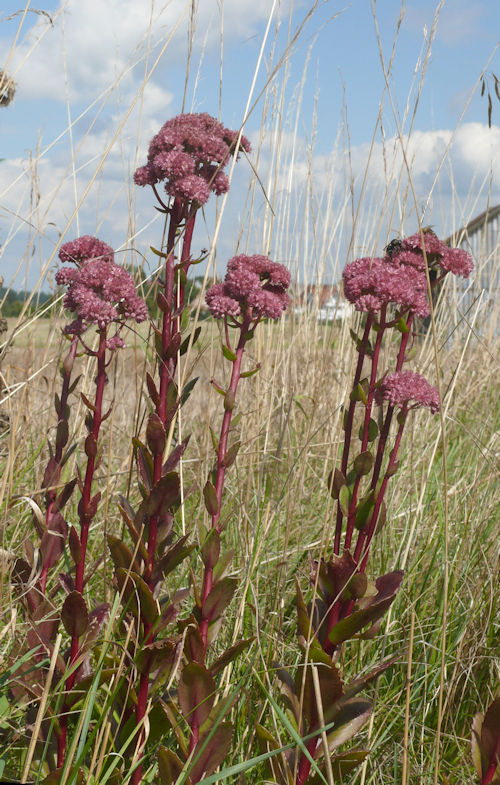
While looking in A Dictionary of Superstitions, edited by Iona and Moira Tatem, specifically for anything concerning Midsummer traditions, I found one that involved the orpine/sedum plant. The following passage was taken from Brand, Antiquities I 263-4, 1777:-
“….on 22nd January, 1801, a small gold ring….was exhibited to the Society of Antiquaries….It had been found….in a ploughed field near Cawood, in Yorkshire, and had for a device two Orpine plants joined by a true-love knot, with this motto above: ‘Ma fiance velt’, i.e. my sweetheart wills, or is desirous. The stalks of the plants were bent to each other, in token that the parties represented by them were to come together in marriage…From the form of the letters it appeared to have been a ring of the fifteenth century….”
Apparently the tradition at Midsummer was to take two slips of orpine/sedum plant and put them close together in a chink in the roof joists. They were kept moist and called Midsummer Men, representing a lover and his sweetheart. The way the slips grew toward or away from each other told if the lovers would know happiness or not. Woe betide them if the slips died!

Unfortunately I haven’t been able to find out more about this ring, not its present whereabouts or an illustration, but it is yet another such treasure from the fifteenth century found in Yorkshire.
Cawood has an ancient bridge over the River Ouse, and a former residence of the Archbishops of York that is now called Cawood Castle. According to Wikipedia: “….George Neville became Archbishop of York in 1465 and held a feast at the castle. The Earl of Warwick, the Archbishop’s brother, aided in the preparation of the feast and is said to have wanted a feast larger than the King’s coronation feast. Guests included the Duke of Gloucester, the King’s brother. The feast lasted several days and became known as the Great Feast of Cawood due to the sheer size of it. Records from the feast show that a substantial quantity of food was consumed, including 104 oxen, 6 wild bulls, 400 swans, 1000 capons and 104 peacocks; 25,000 gallons of wine were consumed with the meal….”
To read more of the feast and of the castle and its history, go to this article This site is well worth a lengthy visit.
Perhaps it was during this great shindig that the ring was lost! But all this goes to show how astonishing research can be. This time it started with finding an interesting Midsummer superstition, led to a 15th-century ring with twined sedum flowers, and thence to a nearby residence of the Archbishops of York and the famous Great Feast of Cawood, attended by Richard and Warwick the Kingmaker, among others. From little acorns great oak trees do grow!
 The New Murrey and Blue blog
Leave a comment