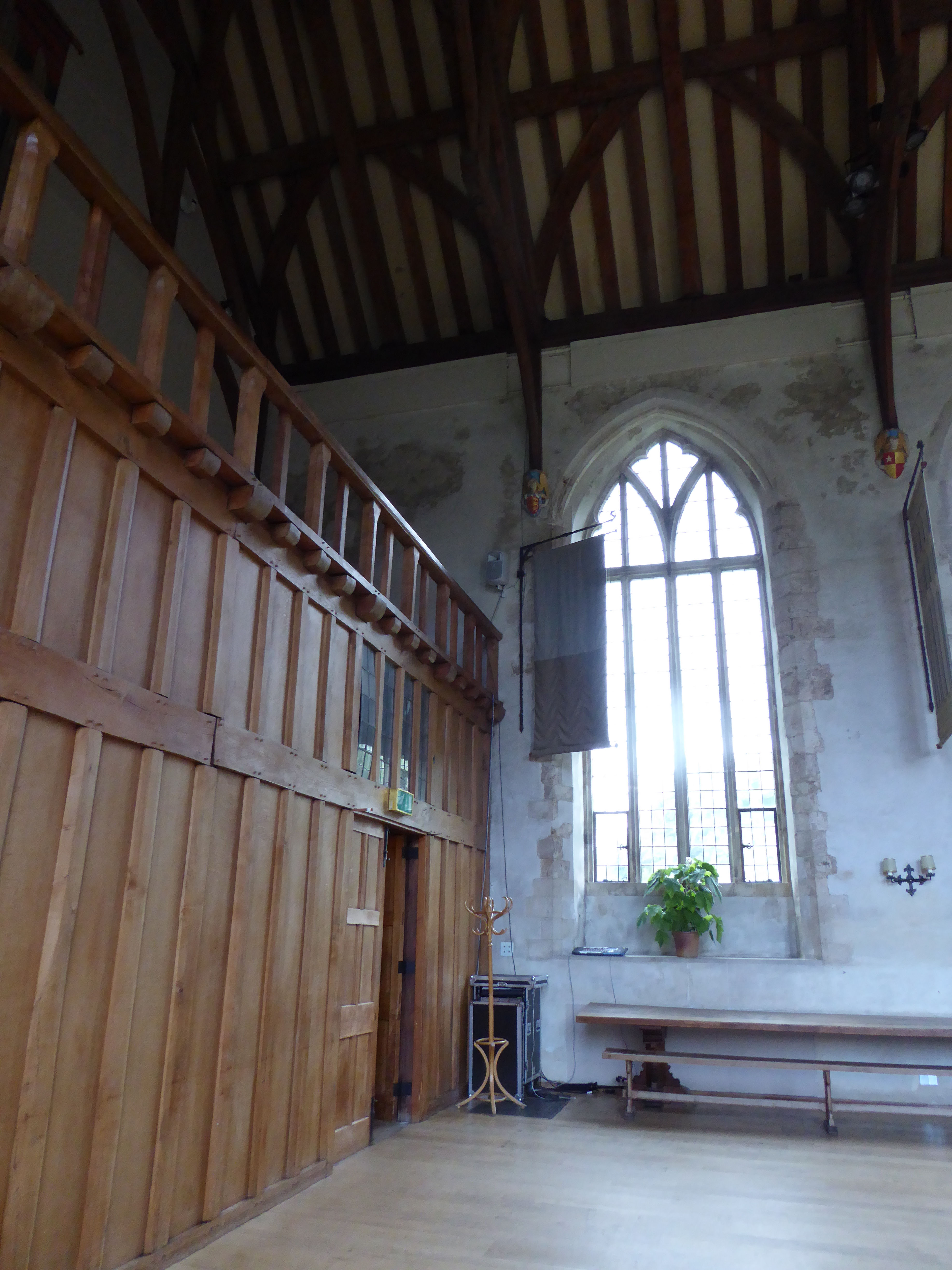
For those of you who do not know, I am very fond of Dartington Hall. I read all I can about it, and its history, originally because of an intention to write about its creator, the first Holand Duke of Exeter, but now because I just plain love the place as well.
These Holand Dukes of Exeter – the first, John Holand, being the younger of Richard II’s two half-brothers through Joan of Kent – only survived for three generations, coming to an end in 1475 with the suspicious death of the third duke, the apparently unlovable Henry Holand. The duke in between, another John Holand, son of the first duke, was responsible for inventing the Duke of Exeter’s Daughter, a vile instrument of torture, a rack, which can still be seen at the Tower. Not a legacy to commend the second duke, methinks.
I digress. Edward IV handed over Henry’ Holand’s estates to the wife from whom Holand was divorced, Edward’s eldest sister, Anne, Duchess of Exeter. Anne was by then married to Thomas St Leger, whose involvement in the Buckingham rebellion led to his execution by Richard III. This is as close as Henry Holand gets to rising against Richard III – through his ex-wife’s second husband!
Imagine my surprise then, when reading an introduction to a booklet about the hall by Anthony Emery, esteemed author of such works as ‘Greater Medieval Houses Of England and Wales 1300-1500’, to find the following statement:
“The Hall remained in the hands of the Holand family for a further 75 years [after the death of the first duke in 1400] but was forfeited to the Crown by the third generation after their unsuccessful attempt to overthrow Richard III.”
Huh? It can’t be a typo between II and III, because the Holands didn’t try to overthrow Richard II, on whose side they most definitely were, and anyway, Richard II was long gone by the time the third duke’s body washed up mysteriously on the shore at Dover. So I would like to know how Anthony Emery concludes that ‘they’ somehow rose against Richard III. They did rise against Henry IV at the end of 1399/ beginning of 1400 but came off worst – the first duke met a very sticky end at Pleshey Castle. And the third and last duke, Henry, was on the Lancastrian side at Towton, but accompanied Edward IV for the 1475 expedition to France. From which he failed to return, except as the body on the beach. He died about eight years before Richard of Gloucester became Richard III.
After Anne, Duchess of Exeter, Dartington fell to her daughter by St Leger, another Anne, who inherited Henry Holand’s estates through her mother. Well, it seems that when the duchess died in January 1476, St Leger did all he could – ‘by seditious means as it is notoriously known’- to get reversion of his late wife’s estates, including the Holand properties, and to secure them for the other Anne, his daughter by the duchess. Emery says it all fell through when St Leger paid the price for joining Buckingham against Richard. Presumably it all then went to the Crown, because from March 1487 to 1509, it was held by Margaret Beaufort – whose coat of arms is one of those supporting the rafters of the great hall.
During the reign of Elizabeth I, Dartington was acquired by the Champernowne family, which held it for eleven generations, until in 1925 selling it to Leonard and Dorothy Elmhirst, who restored it lovingly to its present glory.
So where does Emery gets his ‘fact’ about the Holands rising against Richard III? He also makes sweeping statements and claims concerning the first duke, whom he appears to loathe as much as some historians loathe Richard, but that’s another matter.


 The New Murrey and Blue blog
Leave a comment