Night. The late Middle Ages. An angry mob rips open the sealed tomb of a man and carries his fleshless skeleton through the town streets, jeering. Reaching a field of execution, the bones are hurled on a pyre and burnt, then crushed to small fragments. This indignity not being enough, the desecrated remains are then gathered up and hurled unceremoniously into a Leicestershire river while the throng gazes on, casting  abuse at the meagre remnants of the hated dead man as the waves swallow them…

A version of  River Soar myth about Richard III, now disproved by the finding of his lost grave?

No, but the above story is almost certainly the origin of this once pervasive myth.

It was John Wycliffe, who produced the first Bible in English, whose bones met this fate. A Yorkshire man, who was educated at Merton College in Oxford, he was a noted theologian and philosopher, who became the rector of Lutterworth in Leicestershire. He wrote books that were considered heretical and was accused of  inspiring the Peasant’s Revolt. His followers, the Lollards, were often persecuted…and executed…long after his death. He himself remained a threatening figure to the church even years after he died of a stroke. As he had escaped the normal heretics’ punishment of death by burning, when he lived, it was decided to vent the punishment on his remains. So his skeleton was disinterred, burned and hurled into the River Swift.

Somewhere along the line, this true tale ‘grew in the telling’ and changed, as such stories often do; repeated over and over with added embellishments and errors  they  lose their original meaning and only retain fragments of the truth…in this case, that the remains of a persecuted man had been dug up from the grave by a mob and thrown into a Leicestershire river. To the average person, centuries after the event, who was better known and more interesting to tell such tales about,  a slain King or a heretical theologian?

Once Stuart era cartographer John Speed had written down the legend in regards to Richard, it swiftly took hold and was accepted henceforth accepted as truth by many…including numerous historians, although without one scrap of hard evidence (these historians shall remain nameless!)

The mythologisers had put the wrong man in the wrong river.

You know the rest.
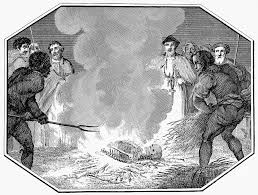
wycliff


Subscribe to my newsletter

  1. As in all myths – there is a kernel of truth – but truth about what and who is distorted over time. So easy to see how Tudor propaganda took hold and grew to ridiculous proportions over the years, aided in no small measure by the Bard.

    Liked by 1 person

  2. The story about Richard III bones being throw into the River Soar, when the Grey Friars in Leicester taken over at the Dissolution of Monasteries, has a counter-part in the story about the remains of King Stephen at Faversham Abbey, Kent.

    In a BBC News web article (by Greig Watson), local historian Jack Long says: “In John Stow’s ‘Annales’ of 1580, he repeats the local legend that the royal tombs were desecrated for the lead coffins and any jewellery that the bodies might have worn, and the bones thrown into the creek”, but ” they were retrieved and reburied in the church of St Mary of Charity in Faversham.”
    http://www.bbc.co.uk/news/uk-england-leicestershire-19487335

    Disrespect for the dead is reported in at least one other place – Saint Paul’s, London – where the Lord Protector in the reign of Edward VI, Edward Seymour, 1st Duke of Somerset, is said to have removed the “burial chapel called the Charnel,” next to Canons Alley, “from whence Somerset sent cart-loads of bones to Finsbury Fields”
    http://www.british-history.ac.uk/old-new-london/vol1/pp262-274

    Like

    1. That King is also being searched for, in Faversham. We aim to report any developments we may hear …

      Like

  3. […] leading? Well, simply to a scene at St Paul’s, at the trial of Gaunt’s friend and protégé. Wycliffe/Wyclif (and other spellings) who was believed by many to be a heretic. Or verging on it. There was […]

    Like

  4. […] moving back in time, an Iron Age shield has been found in, of all places, the River Soar. (Everyone was wrong about Richard being in the Soar, but it seems a lot of other things were thrown  in its waters […]

    Like

  5. […] of their families’ arms. Both men were Lollards, which meant they followed the teaching of John Wycliffe. You can read about this latter aspect of their lives […]

    Like

  6. […] strictly true that no one knew where Richard’s remains were. There was a myth about them being thrown into the River Soar, but that was just a yarn. At the time of his death he was recorded as having been lain to rest at […]

    Like

  7. […] Bale was a Protestant fanatic imbued with the doctrine of Wycliffe and Tyndale. Kynge Johan is the most important of his reformation plays. It is written in two […]

    Like

  8. […] all, these historians mocking now, were the very same ones who were utterly convinced that Richard’s bones ended up in the River Soar. They laughed and jeered at the thought anyone actually might find his […]

    Like

  9. […] to find was the intact skeleton of Richard III. In the 500-odd years since his death, a popular legend had sprung up that his body had been exhumed and his bones hurled into the river Soar by an angry […]

    Like

  10. […] his closest friends and advisers. They were openly heretical, and followed the dissident priest John Wycliffe, who was a deep thorn in the side of the Church throughout his life. He translated the Bible into […]

    Like

Leave a comment