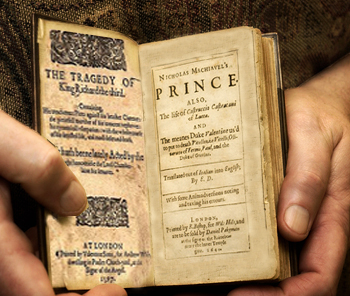
 White Lily’s “Richard III: The Murderous Machiavel?” post, here in Murray & Blue on 31 January 2015, is beautifully presented and argued, with the subject deserving extensive research and multiple books on its own. But I think we’re playing into anti-Ricardian hands if we set Richard III beside Machiavelli’s The Prince. There is another way.
What White Lily presented opens a topic for discussion that deserves to be broken wide open. Shakespeare had his fictional Richard III take Machiavelli to heart and ruthlessly apply some of The Prince’s lessons. But it’s important to remember that while Shakespeare read Niccolò Machiavelli’s The Prince and made the treatise central to his fictional Richard III, the real Richard never read The Prince. The treatise was not published until 1532, so it’s both illogical and unreasonable for anyone to argue that Machiavelli influenced the real Richard in any way.
We need to set aside Shakespeare’s 16th-century fictional play, its 16th-century Machiavellian source, and its fictional Richard III. If we want to know how the real Richard viewed warfare and governance, first as Duke of Gloucester and then as King of England, we need to put him back into his own life and times and consult the 15th-century English “mirror for princes” manuscripts Richard actually had access to.
We might begin with two books we know Richard owned: De regimine principum and Vegetius’ De re military. The latter included Secrets of Philosophers by Lydgate & Burke, which was so important to the warriors/governors of the age that it was inserted into five warfare manuscripts between 1450-1474. We may assume that Richard’s contemporaries were taught the same principles and behaviors as presented in these particular “mirrors for princes.” (We may also assume that Machiavelli had access to Italian translations of various titles in the “mirrors for princes” genre. A book contrasting the morals and principles of behavior presented in those Italian translations, versus what Machiavelli presented in The Prince would also be interesting, but, once again, it would not apply to the real Richard III.)
The medieval mind interconnected success in warfare and success in governance, but what exactly were the moral and chivalric boundaries of the 15th-century prince? Since chivalry was dying by the time Richard was born, was a knight or prince of Richard’s time expected to abide by the chivalric code developed in the 12th century? Or was the code by then so degraded, it was only a quaint notion applicable only in silly romances read by medieval ladies to pass the time while embroidering?
Other questions we might ask as we study these manuscripts are:
- Can we trace how Richard, as duke and as king, applied the principles and behaviors recommended in these texts?
- Can we trace how Edward IV applied the principles and behaviors recommended in these texts, and contrast it with Richard’s application?
- Can we trace how the nobles of the day applied the principles and behaviors recommended in these texts and contrast it with Richard’s application?
- Can we trace how any of these men violated the principles and behaviors recommended in these texts?
By way of further research, we can consult Reading and War in Fifteenth-Century England, by Catherine Nall. She begins her discussion with De re military, and goes on to discuss how such works – and contemporary fiction as well – influenced the nobility and rulers of the 15th century.
Nall also discusses a verse version of De re militari that was written anonymously during the Wars of the Roses, and which has basically been ignored, called “Knyghthode and Bataile”.
We have no need to look to Shakespeare or to Machiavelli as legitimate sources of the principles Richard was taught, or those he lived by.
What we have is the opportunity to dive some of the original 15th-century manuscripts that Richard himself read and applied, and discern how they affected his life and his behavior.


 The New Murrey and Blue blog
Leave a comment