In the recent newspaper reports about further genetic testing on King Richard’s remains, a surprise for many people was the fact he had a fairly strong blond gene. As is typical, the newspapers jumped on this new information immediately, inundating us with a series of badly photoshopped pictures of Richard III with bright yellow Barbie-doll hair. Theories came out that his hair had been shown dark in his portraits, all painted after his death, to emphasise that he was ‘evil’, that his ‘deeds were dark.’
As is also usual, people failed to read the original scientific article, in which geneticist Dr Turi King, explained that the gene is primarily associated with hair colour in youth, rather than adulthood, and provided a chart of hair colour possibilities for Richard. The latter two were firmly in the brown spectrum.
The led me to further research on this subject. I have known for years that many people in Britain and indeed along the whole western coast of Europe as far as Iberia (even parts of North Africa such as Morocco) have a tendency to be blond or fair-haired as children but by adolescence at the very latest, start to darken in colour, with the end results being brown hair ranging from light to dark and every colour inbetween. This includes me (a strawberry blond till 5, dark brown as an adult.) This part of Europe has a strong genetic affinity anyway, with autosomal results showing a fairly close split of 50/50 ‘Northern’ and ‘Southern’ genes.
The change in hair colour comes due to an increase in eumelanin in the body. It usually happens by age nine, but can be later. Sometimes hair changes colour more than once, with a second darkening of hue in adolescence due to hormonal change. It can even happen later still; my niece, who I would have described as ‘dark blonde’ as late as age 17, is now, in her mid-30’s, most definitely brown haired though with fair highlights.
Further exploration into the results of genomic testing for traits also turned up that nearly a third of those recently tested in Europe and shown to have a ‘blond’ marker, were not in fact blond, at least as adults. It seems to be the least reliable hair colour for accurate prediction, probably because of the aforementioned changes in childhood and adolescence. Black hair and red hair, on the other hand can be predicted with about 85% accuracy.
As for the idea that Richard’s portraits were painted darker that reality, there is no account of this sort of dark/evil symbolism in art of the late medieval/early modern era. The idea seems fairly recent. Several kings who were unpopular and were deposed, such as Edward II and Richard II, were depicted in art as blond and not dark. In Richard’s case there is also no evidence of over-painting in regards to hair colour unlike the other features of his portraits, such as his skin, lips, eyes and shoulder.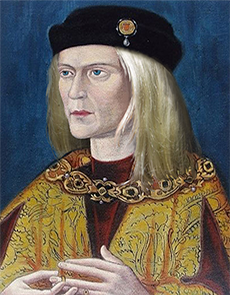
SPLITTING HAIRS: THE HAIR COLOUR OF RICHARD III
Subscribe to my newsletter
6 responses to “SPLITTING HAIRS: THE HAIR COLOUR OF RICHARD III”
-
-
-
ah, yes, the ‘unbeliever’ who seems to think there were millions of people running about with Richard’s VERY rare maternal haplogroup, despite being informed that alternative lines of descent from the same female (Joan Beaufort) have been traced as well and that the known males who also carried this mtdna and who may have been present at Bosworth (only 2, I believe, other than R himself) , have been ruled out out for various reasons…a particularly important one being that neither died there. Neither were the correct age at death, either; advanced techniques have actually pinpointed the age at death for the Greyfriar’s skeleton as even MORE close to Richard’s age than the initial report indicated.
-
-
-
In which was his facial features changed? Are there any portraits of Richard from his lifetime?
LikeLike
-
As an addenda on blond hair in medieval portraits; often Queens were painted with ‘gold’ hair whether they were fair-tressed or not, as this was considered desirable and the ideal in medieval females. It didn’t seem to apply to the men. It was not a ‘good/bad’ thing.
LikeLike


 The New Murrey and Blue blog
Leave a comment